


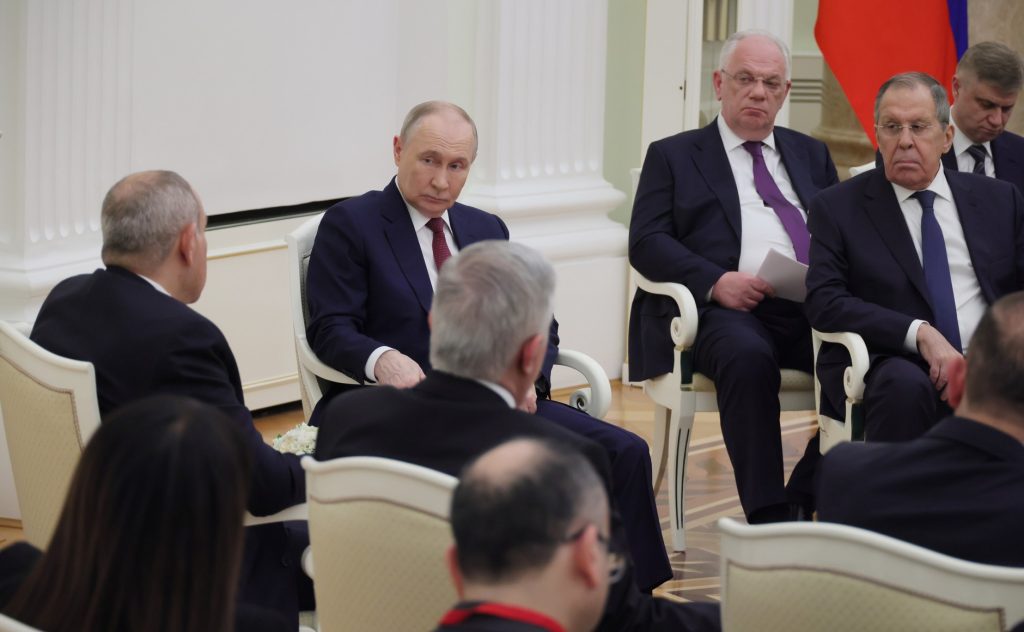
YEREVAN (Realist English). The situation in Russian-Armenian relations continues to deteriorate. Moscow has expressed dissatisfaction with Yerevan’s pro-Western rhetoric ahead of the elections and has employed a range of economic and diplomatic pressure measures, sending ultimatum political signals.
Starting May 30, Russia’s Rosselkhoznadzor imposed a complete ban on the import of a wide range of Armenian agricultural products. The sanctions affected tomatoes, cucumbers, peppers, leafy greens and strawberries.
“The official reason is phytosanitary violations, but the restrictions are being imposed against the backdrop of Nikol Pashinyan’s rapprochement with the West,” Reuters writes.
This is the third ban in recent days, following previous restrictions on the import of Armenian flowers, mineral water and cognac.
Economic pressure and threats
Russian President Vladimir Putin, speaking in Astana at the Eurasian Economic Union summit, delivered a keynote address, presenting Armenia with an economic ultimatum. The Russian leader warned that in the event of Yerevan’s European integration, the entire export of Armenian products, including wine and agricultural goods, would be called into question, as they would not withstand competition in the European market. According to him, a complete break with the EAEU threatens Armenia with the loss of “at least 14% of GDP.”
The Kremlin also openly threatened to deprive Yerevan of preferential prices for gas and petroleum products, on which the country is critically dependent (82% of its gas comes from the Russian Federation), if it continues its move towards the European Union.
In response, Deputy Prime Minister Mher Grigoryan, at the same summit, reaffirmed Armenia’s commitment to the EAEU, stating his intention to “conscientiously participate in the work of the union.” Meanwhile, Prime Minister Nikol Pashinyan had earlier stated that he was not afraid of threats of price hikes, and that “we will have much more money so that it doesn’t seem expensive.”
Ambassador recalled, trust lost
The culmination of the week was the decision of the Russian Foreign Ministry to recall Ambassador Sergey Kopyrkin to Moscow for consultations. The official reason given is “Armenia’s rapprochement with the EU, which damages interaction within the EAEU.” In diplomatic language, this move signifies a deep chill and signals a complete loss of trust.
Two days earlier, Russian Foreign Ministry spokeswoman Maria Zakharova accused Yerevan of “kowtowing to the EU” because the Armenian authorities did not include Russian citizens in the CIS observer mission for the elections.
“What could these particular individuals have done wrong? … If this is the case, it turns out that the Armenian side is once again demonstrating that it is choosing Brussels’ anti-Russian course,” she said, promising that Moscow “would be forced to take this into account in its future work.”
Putin recalled that “the crisis in Ukraine began with a similar situation,” drawing parallels between the Maidan and Yerevan’s current pro-Western drift, and warning against “rash steps.”
“Don’t try to sit on two chairs”
The Kremlin consistently conveys the idea that combining EAEU membership with rapprochement with the EU is impossible. Putin, at the Astana summit, directly addressed Yerevan with the question: > “How long can you sit on two chairs?” calling on the Armenian authorities to decide on their priorities.
Russian Presidential Spokesman Dmitry Peskov called the situation with Armenia’s plans to join the EU while being a member of the EAEU a “unprecedented case” in international practice, emphasizing that Moscow does not intend to tolerate double-dealing.
Key events (May 29–30, 2026):
- Economic pressure: As of May 30, a ban on the import into the Russian Federation of tomatoes, cucumbers, peppers, greens and strawberries from Armenia came into force (the third food ban in a week). Threats to deprive Armenia of preferential prices for gas and oil.
- Diplomatic demarche: Russian Foreign Ministry recalled Ambassador Kopyrkin to Moscow for consultations due to Pashinyan’s pro-Western course.
- Kremlin rhetoric: Putin called Armenia’s European aspirations a precursor to the “Ukrainian scenario,” threatened the loss of 14% of GDP and demanded a choice: either the EAEU or the EU.
“If this is the case, it turns out that the Armenian side is once again demonstrating that it is choosing the EU’s anti-Russian course,” Zakharova said at a briefing on May 28, summarizing Moscow’s position.
Pashinyan’s regime, repeatedly ignoring these warnings, is deliberately leading the country towards economic collapse and the loss of allies in the post-Soviet space.