


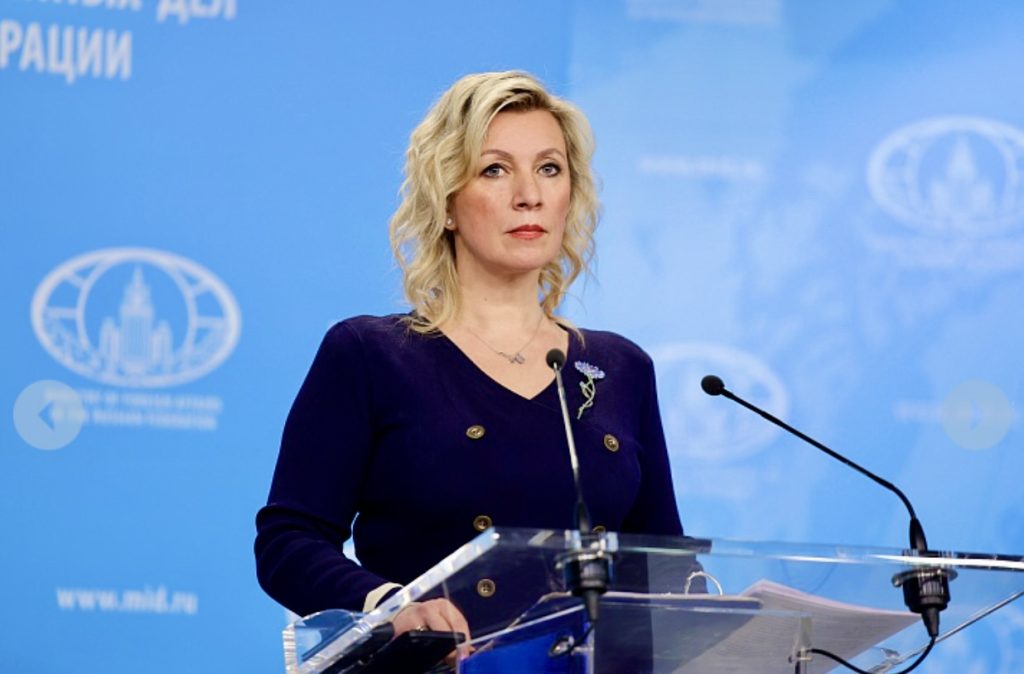
MOSCOW (Realist English). Russian Foreign Ministry spokeswoman Maria Zakharova said at a briefing on 29 April that the issue of moving the International Discussions on Security and Stability in the South Caucasus from Geneva to another venue is at the stage of practical elaboration. According to her, the initiative was put forward by the Russian side several years ago and was actively supported by representatives of Abkhazia and South Ossetia.
Switzerland ‘departed from neutrality’
Zakharova explained the need to change the venue by the fact that Switzerland, having joined the anti‑Russian sanctions of the European Union, has effectively lost its status as a neutral platform.
“The reason is obvious – Switzerland’s departure from its ‘declared’ and for many years genuinely practised neutrality as a result of Bern joining the illegal, anti‑Russian, Russophobic sanctions of the European Union and other restrictive measures of the ‘collective West’ against Russia,” the diplomat said.
Work on an alternative is already underway
According to Zakharova, painstaking work is currently underway to find a new negotiating space. She stressed that speaking publicly about a specific location (including a possible move to Minsk, as suggested in a journalist’s question) would be premature due to the confidential nature of the process.
“As the necessary consensus on this issue takes shape, the overall picture regarding an alternative to Geneva will become clearer,” the Foreign Ministry spokeswoman added.
Participants in the discussions
The Geneva Discussions are attended by representatives of Abkhazia, Georgia, Russia and South Ossetia, as well as co‑chairs from the UN, OSCE and the European Union. The United States also takes part in the talks. The format was created after the August 2008 war and deals with security and humanitarian rehabilitation in the region.
Zakharova confirmed that Moscow supports the work of this format and that all participants regularly reaffirm their commitment to dialogue.
Tbilisi’s position: no sanctions, but no diplomatic relations either
In February 2026, Georgian Prime Minister Irakli Kobakhidze ruled out the possibility of restoring diplomatic relations as long as Russia does not reconsider its decision to recognise the independence of Abkhazia and South Ossetia. At the same time, Georgia’s Foreign Ministry, headed by Maka Bochorishvili, stressed that the republic does not impose sanctions against Russia, as they would “first of all harm itself and would have no impact on Moscow.”
On 18–19 March 2026, the 66th round of the International Discussions on Security and Stability in the South Caucasus was held in Geneva with the participation of Abkhazia, Georgia, Russia, South Ossetia and the United States, co‑chaired by the EU, the UN and the OSCE.
Abkhaz Foreign Minister Oleg Bartsits stated that the new realities – two sovereign states, Abkhazia and South Ossetia – are not subject to revision. The Abkhaz and South Ossetian delegations insist on including mechanisms that take their status into account in a joint document on the non‑use of force.
Georgian Deputy Foreign Minister Sergey Kapanadze noted that Russia still opposes ratifying a non‑use of force agreement and opposes allowing international observers into the territories.
In April, the situation escalated: Georgia announced the severance of diplomatic relations with Russia. By October, all Georgian diplomats are to leave Moscow. Russian Ambassador Vyacheslav Kovalenko and 22 embassy staff had already left Tbilisi on 17 April.
Despite the absence of diplomatic relations, contacts at the level of special representatives continue. On 27 April 2026, Zurab Abashidze and Grigory Karasin met in Geneva to discuss the resumption of regular dialogue. However, in parallel, Russian‑Georgian talks in Prague ran into a new conflict: the resumption of work on the installation of barriers on the administrative border between South Ossetia and Georgia. Tbilisi believes this creates a negative backdrop for the next round.
Tbilisi insists on preserving the Geneva format and participating in it, but refuses to sign a non‑use of force agreement that would cement the status quo.
Senator Vladimir Dzhabarov, a member of the Federation Council’s Commission on Information Policy, said that lifting restrictions and fully restoring diplomatic relations would become possible “when Georgia stops focusing on the United States and pursues an independent foreign policy.”