


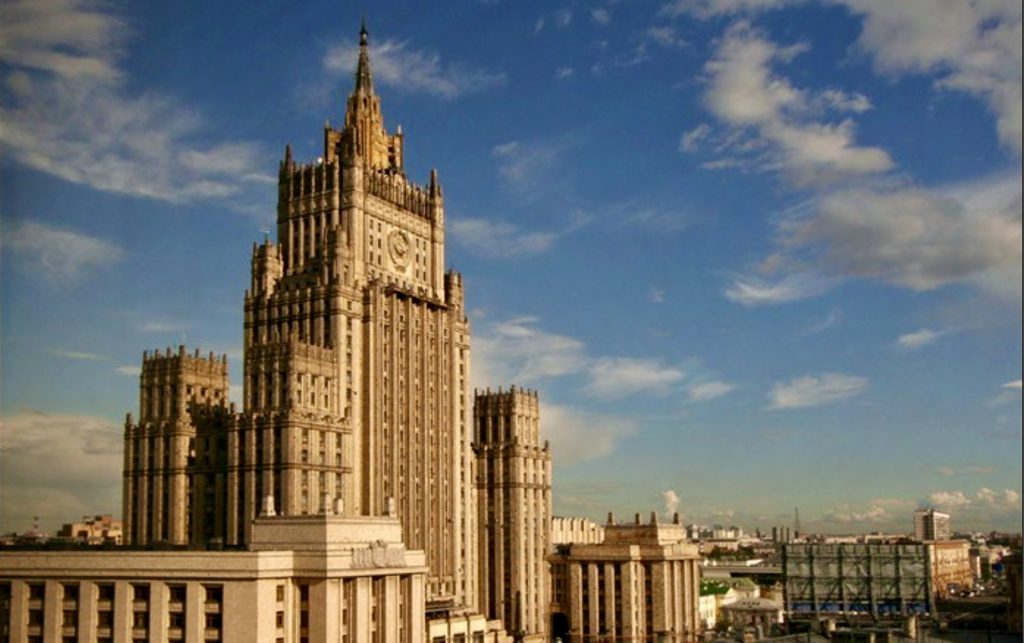
MOSCOW (Realist English). During the week of April 13–20, 2026, Russian diplomacy held a series of key meetings, outlining its positions on the Middle East crisis, the Ukrainian settlement, and interaction with NATO.
The central event was the participation of Russian Foreign Minister Sergei Lavrov in the fifth Antalya Diplomacy Forum (April 17–18), where he held talks with his Turkish counterpart Hakan Fidan and other partners.
Russian-Turkish Dialogue: Coordination and Energy
Following the meeting between Lavrov and Fidan, the ministers signed a “Consultative Action Plan for 2026–2027,” aimed at institutionalizing cooperation amid geopolitical turbulence.
The talks focused on energy projects: the sides reaffirmed their interest in the successful implementation of the Akkuyu nuclear power plant and the continued operation of the Blue Stream and TurkStream gas pipelines. Security in the Black Sea and the situation in the Persian Gulf were also discussed.
Iranian Direction: The Unsuccessful US-Iran Dialogue
Moscow closely monitored the negotiation process between the United States and Iran in Islamabad (April 11–12). The Russian side welcomed the commitment to continue diplomatic efforts, but Kremlin spokesman Dmitry Peskov noted the lack of results.
“For now, we can state that the talks ended without result,” Peskov said.
At the same time, Moscow reaffirmed its unwavering readiness to assist in resolving a crisis that has no military solution. Lavrov discussed the details of the consultations with his Iranian counterpart, Abbas Araghchi.
Deputy Foreign Minister Sergei Ryabkov emphasized Russia’s readiness to act as a mediator, and Moscow consistently stated that the conflict has no military solution.
Middle East Settlement: Facilitating the Ceasefire in Lebanon
Russia welcomed the 10-day cessation of hostilities in Lebanon announced on April 16. Russian Foreign Ministry spokeswoman Maria Zakharova expressed hope that it would be respected. At the Inter-Parliamentary Union assembly on April 17, Russia’s key role in resolving the Middle East conflict was noted. Lavrov stated that Russia desires the pacification of the region based on a balance of interests of all parties.
Relations with China: Strategic Partnership
Ahead of the Antalya forum, Lavrov paid a visit to Beijing, where he held talks with Chinese Foreign Minister Wang Yi. The sides discussed the preparation of new high-level contacts and signed a plan of consultations between the foreign ministries. Russia and China reaffirmed their intention to coordinate positions on international platforms, especially on the Iranian issue, advocating a diplomatic resolution.
The ministers held an in-depth exchange of views on the US-Iranian conflict, the situation in the Asia-Pacific region, and the Ukrainian crisis. Lavrov stated that the West continues its dangerous games regarding Taiwan, while Wang Yi emphasized that, despite the complex and volatile external environment, Sino-Russian relations “are developing confidently against all odds.” The sides also reaffirmed their intention to jointly counter Western attempts to violate basic international norms.
Negotiations on Ukraine: Readiness for Dialogue
On the sidelines of the Antalya forum, Lavrov said that Russia views positively the possibility of resuming negotiations on Ukraine, particularly in Istanbul, although this topic is not currently a top priority. The foreign minister also noted that Russia is interested in implementing all agreements reached over the past three years, including those on the security of navigation in the Black Sea. Fidan, for his part, confirmed Turkey’s readiness to provide a platform in Istanbul for a new round of talks.
Relations with NATO: ‘Decline’ and ‘Red Lines’
Lavrov said that NATO is “not in the best shape,” stressing that Russia does not intend to interfere in the alliance’s internal affairs. The minister denied allegations that Moscow is “aping” the alliance. Against the backdrop of NATO exercises in Finland, which Russian Ambassador to Helsinki Pavel Kuznetsov regarded as a rehearsal for conflict scenarios with Russia, Moscow warned that it was ready to respond to the alliance’s challenges in the Arctic.
British analysts called Lavrov’s statements about “red lines” an important warning to the West. In particular, military analyst Alexander Merkouris said that Lavrov’s words should be seen as a serious signal to NATO. “Lavrov said that, ultimately, if the red lines are indeed crossed, the Russians will react,” the expert said, adding that the Baltic countries and Finland have almost reached the point at which Russia will have to react to their actions.
European Direction and Other Regions
Russian Ambassador to Germany Sergei Nechaev said that Russia is open to an equal dialogue with European countries. Deputy Foreign Minister Alexander Grushko warned that Moscow would respond to the reduction of its diplomatic presence in the European Union. Amid the Middle East crisis, Bloomberg reported on the strengthening of Russia’s cooperation with Madagascar.
Polish journalists noted that Moscow has been working quietly, building ties with African partners in the mining sector. Deputy Foreign Minister Sergei Ryabkov said that Russia does not intend to leave Latin America, despite Washington’s attempts to push it out of the Western Hemisphere.
Foreign Trade and Sanctions
According to the Federal Customs Service, Russia’s foreign trade turnover in January–February 2026 amounted to $99.3 billion, down 3.97% compared to the same period in 2025. Exports fell by 9% to $56.7 billion, while imports rose by 3.5% to $42.6 billion.
The positive balance decreased by 32.86% to $14.1 billion. In the geographical distribution of trade flows, the share of the Asian region was 74.8%, European countries — 18.3%, the American continent — 3.8%, and Africa — 3.3%.
Russian exports to European countries fell by 22.6%, while exports to Asian countries fell by 3.6%. Mineral products dominated the export structure — $28.5 billion (50.4%). In imports, the largest share — 48.5% — was made up of machinery, equipment, and vehicles.
Amid the energy crisis in the Persian Gulf, the United States on April 18 extended a general license easing sanctions on Russian oil until May 16. The permit applies to crude loaded onto tankers before April 17 and is aimed at preventing a shock rise in prices.