


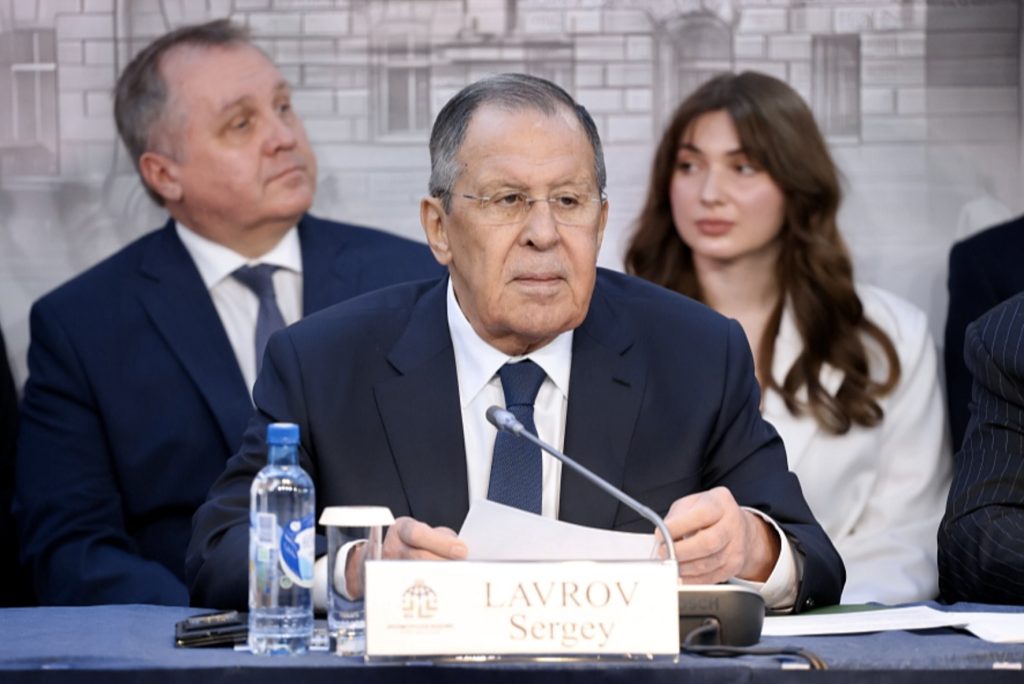
MOSCOW (Realist English). Russian Foreign Minister Sergey Lavrov, speaking at an ambassadorial roundtable in Moscow, said that Russia is ready to take “the full range of measures” provided for by the Security Guarantees Treaty within the framework of the Union State to protect Belarus from threats emanating from Ukraine and the West.
Addressing diplomats, Lavrov condemned statements by Ukrainian President Vladimir Zelensky, who demanded that Belarus “restore order” on its territory and threatened to “take care of the matter” himself. The minister called the remarks “insolent” and described them as an attempt to drag Minsk into the conflict and expand the geography of hostilities.
“This is clearly aimed at dragging Belarus into the conflict and expanding the geography of hostilities, thereby complicating the possibilities of resolving the conflict through political and diplomatic means,” Lavrov said.
He also drew attention to the position of the European Union, whose official representative, Ariane Hiepper, supported Kyiv’s statements, accusing Minsk of assisting Russia and “provocative actions” against EU member states. Lavrov called this a “cynical attempt” and called for such a position to be condemned.
“This German lady directly supported the threats that Zelensky issued yesterday against a sovereign state, promising to use force if this dictator so wishes,” the minister said.
Lavrov recalled that since March 2025, the Security Guarantees Treaty between Russia and Belarus within the Union State has been in effect, providing for joint measures to ensure the security of allies.
The minister also expressed words of support to Belarusian Ambassador to Russia Yuri Seliverstov in connection with the terrorist attack committed by the Ukrainian Armed Forces in the Bryansk region, and gave him the floor to respond.
Lavrov’s statement came against the backdrop of a sharp escalation on the Belarusian-Ukrainian border. On June 18, Belarusian President Alexander Lukashenko said the situation on the border was “burning like never before” and that it needed to be protected in an enhanced mode.
The trigger for the escalation was a June 17 terrorist attack in the Bryansk region, where a Ukrainian drone attacked a bus carrying a children’s football team from Belarus. A woman accompanying the group was killed, and six others were injured, four of whom were children.
On June 22, Zelensky issued an ultimatum to Minsk, demanding the dismantling of repeaters in the Gomel and Brest regions, which he claimed were being used to guide Russian drones. He threatened that if Minsk did not comply with the demand within a week, Ukraine would “restore order” on its own. Zelensky also said that Lukashenko’s apologies “have not worked since the first day of the war.”
In the Kremlin, Zelensky’s threats were described as “absolutely aggressive” and an infringement on Belarus’s sovereignty. Kremlin spokesman Dmitry Peskov stressed that this was interference in the internal affairs of another country. Belarus’s Defence Ministry, for its part, said that the republic had no military reason to become involved in the conflict in Ukraine, but that the border remained tense.
The European Union continues to tighten sanctions pressure on Minsk. As part of the preparation of the 21st package of anti-Russian sanctions, the EU is proposing to equalise trade restrictions against Belarus and Russia so that Moscow cannot circumvent restrictions through Belarus. European Commission President Ursula von der Leyen has announced the introduction of export restrictions against Russia and Belarus worth €60 million.