


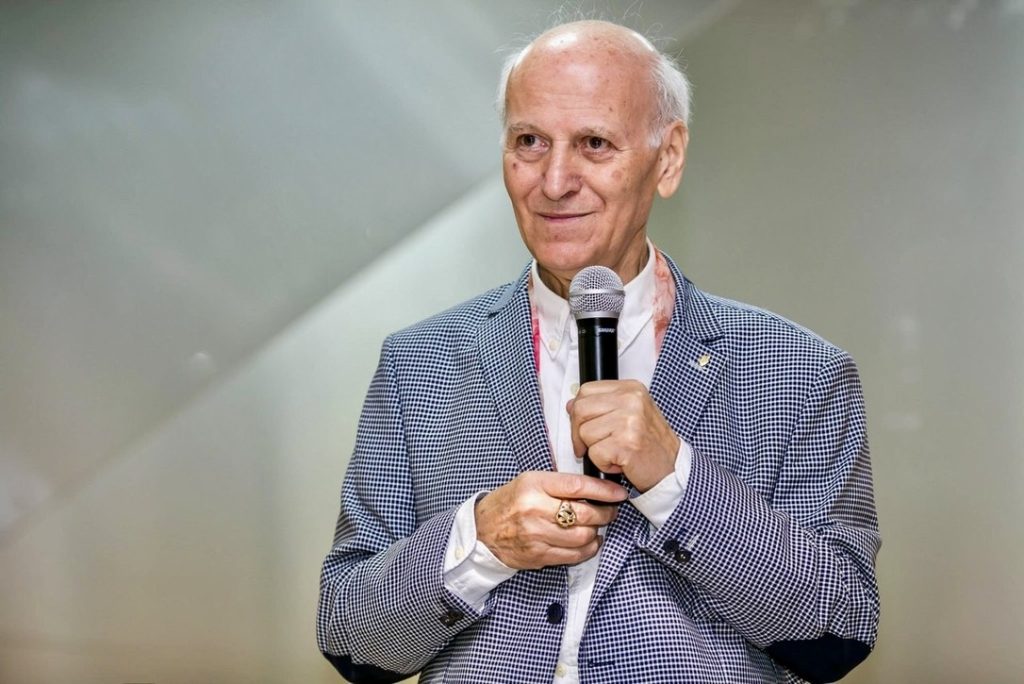
MOSCOW (Realist English). The well‑known educator, Academician Shalva Amonashvili, delivered a keynote address on the state of modern education. He stated that pedagogy is a universal culture of thinking, not a narrow field for specialists. In his view, upbringing must take place everywhere: at school, in the family, on the street, in the theatre, and even on the Internet. The main goal is to instil in children generosity, nobility and love of humanity.
On the goals of upbringing
Amonashvili noted that when people talk about upbringing, they often forget the main thing: “What do we want from a child? The years will fly by quickly — 10–15 years — and he will already be an adult. And what do we want to lead him towards? That is what they do not talk about.” He emphasised that only humane pedagogy possesses the true meaning of upbringing — generosity and nobility. If these qualities are cultivated from an early age, a child will “never be lost anywhere”.
On spirituality and the presidential decree
The educator recalled that Russia is going through a difficult period, and at the same time a presidential decree on spirituality has been issued. However, Amonashvili warned, if spiritual values are developed for the school by unspiritual people, “that decree will be worthless”. Spirituality, in his conviction, means faith: “The spirit is an immortal essence. It is given to us by God, and on the basis of the spirit, spirituality arises.”
On Ushinsky and the separation of education
Amonashvili urged following the precepts of Konstantin Ushinsky, who maintained that truly humane education is the education of the human spirit, and that a reasonable religiosity must be present in education. The educator criticised the modern division of the unified concept of “education” into teaching and upbringing. “Teachers are supposedly only there to teach and nothing else, while parents are there to bring up children and nothing else. That is a very dangerous path,” he said.
On good and bad teachers
Quoting Dmitry Likhachev (“where there are good teachers, there are good students”), Amonashvili stated that there are very few good, God‑given, talented, creative teachers — only about five to seven per cent. The rest either conscientiously carry out instructions or, unfortunately, are “C‑grade teachers”. He called on his fellow professors to revise their educational courses and add a line to future teachers’ diplomas: “to love children”. “If you don’t love children, don’t go to school, don’t give birth,” the educator summed up.
On practical training
Amonashvili proposed adding three to four months of practical work at school for future teachers so that they could assess how children and colleagues relate to them and decide whether to stay in the profession. He also related how, on the advice of his friend, Vice‑President of the Russian Academy of Education David Feldstein, with the support of the historian of pedagogy Mikhail Boguslavsky and a publishing house, he began to publish his books — that was about 15 years ago.
From orientalist to national teacher
Amonashvili is one of the most famous innovative educators, the creator and permanent leader of the humane pedagogy movement. His name is known to every teacher in Russia and the former Soviet republics, and the educational system he developed, based on love for children and belief in their limitless possibilities, is recognised throughout the world.
He was born on March 8, 1931, in Tiflis (now Tbilisi, Georgia). His father, Alexander Dmitrievich, died at the front in 1942. In 1955, the future educator graduated from the Faculty of Oriental Studies of Tbilisi State University, and completed his postgraduate studies in 1958. While still a student, in 1952, he began working as a pioneer leader at a school, and it was there that he found his true calling, abandoning a career as a diplomat. In total, Shalva Amonashvili worked at school for more than 70 years.
Academic recognition and overcoming criticism
Amonashvili’s academic career developed rapidly:
- 1960 — Candidate of Pedagogical Sciences
- 1972 — Doctor of Psychological Sciences
- 1980 — Professor
- 1985 — Corresponding Member of the USSR Academy of Pedagogical Sciences
- 1989 — Full Member (Academician) of the USSR Academy of Pedagogical Sciences
- 2001 — Academician of the Russian Academy of Education
In the 1970s and 1980s, his activities were harshly criticised by official pedagogy, and he repeatedly risked losing his job. However, the large‑scale experiment in Georgian schools that he led became world‑famous as the “Humane‑personal approach to children in the educational process”.
“School of Joy” and humane pedagogy
Amonashvili’s first project was the “School of Joy” in Tbilisi. His pedagogical system is based on love for children, belief in their limitless possibilities, respect and acceptance of the child’s personality, and the absolute rejection of authoritarian pedagogy. The educator himself called his creation “spiritual pedagogy”, based on love, kindness and beauty.
International activity and literary legacy
Amonashvili is the founder of more than 200 centres and laboratories of humane pedagogy in Russia and neighbouring countries. In 2001, he founded the International Centre of Humane Pedagogy in Moscow, which annually holds International Pedagogical Readings. He is the author of more than 70 books and 25 scientific works, many of which have been translated into foreign languages. Among his most famous works are: Hello, Children, Unity of Purpose, Reflections on Humane Pedagogy, School of Life, A Father’s Confession to His Son, Letters to a Daughter, and The Truth of the School.
Recognition and awards
For his many years of activity, he has received numerous awards:
- Lenin Komsomol Prize (1988)
- Laureate of the Prize of the Government of the Russian Federation in the field of education (2008, 2013)
- Honorary titles “Knight of Humane Pedagogy” (2003), “Knight of Childhood” (2007)
- Honorary Citizen of Tbilisi (2022)
- K.D. Ushinsky Medal (2006)
- Badges “Honorary Worker of General Education of the Russian Federation” (2001) and “Honorary Worker of Higher Professional Education of the Russian Federation” (2002)
Family and continuation of traditions
Amonashvili’s spouse, Valeria Nioradze (1935–2012), was a Doctor of Pedagogical Sciences, professor at Moscow City Pedagogical University. His children: Paata (psychologist, sociologist) and Nino (philologist, jeweller). His sister, Natela Amonashvili, is also a Doctor of Pedagogical Sciences and author of textbooks for grades 1–4.
Today, despite his advanced age, Shalva Amonashvili continues to speak actively, publish books, and influence the development of Russian pedagogy, remaining for millions of teachers a symbol of a humanistic approach to the upbringing of children.