


BEIRUT (Realist English). The Middle East today is an echo of exploding bombs, diplomatic dead ends, and dozens of contradictory interpretations of what is actually happening.
In the chaos, the voices of those who see not only tactics but also strategy, not only blood but also doctrinal designs behind events are especially valuable.
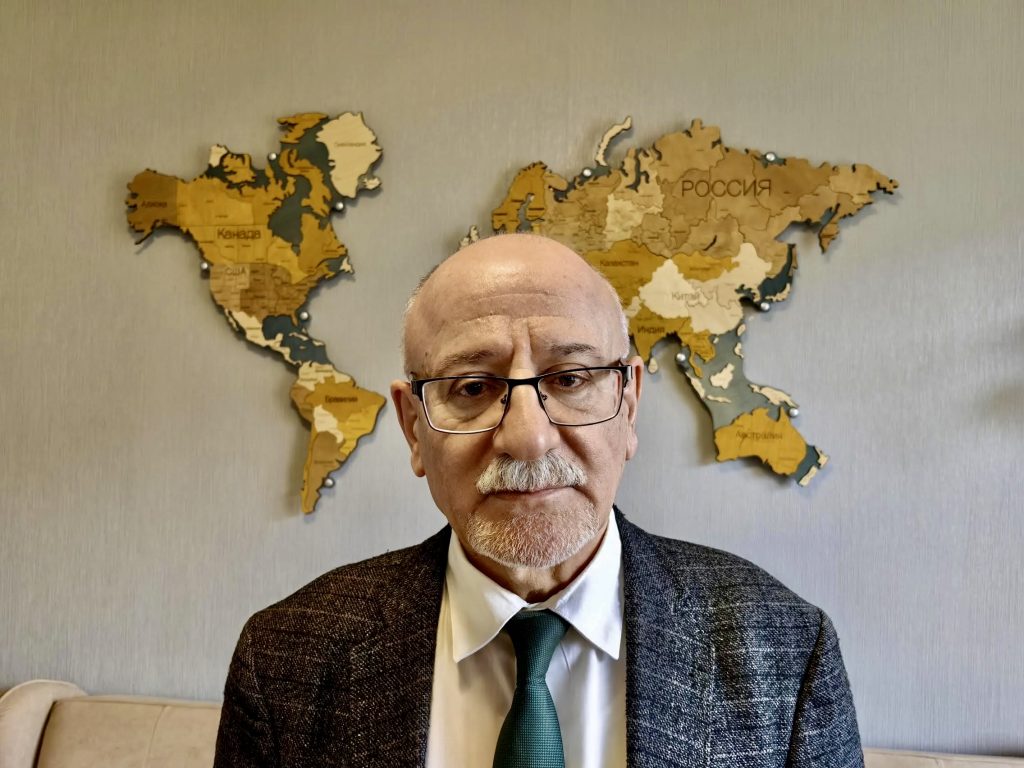
One such voice belongs to Dr. Sheaito Moussallam – director of the Moscow bureau of Al Mayadeen, a man who has professionally analysed geopolitical processes in the Middle East for many years.
Realist English approached Dr. Moussallam with a series of sharp questions. In this interview, our interlocutor shares his vision of US and Israeli plans for Iran and Palestine, speaks of a collusion between Azerbaijan and the West, describes the fate of Lebanon, and explains events in the region drawing on the teachings of Karl Marx.
The war in Gaza, strikes on Lebanon, war with Iran. In your opinion, does a single US‑Israeli plan to redraw the map of the Middle East exist?
Sheaito Moussallam: Not only does it exist, they are working to implement it. The plan is clear: not just to redraw borders, but to create a “Greater Israel” in Western Asia.
The main problem for them is the Palestinian people, whom they want either to destroy or to expel. Iran was the main obstacle to implementing the plan, so war became inevitable. They do not hide it; they openly declare that their border is the entire region from Iran to Egypt.
Even the US ambassador to Israel says that this is their religious right, it was promised to them, and they must realise it. All these wars and conflicts are connected to this plan.
How are the wars in Iraq, Syria and Yemen connected to the war with Iran?
Sheaito Moussallam: All wars in the region are connected. The movements in Iraq, Lebanon and Yemen are Shia, they help each other, especially now that there is a war against Iran, which is taking on a religious character.
If Iran is destroyed, their plans in Lebanon and Iraq will be easy to realise. Iraq has already been destroyed after the US invasion. Therefore, all local forces are convinced: if they do not unite and defend themselves, their turn will soon come.
Besides the religious factor, the Arab factor is also important: for them, the Palestine issue is above all else, and defending it is both an Arab duty and a matter of faith. So many things unite them.
If we turn to the teachings of Karl Marx, how would he assess the current wars in Iran and Lebanon?
Sheaito Moussallam: This is a crisis of capitalism – one might say the greed of capitalism. They consider themselves the sole masters. Trump always talks about oil and gas – they have already seized resources in Iraq, now it’s Lebanon and Iran’s turn. To continue building imperialism, to be more brutal and to control the world – this confirms Marx’s theory.
So Marx’s teachings are still relevant?
Sheaito Moussallam: Yes, of course.
Iran is a symbol of resistance to Western domination for many. Who is actually its ally in confronting the US and Israel?
Sheaito Moussallam: In military terms, there are no allies. There are parties in Lebanon, Yemen, Iraq, but they are non-state organisations. There is political support – from China, Russia, North Korea. As we saw in the Security Council, Russia and China vetoed in defence of Iran.
Many countries in the world support Iran politically because they understand: if Iran holds firm, the world will change and they will be saved. So there are many political supporters, but in military terms Iran is alone.
Iranian sources claim that Azerbaijan provided its territory for strikes against Iran. Do you agree with this information? Whose interests is the Azerbaijani regime serving today?
Sheaito Moussallam: That is exactly what happened. Azerbaijan is acting in the interests of the Anglo-Saxons. They are closely linked to the Americans and the British. Even the operation in Nagorno‑Karabakh could not have succeeded without the help of the US, Britain, Israel and Turkey.
Azerbaijan feels powerful because of the weakness of its neighbours: Armenia is weak, Georgia is weak, and Russia is busy with war.
The leadership of Azerbaijan has a dream – to take a “piece” of territory from Iran. This is not their project, but an Anglo-Saxon one: to connect the Caspian with the Mediterranean.
Imagine: Iranian Azerbaijan plus territory closer to Iraq – a strategic region with huge oil and gas reserves, and all the local inhabitants united by Shiism. The Anglo-Saxons think that with the help of the Azerbaijanis they will be able to open a corridor from the Persian Gulf to the Caspian. Personally, I consider this unrealistic – they overestimate their capabilities.
In Iranian Shia ideology, resistance to Israel has a religious dimension – defence of the oppressed and struggle against arrogance. In Israeli discourse, Iran is the heir of the Persian Empire. Is a purely pragmatic, secular agreement between states possible if religious and messianic components are set aside?
Sheaito Moussallam: In principle, yes. Before the Islamic Revolution of 1979, Iran and Israel were close allies; Mossad and SAVAK cooperated closely. If the religious factor is put aside, they could be allies. But that is not Israel’s dream.
They hoped to change the regime in Iran, but it did not work – either they do not understand Shiism well, or they are arrogant enough to think they can do anything with the Americans. So the religious factor is very important for Iran’s defence and its confrontation with the West.
Russia and China have their own interests in the region. Can they act as guarantors of a settlement of the Iranian crisis?
Sheaito Moussallam: They can; they have every prerequisite. Russia and China have good relations with all the conflicting parties. Especially Russia: it has good relations with Israel (two million Russian‑speakers live there), with the Arab countries, and with Iran.
They could play an important role, but the Americans will not allow them to. The US has other plans: to seize Iran – if not territorially, then its raw materials and the strategic North‑South corridors and the Silk Road through Iran. So the US will obstruct.
How do you assess the likelihood of a ground invasion of Iran by the Americans and Israelis?
Sheaito Moussallam: There is a likelihood – in north‑western Iran, where the Kurds live, on the border with Armenia and Azerbaijan. The Americans and Israelis have invested a lot in Kurdish organisations. Moreover, they could symbolically capture some small island to declare victory and dictate terms. The Americans have a plan, and everything we are seeing is preparation for an invasion.
In the event of a military defeat of one side, will the doctrinal contradictions between Israel and Iran disappear?
Sheaito Moussallam: If Iran wins, all of Israel’s plans will collapse. Israel itself will either become a small state or return to the original Palestinian territory. Israel has no way out except victory. If it does not win, it loses.
And to win, it must completely destroy Iran. So any compromise solution will be temporary, short‑lived. The Israelis and the Anglo‑Saxons consider their plan achievable; only Iran stands in their way, and they will keep trying.
What role do you assign to Turkey in this context?
Sheaito Moussallam: Turkey’s role is unclear. It is increasing its capabilities, protected from external pressure. But if Iran holds out for 40 days or two months, Turkey will not last more than 15 days.
There is no unity in Turkey – there are Kurds, Arabs, different moods. Unlike Iran, where people unite during war, in Turkey unification is impossible. The Arabs there consider themselves Syrians and do not agree with the destruction of their culture.
The Kurds too. If Iran collapses, the Kurds will feel strong, but without access to the sea and without their own territory in Turkey they will achieve nothing. So if Iran falls, Turkey will not be able to defend itself.
Do you expect the conflict to spread to Turkey?
Sheaito Moussallam: Certainly. Israel is hindered by Iran, Turkey and Egypt. If the first falls, the next is Turkey. And Egypt will not stand alone – it has many economic and social problems. All Arab countries will be destroyed. So the hope is only in Iran.
How do you assess the negotiation process between Israel and Lebanon that was launched in Washington?
Sheaito Moussallam: These are negotiations between people disconnected from reality. The Lebanese authorities do not have the ability to fulfil what might be agreed.
So without Hezbollah’s participation it won’t work?
Sheaito Moussallam: Even if an agreement is reached, the parliament will not accept what Israel demands. This is happening under US pressure – Trump wants to show he is solving the Lebanese issue. But Iran is solving it in practice.
This is not the first time: in 1982 the Israelis captured Beirut, signed a treaty with Lebanon, and a month later everything collapsed and Lebanon rejected the treaty.
So without Hezbollah’s participation there is no solution. Israel, of course, will use its methods – killing and destroying, as in Gaza. It has the capability.
What do you see as Lebanon’s future against this background?
Sheaito Moussallam: Lebanon by itself can determine nothing. Everything depends on the outcome of the war with Iran. It is a small country, but at one time it had huge functions – the banking system, tourism, services, universities, medicine, culture.
All of this has been destroyed, “thanks” to Israel and some Arab countries. These functions were transferred to the UAE, and now Israel dreams of taking them from there to itself. Small countries in this situation can do nothing.