


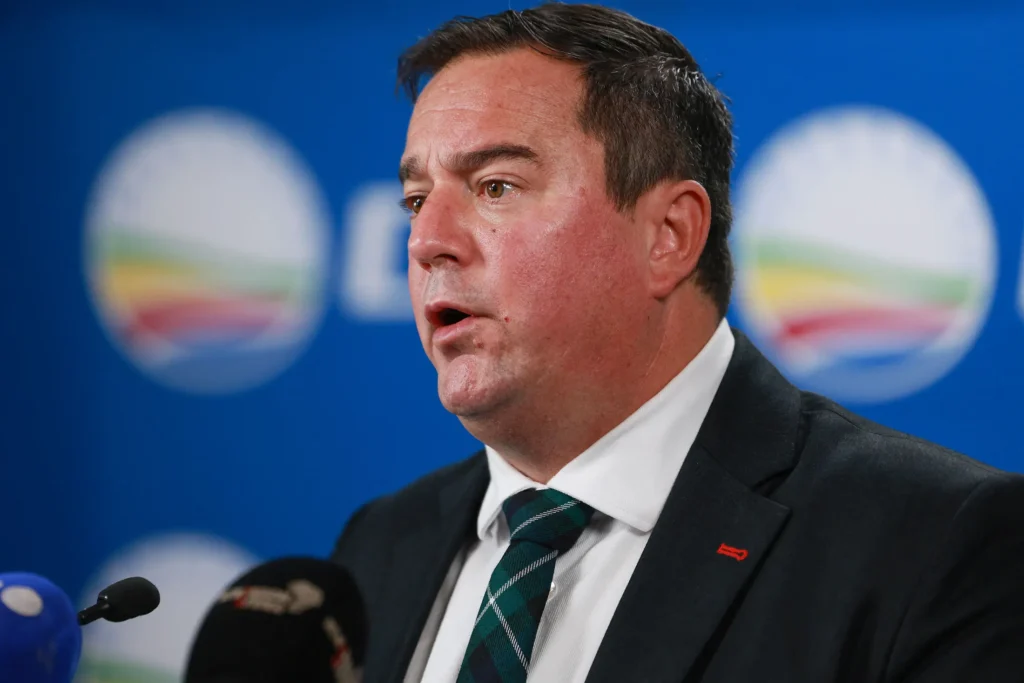
DURBAN (Realist English). John Steenhuisen, leader of South Africa’s Democratic Alliance (DA), said he will step down in April after weeks of mounting criticism over his leadership, marking a turning point for the second-largest party in the country’s fragile Government of National Unity.
Steenhuisen, who has led the DA since 2019, announced that he would not contest the party’s leadership race in April, describing his departure as “mission accomplished” after steering the long-time opposition party into government following the 2024 elections.
Speaking at a media briefing in Durban, where his political career began nearly 30 years ago as a local councillor, Steenhuisen said his tenure had transformed the DA from a party “shouting from the sidelines” into one directly involved in governing and fixing the country’s problems.
His leadership, however, has been marked by growing internal turmoil that has increasingly played out in public. In January, the party’s federal finance chair Dion George resigned after accusing senior figures of manipulating party finances to shield Steenhuisen from allegations of improper spending and of yielding to pressure from the African National Congress (ANC), the dominant force in the coalition.
George alleged that Steenhuisen used a party-issued credit card for personal expenses, including food deliveries. Steenhuisen denied the claims, and an internal investigation found no evidence of misappropriated funds.
The business-friendly DA has frequently clashed with the ANC, which governed South Africa uninterrupted after the end of apartheid in 1994 but lost its parliamentary majority for the first time in the May 2024 elections amid voter anger over corruption and poor public services. The result forced the ANC into an unprecedented coalition with long-standing political rivals.
Tensions within the coalition surfaced last year when the DA opposed proposed VAT increases, compelling the ANC to rely on smaller parties — including some outside the coalition — to pass a budget framework. The DA has also openly criticised elements of South Africa’s foreign policy, particularly its close ties with Iran and Russia.
Analysts say investors, who have welcomed signs of an improving business climate under the unity government, will be closely watching the leadership transition. Chris Hattingh, executive director of the Centre for Risk Analysis, said the coalition is likely to remain “as relatively stable as it has been since the budget impasse in early 2025”.
“At present, the balance of forces in the DA’s leadership favours remaining in the unity government and attempting reform from within,” Hattingh said.
Steenhuisen’s exit nonetheless opens a leadership contest at a sensitive moment, with key local elections due before February next year. Analysts see Geordin Hill-Lewis, the 39-year-old mayor of Cape Town, as a leading contender capable of consolidating the party’s support base. Other potential candidates include Solly Msimanga, one of the DA’s most senior Black leaders, as the party continues to struggle to broaden its appeal among Black working-class voters.
Steenhuisen, who currently serves as agriculture minister, said he would focus his remaining time in office on tackling a severe foot-and-mouth disease outbreak affecting the country’s livestock sector.