


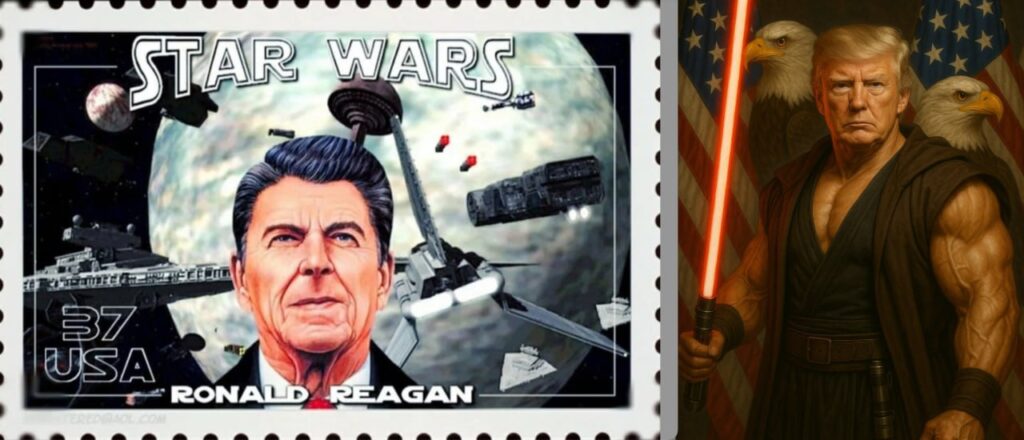
MOSCOW (Realist English). “Star Wars” stopped being science fiction long ago. Unfortunately, over ten thousand years of civilisation, humanity has still not learned how to live in peace. Dreams of flights to the stars have turned into the creation of weapons in outer space. What began in 1957 with a fragile craft barely capable of exceeding the speed of sound has today grown into constellations of satellites, combat vehicles capable of attacking any targets in space, and ballistic missiles able to destroy continents within minutes.
Ideas about the militarisation of space emerged long before the space age itself. For example, Konstantin Tsiolkovsky saw cosmonautics as a path toward a utopian society beyond Earth. Several decades later, Hermann Oberth dreamed of mirrors in orbit capable of incinerating cities with a concentrated beam of sunlight. Friedrich Zander fantasised about a flight to Mars, while Sergei Korolev worked on a high-altitude rocket plane.
It is symbolic that the “Star Wars” whose revival was announced by Trump effectively began on 4 October 1957 with the launch of the first Soviet satellite. For the USSR, it was a celebration; for the United States, it was sheer panic. The satellite instantly altered the military and strategic balance. Soviet assurances about the peaceful nature of its space programme did not calm fears but instead intensified tensions. It became clear that the confrontation between the superpowers had moved into outer space, and that anything could be expected.
In 1983, Ronald Reagan announced the Strategic Defense Initiative, an ambitious programme to create a “space shield” for the United States. This project, nicknamed “Star Wars,” envisioned intercepting ballistic missiles using futuristic technologies such as lasers and particle beams. Today, Trump intends to revive the idea of “Star Wars” by developing a missile defence system known as the “Golden Dome,” analogous to Reagan’s initiative. Trump has said that the necessary technologies did not exist in Reagan’s time, whereas today unprecedented technologies have emerged. He added that part of the system would be deployed over Greenland, underscoring the island’s strategic importance.
The executive order signed by Trump envisages the creation of a network of interceptor satellites equipped with laser weapons, the deployment of an additional interception layer, and even the destruction of missiles during the launch phase. However, some experts believe that the prospect of creating an “impenetrable” space shield looks doubtful and that no magical protective blanket exists. According to specialists, technologies capable of intercepting ballistic missiles with lasers at the initial stage of their flight, during the critical three to five minutes, remain unattainable and would require colossal investments of time and resources.
Some politicians in Russia believe that Trump is simply generating hype so that everyone talks about him. But no matter how fantastical his statements may seem, it must be understood that “Star Wars” have in fact been under way for several decades already. When the threshold for a direct clash of forces on the planet is reached, the next phase begins: the militarisation of space. For example, Stanislaw Lem saw the embryonic form of these processes in missile defence and anti-satellite systems, which continue to be improved despite all international treaties and bans.
There is already no shortage of interested parties: the United States, Russia, China, the European Union, India, Japan — everywhere work is under way on orbital platforms of “dual-use” purpose. These facts cannot be brushed aside, because even a brief overview of the emergence of space exploration shows that from the very moment of its birth it was, in one way or another, subordinated to aggressive plans for achieving global dominance. In Russia, several decades ago, the creation of military space forces was regarded as insane fantasy.
Where will this lead? When will a full-scale “star war” begin? For now, it is unknown…
Andrey Troshkin — analyst, specially for Realist English