


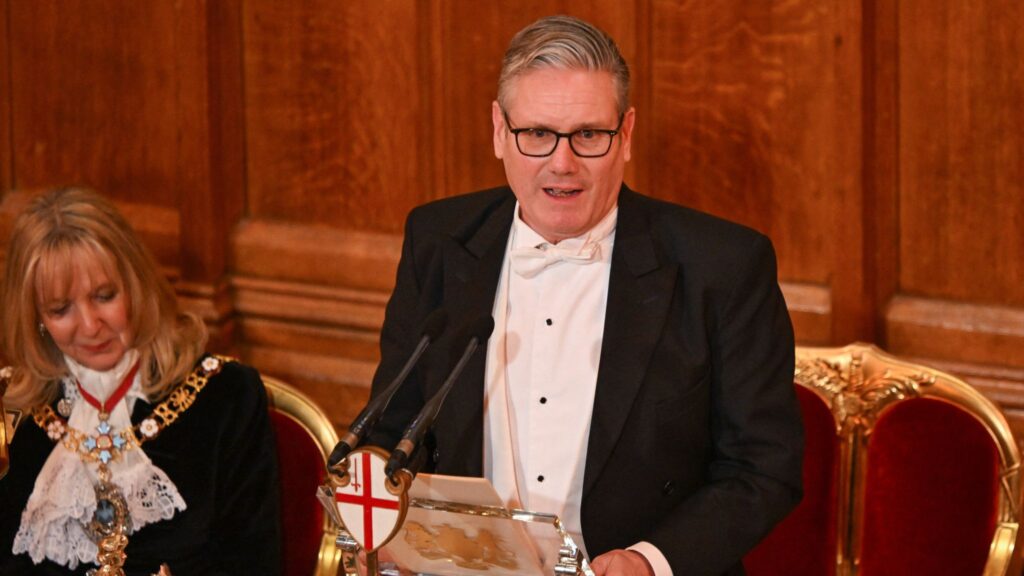
LONDON (Realist English). Prime Minister Sir Keir Starmer has warned that China represents “real national security threats to the United Kingdom,” using his flagship foreign-policy speech at London’s Guildhall to signal a major strategic shift and to rebuke what he called Britain’s “corrosive, inward-looking” political tendencies since Brexit.
Starmer said the “wild promises” made ahead of the 2016 referendum had not been fulfilled and that the way Brexit was “sold and delivered was simply wrong,” adding that the country is “still dealing with the consequences today.” He argued it would be “utterly reckless” to use Brexit as a model for future foreign-policy decisions, criticising figures such as Kemi Badenoch, Nigel Farage and Zack Polanski, who advocate withdrawing from the European Convention on Human Rights or NATO. Such positions, he said, reflect “a declinist vision of a lesser Britain, not a Great Britain.”
Although he opposed Brexit while in opposition, Starmer insisted the vote was “a fair, democratic expression” that he respects. His message to the Lady Mayor’s Banquet on Monday night was that Labour has made “a decisive move to face outward again and build our power, both hard and soft, which had been so damaged and neglected.”
A new stance toward China
A significant portion of Starmer’s speech focused on China. He said the UK must adopt a policy that recognises Beijing as both a threat and an unavoidable global actor. “For years we have blown hot and cold,” he said, referencing the past framing of relations as either a “Golden Age” or an “Ice Age.” The UK, he insisted, will reject such “binary choices.”
“Our response will not be driven by fear, nor softened by illusion. It will be grounded in strength, clarity and sober realism,” he said. China has been under heightened scrutiny in Westminster following allegations of espionage and controversy around Beijing’s planned “super-embassy” in central London.
Despite criticism from China hawks, Starmer defended plans to visit China next year, calling an absence of engagement with the world’s second-largest economy “staggering” and a “dereliction of duty.” He described China as “a nation of immense scale, ambition, and ingenuity” and a “defining force in technology, trade and global governance.”
He stressed that security will not be traded for economic benefits. “Protecting our security is non-negotiable — our first duty. But by taking tough steps to keep us secure, we enable ourselves to cooperate in other areas.” He said British firms in sectors such as financial services, creative industries, pharmaceuticals and luxury goods should be supported to seize “huge” opportunities in China.
Political backlash
Starmer’s emerging China policy triggered immediate criticism from Conservative figures. Shadow foreign secretary Dame Priti Patel accused him of offering a “naive one-way street” to Beijing and of “kowtowing to China.”
“From economic rule-breaking to repression of Hong Kongers in Britain, Starmer’s ‘reset’ puts Britain at risk while Beijing gets everything it wants,” Patel said, adding that the prime minister’s approach is “a desperate ploy to generate economic growth following his budget of lies.”
She called Starmer “Beijing’s useful idiot,” saying China continues to back Iran and Russia while attempting to undermine UK institutions.
Meanwhile, Sky News reported that Starmer is expected to approve the controversial Chinese “super-embassy” near the Tower of London, with a final planning decision due on 10 December.
Since taking office last year, Starmer has sought to reassert the UK’s global role, highlighting new agreements with the United States, India and the European Union, while leading a coalition supporting Ukraine. His critics, however, argue he is spending too much time abroad and not enough on domestic challenges.
Starmer’s speech — one of the most comprehensive foreign-policy statements of his premiership — signals a clear departure from recent years: rejecting isolationism, rebuilding alliances and taking a more interventionist role on the world stage, with China placed firmly at the centre of Britain’s strategic concerns.