


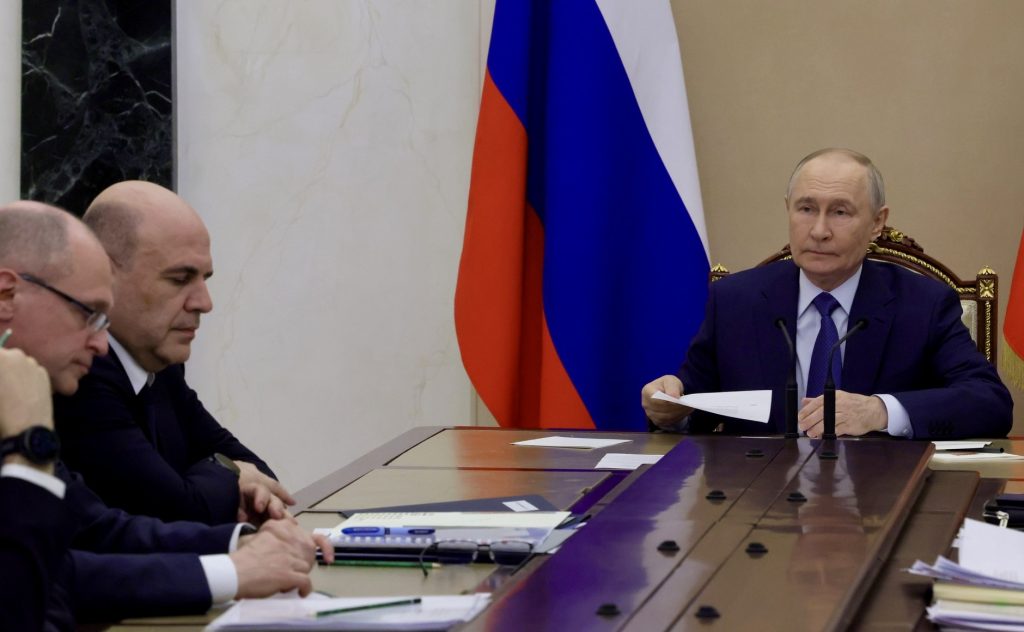
MOSCOW (Realist English). The past week has been marked by personnel changes in the leadership of border regions. President Vladimir Putin accepted the resignation of the governors of Belgorod and Bryansk oblasts – Vyacheslav Gladkov and Alexander Bogomaz.
According to experts, a different governance model was required for border regions that are in a zone of constant risk. They have been replaced by graduates of the presidential programmes “Time of Heroes” and “School of Governors”: Yegor Kovalev and Alexander Shuvayev.
Notably, the latter is a Hero of Russia and a participant in the special military operation.
Roman Cheremukhin, member of the Expert Council under the Government of the Russian Federation and head of the Stratagem agency, describes this as the “militarisation of the personnel reserve” and the creation of a belt of “fortified areas”.
The era of the “governor as a crisis manager” is giving way to a model of “military-civilian administration”, where the biographies of acting governors are now more important than programmes, and operational experience outweighs bureaucratic merit.
The Kremlin is entrusting governance to those who know how to work in extreme conditions, and voters vote for confidence in the future, which a “man in uniform radiates on an instinctive level”. This is a signal of the priority of strict discipline and ties with the security services.
Economy: “growth slowdown” and a strong ruble
The economic news of the week was the most contradictory. On the one hand, Vladimir Putin announced positive dynamics at a meeting on economic issues on 15 May.
He noted that GDP grew by 1.8% in March, industrial production by 2.3% (3% in manufacturing), and unemployment remains at a record low of 2.2%. The president called these indicators the result of government measures and instructed that growth be made more substantial and sustainable.
However, the real picture is more complex.
- Q1 decline: Rosstat and the Ministry of Economic Development confirmed that Russia’s GDP contracted by 0.2% in January-March 2026 compared to the same period last year.
- Forecast revision: The Ministry of Economic Development sharply downgraded its annual GDP growth forecast from 1.3% to 0.4%. Analysts (Alexander Timofeev, Director of Macroeconomics at F‑Broker) attribute this to extremely tight fiscal and tax policies, high military spending (which is crowding out investment from the civilian sector), and the unavailability of credit for most industries.
Separately, preparations for the St. Petersburg International Economic Forum (SPIEF) in early June were discussed. Putin proposed exchanging views on the main topics to be raised.
Protection of Russians abroad
On 13 May, the State Duma passed in its final reading a law allowing the Russian Armed Forces to be deployed to protect Russian citizens arrested or persecuted by decisions of foreign courts (including the International Criminal Court) handed down without Russia’s participation. The document gives the president the right to use the army to carry out these tasks.
The law was passed with unanimous support (381 votes for, 0 against). The document now awaits the signature of the head of state, after which it will come into force.
State Duma Speaker Vyacheslav Volodin said that “Western ‘justice’ has turned into a repressive machine” and that it is necessary to protect Russians from its arbitrariness.
New Ombudsman
On 14 May, deputies approved a new Commissioner for Human Rights. The position was taken by Yana Lantratova (A Just Russia — For Truth faction), who previously chaired the committee for the development of civil society.
Support for SMO participants
A draft law was passed in its first reading exempting SMO participants and their wives from obligations on overdue loans of up to 10 million rubles.
Employment of veterans
At the congress of the Union of Machine Builders of Russia, Putin instructed the government, relevant ministries and enterprise heads to actively promote the employment of wounded and disabled veterans of the special military operation in enterprises of the military-industrial complex and other industries.
He called this decision necessary to strengthen the country’s “technological sovereignty”.
At the same congress, Putin declared Russia’s intention to create technological alliances with other countries, emphasising that the Russian Federation does not intend to isolate itself. Moscow is interested in expanding mutually beneficial partnerships and is ready to support foreign projects that use Russian machinery, equipment and technology platforms.
Conclusions
The results of the week demonstrate the authorities’ integrated approach to current challenges. Personnel changes in the border regions signal a transition to a governance model focused on emergency situations and security.
The law on the protection of citizens abroad creates a new legal toolkit for foreign policy démarches. The economy shows cautious optimism in the March figures, but the overall quarterly decline and the downward revision of annual forecasts indicate the persistence of high risks associated with sanctions pressure and the militarisation of the budget.
The agenda of security and the “military mandate” is becoming dominant on the eve of a new electoral cycle.