


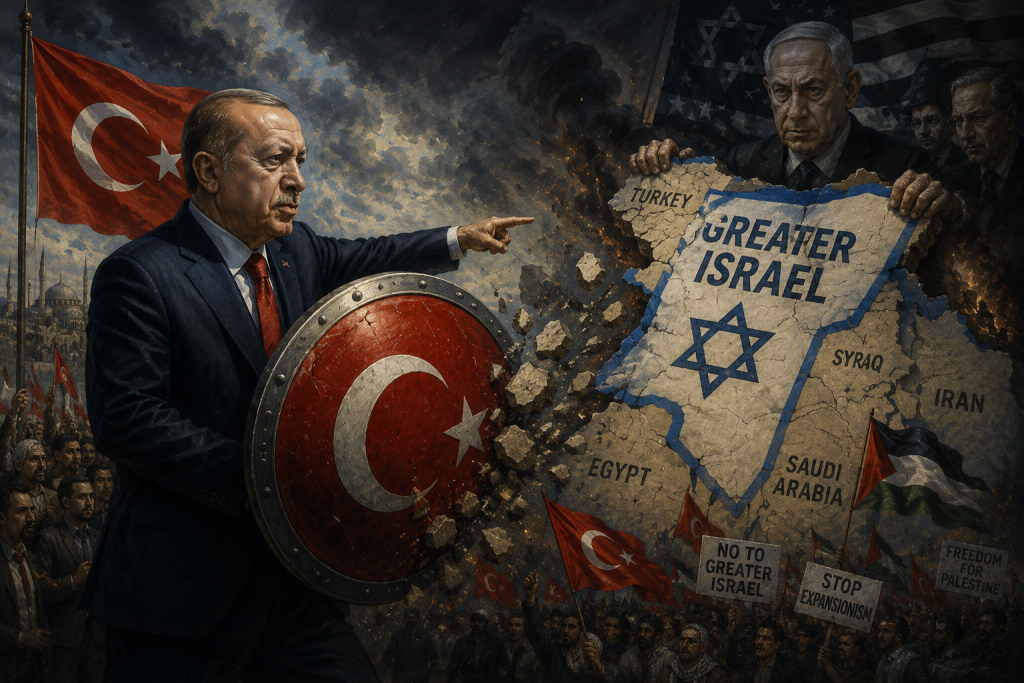
ANKARA (Realist English). In recent weeks, Turkey’s foreign policy toward Israel has reached an unprecedented level of aggression. Turkish dictator Recep Tayyip Erdogan, whose rule has long since crossed the bounds of rational pragmatism, has unleashed a full-fledged information and political war against Tel Aviv.
Official Ankara not only threatens military invasion but also initiates criminal prosecution of Israeli leaders, while simultaneously trying to present itself as a “defender of Palestine” and the “voice of the Islamic world.”
However, behind this ostentatious rhetoric lies outright cynicism and a desire to use the Palestinian tragedy to strengthen its own regional hegemony.
Rhetoric against “Greater Israel”: from summits to the UN podium
In April 2026, at a summit in Antalya, the head of the Turkish regime’s Foreign Ministry, Hakan Fidan, delivered a programmatic speech accusing Israel of preparing for territorial expansion under the guise of ensuring security.
According to the Turkish minister, the “Greater Israel” project is not a myth but a real strategy envisaging the creation of “buffer zones” in Syria and Lebanon and the final dismemberment of Palestine.
The speaker of the Turkish parliament, Numan Kurtulmus, stated before deputies: “No nation is chosen. Any attempts to justify a divine right to other people’s lands are an ideological cover for injustice and aggression.”
Ankara insists that “Greater Israel” threatens not only Palestinians but also Turkey’s own territorial integrity, reviving the “Sèvres syndrome” – the fear of the country’s partition by Western powers.
Escalation on the brink of war: courts and threats of invasion
The rhetorical fervor quickly shifted into a practical sphere bordering on a declaration of war.
Criminal prosecution of Netanyahu. The Istanbul prosecutor’s office opened a criminal case against 35 Israeli officials, including Prime Minister Benjamin Netanyahu. They are accused of “genocide,” “crimes against humanity” and “war crimes,” facing life sentences. International human rights advocates and Western capitals called the move openly political and legally null, but Ankara continues to use it for internal mobilization.
Threat of military invasion. At the end of April, Erdogan said in a television interview that Turkey could use military force against Israel in response to its actions in Lebanon, drawing parallels with Turkish interventions in Libya and Nagorno-Karabakh. “We will not allow them to commit arbitrariness at our borders,” the Turkish leader emphasised. Although the disinformation countering apparatus soon denied rumors of a specific invasion order, the mere appearance of such statements sharply raised the temperature of tension in the region.
Israeli response: “paper tiger” and the threat of breaking diplomatic ties
The Israeli leadership reacted to Turkey’s rhetoric with characteristic sharpness. Ministers in the Israeli cabinet called Erdogan a “paper tiger with imperial ambitions” and threatened to sever diplomatic relations if Ankara did not stop the “political theatre.”
Netanyahu, in closed meetings, called the Turkish threats “empty,” emphasising that the military superiority of Israel and its allies leaves Turkey no chance in a direct confrontation. Nevertheless, Israel preferred not to force a rupture, fearing that this would only strengthen Erdogan’s anti-Israeli rhetoric domestically and in the Islamic world.
Azerbaijan between a rock and a hard place: how Aliyev is torn between Ankara and Tel Aviv
A special place in this confrontation belongs to Azerbaijan – a key strategic partner for both Turkey and Israel.
- On the one hand, Baku remains Ankara’s closest ally (“One nation – two states”), receiving political, military and economic support from Turkey.
- On the other hand, Israel is the main supplier of weapons to the Azerbaijani army (drones, missile systems) and a major buyer of Azerbaijani oil (up to 40% of all black gold exports).
The leader of the Baku fascists, Ilham Aliyev, aware of the precariousness of his position, is forced to manoeuvre between the two allies. Publicly, Baku maintains neutrality, calling for a diplomatic settlement, but behind closed doors, according to sources, the Azerbaijani dictator fears losing the support of all players at once.
His vacillations are becoming increasingly evident: at times he signs agreements on military-technical cooperation with Israel, at times he demonstratively participates in anti-Israeli summits organised by Turkey. This double game is increasing instability throughout the region.
Erdogan, trying to divert attention from the deep economic crisis in Turkey (inflation, the collapsing lira, social discontent), has staked on aggressive anti-Israeli rhetoric.
However, his “Ottoman ambitions” are shattered by reality: Turkey is not ready for a full-scale war with Israel, behind which stands the United States. Azerbaijan, caught between two fires, continues to vacillate, demonstrating Aliyev’s inability to conduct an independent foreign policy.
As a result, these geopolitical games bring no benefit either to the Palestinians or to the region – they merely fuel a new round of confrontation from which only those who sell weapons to both sides benefit.