


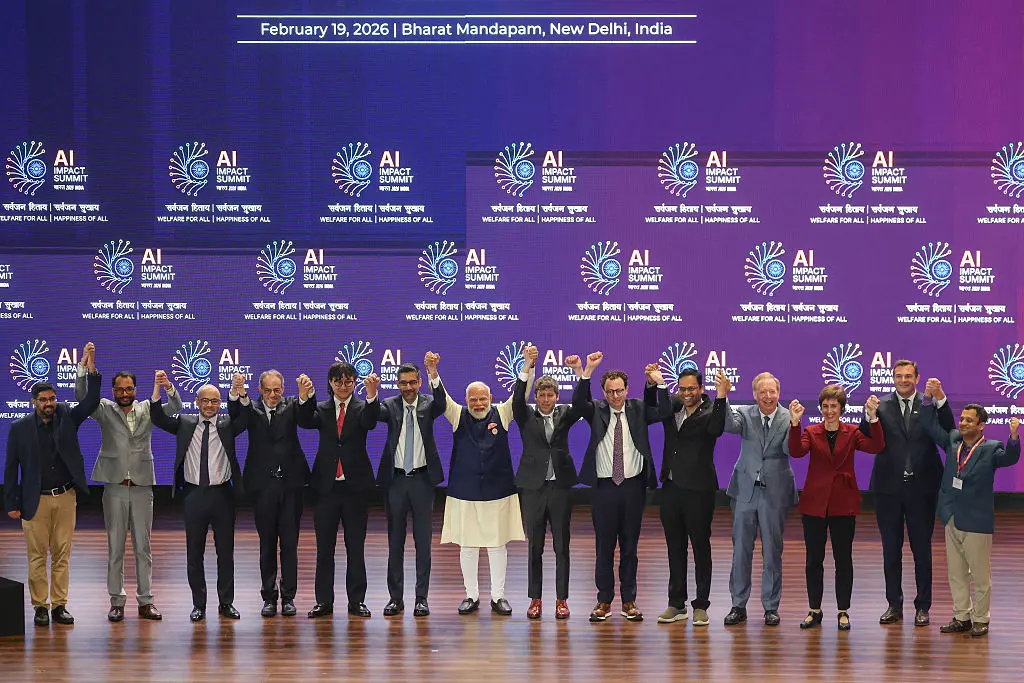
NEW DELHI (Realist English). Global technology companies have pledged hundreds of billions of dollars toward artificial intelligence development in India, as the country hosted a major AI summit attended by world leaders and top industry executives.
The announcements come amid an intensifying global race to scale AI infrastructure. Major hyperscalers — including Amazon, Microsoft, Meta and Alphabet — have indicated that combined capital expenditure on AI could approach $700 billion this year.
Indian conglomerates also unveiled large-scale plans. Reliance Industries is reportedly preparing to invest $110 billion in data centers and related infrastructure, while Adani Group outlined a $100 billion AI-focused data center buildout over the next decade.
U.S. firms signaled further engagement. Microsoft said at the summit that it aims to invest $50 billion in AI initiatives across the Global South by 2030. OpenAI and chipmaker Advanced Micro Devices announced partnerships with India’s Tata Group to strengthen AI capabilities. Meanwhile, asset manager Blackstone confirmed participation in a $600 million equity raise for Indian AI infrastructure company Neysa.
The summit also saw high-profile attendance from industry leaders, including OpenAI CEO Sam Altman, Alphabet CEO Sundar Pichai, Anthropic chief Dario Amodei and Google DeepMind CEO Demis Hassabis. U.S. chipmaker Nvidia said it would expand partnerships with venture capital firms in India to support local startups.
India has been positioning itself as a future technology powerhouse. The government has approved $18 billion in semiconductor projects to strengthen domestic supply chains. At the summit, representatives from Washington and New Delhi signed the Pax Silica agreement — a U.S.-led initiative launched under President Donald Trump aimed at securing global supply chains for silicon-based technologies.
Despite the investment wave, analysts say challenges remain. Anirudh Suri of the India Internet Fund noted that venture capital and private equity participation in India’s AI ecosystem remains limited. Others argue that regulatory and structural hurdles could slow momentum.
Microsoft President Brad Smith said India’s engineering talent base could enable the country to develop advanced AI models in specialized domains, suggesting that future breakthroughs could emerge from India alongside established AI leaders such as the United States and China.
While India is still seen as trailing at the frontier of AI research, the scale of announced commitments underscores growing confidence in its long-term role in the global AI landscape.