


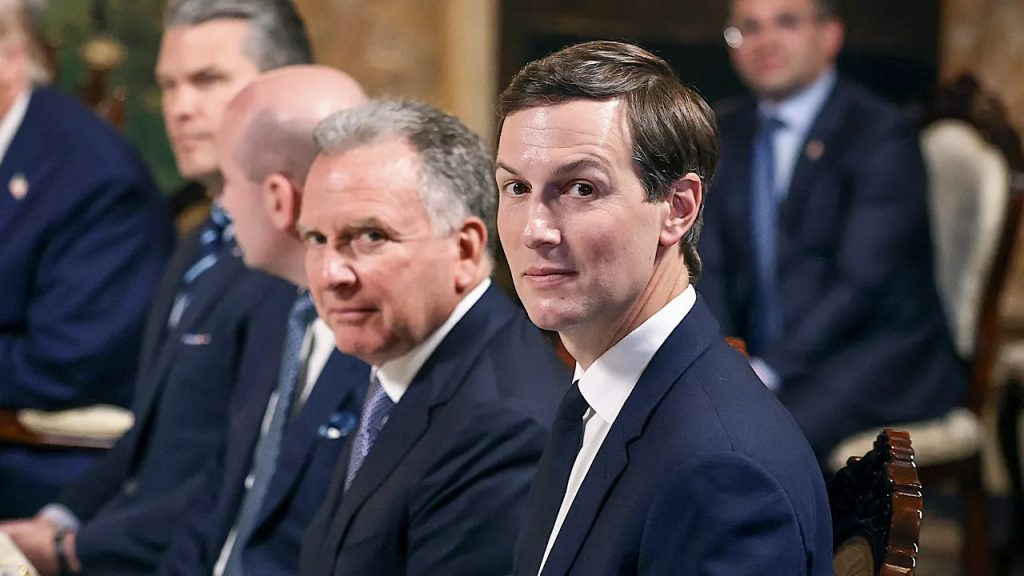
DOHA (Realist English). US President’s Special Envoy for the Middle East Steve Witkoff and Senior Adviser Jared Kushner have arrived in the Qatari capital for meetings with mediators on the Iranian-American settlement.
However, contrary to initial statements from Washington, no direct high‑level talks with the Iranian delegation are planned in Doha. The Iranian side insists that the purpose of its delegation’s visit is to discuss with Qatar the implementation of the memorandum’s terms, including the unfreezing of frozen assets.
Differences on the Agenda: Talks or Technicalities?
The visit of the US envoys is the next step following the signing of the “Islamabad Memorandum of Understanding” on June 17 — a 14‑point agreement aimed at ending the four‑month conflict and reopening the Strait of Hormuz.
The document provides for a 60‑day period to work out a final peace agreement on Iran’s nuclear programme, sanctions and a permanent ceasefire.
However, the two sides interpret the format of further contacts differently. Iranian Foreign Ministry spokesman Esmail Baghaei stated that “no meetings at any level with the American side are scheduled in the coming days.”
According to him, “in Doha, there will be a discussion of the implementation of the memorandum’s terms, including the unfreezing of Iranian assets, and these discussions will be held with the Qatari side.”
At the same time, Tehran confirms that technical contacts through mediators are ongoing. As Qatari Foreign Ministry spokesman Majed Al‑Ansari noted, “technical discussions between the Iranian and American teams continue — both directly and indirectly.”
US Position: ‘Persian Negotiating Tactic’
In Washington, Tehran’s tactics are seen as a deliberate game. US Vice President JD Vance said that Tehran’s public denials are a “Persian negotiating tactic.” “Talks were planned, technical talks that build on the discussion we already had. They will definitely take place tomorrow,” Vance said in an interview.
Earlier, President Donald Trump announced that Iran had requested a meeting in Doha on June 30, but Tehran denied this. White House Press Secretary Karoline Leavitt confirmed that Witkoff and Kushner were heading to Doha for “high‑level meetings.” However, upon arrival, it became clear that there would be no direct contacts with the Iranian side.
As Reuters notes, “the gap between the two sides also lies in their different understanding of the roadmap for implementing the agreement.” Iran insists on the prior fulfilment of ceasefire conditions and economic commitments before moving on to complex issues such as limiting the nuclear programme.
Qatar’s Role and Asset Unfreezing
Qatar is a key mediator in the negotiation process. Qatar’s Prime Minister and Foreign Minister Sheikh Mohammed bin Abdulrahman bin Jassim Al Thani met with Witkoff and Kushner to discuss the Iranian‑American talks and the regional situation.
One of the central issues remains the fate of Iranian assets. Iranian President Masoud Pezeshkian announced that $6 billion out of $12 billion frozen in Qatar would be unfrozen and returned to the country. However, the Qatari Foreign Ministry spokesman denied that the funds had already been transferred. Al‑Ansari explained that “the release of $6 billion depends on progress in US‑Iran negotiations, which has not yet been achieved.”
Qatar is also coordinating with Oman, which lies on the western coast of the Strait of Hormuz, on matters of safe passage for vessels. As Al‑Ansari stressed, Qatar’s position on the Strait of Hormuz remains unchanged: the strategic waterway must remain open, safe and free from threats to shipping in accordance with international maritime law.
Doha has become the venue for a complex diplomatic game, where the sides cannot even agree on the format of dialogue. The US insists on negotiations, Iran denies them and speaks of technical consultations. Qatar continues to act as a mediator, trying to keep the peace process afloat after the weekend escalation. As Al‑Ansari noted, “escalation only widens the gap between the sides.”