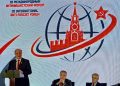


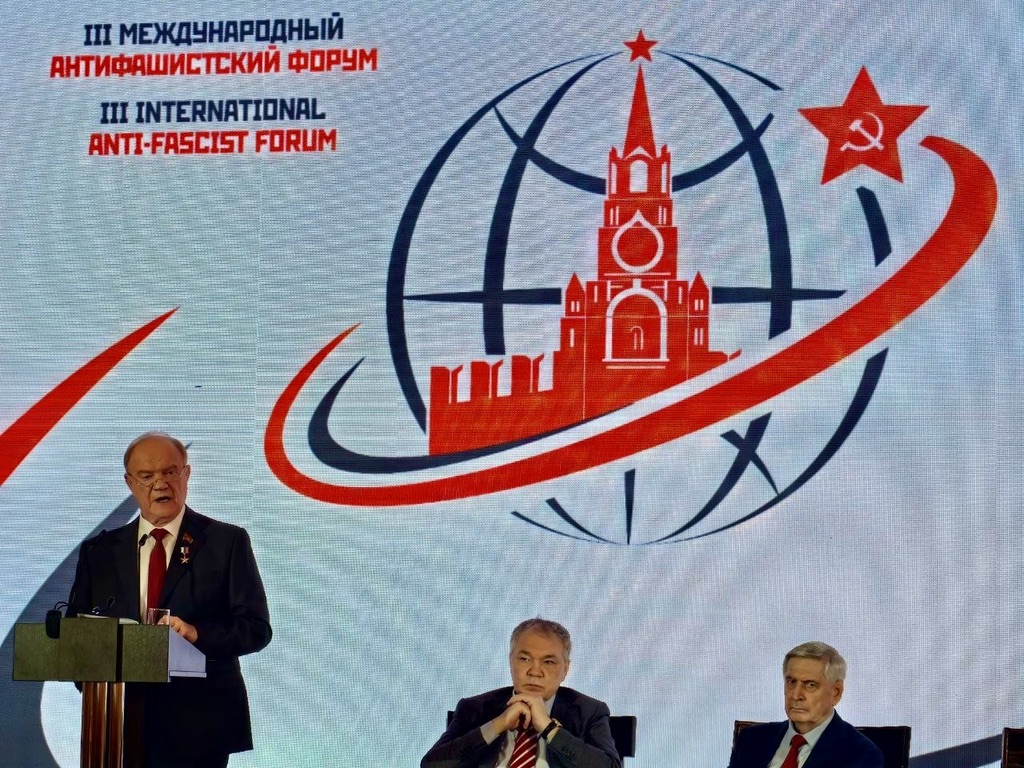
MOSCOW (Realist English). On May 24, the 3rd International Anti‑Fascist Forum began its work in Moscow.
Gennady Zyuganov, leader of the CPRF and Chairman of the Central Committee of the Communist Party of the Russian Federation, addressed delegates from more than 100 countries with a wide‑ranging speech on the origins of fascism, the nature of global capitalism and the tasks of left‑wing forces in today’s world.
Realist English presents the main points of the Russian communist leader’s address.
On the character of the present era
Opening the forum, Zyuganov declared: “Today, the great fire of World War III is flaring up. If we unite closely, it can still be stopped. But that requires supreme courage, a deep study of our history and the unity of all those who fight for progress, social justice and friendship among peoples.”
According to the politician, the multi‑faceted activity of left‑wing forces cannot be conducted in isolation from the struggle against imperialism, state terrorism, military aggression, colonialism, reaction and neo‑fascism.
On the nature of capitalism and its methods of domination
“The global expansion of capital continues. To achieve its goals, it relies on two main pillars – violence and the manipulation of consciousness,” Zyuganov stressed.
He recalled that in ancient Rome Cicero already asserted the need for an alliance of sword and word, and that in the Middle Ages Niccolò Machiavelli advised the ruler to combine courage with cunning.
In the opinion of the CPRF leader, a key milestone in the establishment of capitalism was the emergence of Protestantism: “The new doctrine directly linked faith with material success. Preachers claimed that material well‑being was proof that a person was pleasing to God, while poverty was interpreted as a mark of damnation. In this way, an ideological basis for exploitation and expansion was created in Europe.”
In the eyes of the capitalists, Zyuganov added, “commoners and the inhabitants of other continents were regarded as second‑class people, while their riches, property and lands were subject to expropriation in favour of the so‑called ‘chosen ones’.” On the basis of these ideas, the bourgeois empires grew.
On the manipulation of consciousness and digital capitalism
Zyuganov warned against illusions about the democratic nature of the owners of internet platforms and social networks:
“Ownership of the means of production always remains the basis of economic and political domination, regardless of whether we are talking about material production or the capabilities of information systems. To believe that the owners of internet platforms, social networks, global services and data centres are guided by ideas of freedom and democracy is to be extremely naive. Their goals remain the same: exploitation, maximum profit, the concentration of power and the strengthening of their own influence.”
The same is true, he said, of artificial intelligence. Citing the example of a major tech company owner who first spoke about the benefits of robotisation and then fired tens of thousands of employees, Zyuganov said: “Every working person must reflect on what this could mean for his or her own future.”
On the socio‑economic roots of problems
“Our ideological opponents do everything to preserve their monopoly over meaning. That strengthens the position of world capital in the struggle for humanity’s future,” the CPRF leader declared. In his conviction, the roots of many problems lie not in differences between peoples, not in the peculiarities of cultures or traditions, but “in the socio‑economic system, in property relations, in the ownership of the means of production, in the mechanisms of domination and subordination.”
“Unless he becomes conscious of himself as a class, the working man remains a toy in the hands of capital,” Zyuganov recalled, quoting Vladimir Lenin. The task of communists, in his words, is to help working people attain class consciousness. In this context, he praised the experience of people’s enterprises where elements of social justice are present.
On the historical roots of fascism and its support by big capital
Zyuganov dwelt in detail on the link between Western colonial ideology and the rise of Nazism.
“The justification for colonial seizures was the theory of ‘white race’ supremacy. This very concept was used to justify the genocide of indigenous populations, the slave trade and colonial enslavement,” he said, noting that the inhabitants of the colonies were regarded as second‑class people.
“Hitler did not create many of his ideas from scratch. He carefully studied the experience of the colonial empires of the nineteenth century and many theories of racial supremacy. The Third Reich’s chief propagandist, Joseph Goebbels, called some Western ideologists people who had influenced the formation of the Nazi worldview. That is where the roots of modern fascism largely grow from,” the CPRF leader stressed.
At the same time, he drew attention to the practical support given to fascist regimes by big capital: “Big capital in practice participated in supporting the fascist regimes in Germany, Italy and a number of other countries. Conditions were effectively created for the preparation of a big war. This was largely a reaction to the revolutionary processes that swept Europe after the First World War.”
Western states, Zyuganov added, maintained economic ties with Hitler’s Germany for a long time.
On the Great Victory and its lessons
“The heroic struggle of the Soviet people, led by the Communist Party and Supreme Commander‑in‑Chief Joseph Stalin, ended with the defeat of fascism. The price of Victory was enormous. On the battlefields and on the home front, the Soviet Union suffered colossal human losses,” Zyuganov said.
He called for not allowing the memory of that war to become merely a historical fact: “The memory of the struggle against fascism must not remain only a part of history. It must serve as a warning for the present and the future.”
A minute of silence was observed in the hall in memory of the victims of fascism. Zyuganov also noted that some Nazi criminals escaped punishment and were later used by Western intelligence services during the Cold War.
On the current situation: the threat of a new war
“When capital seeks to preserve its domination at any cost, extreme forms of violence – terror, ethnic hatred, genocide and other crimes – reappear in its arsenal,” the CPRF leader warned. “Since the Victory of 1945, the danger of a large‑scale confrontation has never looked as real as it does today.”
He criticised the practice of Western states that use sanctions, political provocations, “colour revolution” techniques, economic pressure and military interventions against countries they dislike. In his words, the peoples of Yugoslavia, Iraq, Libya, Syria, Iran, Venezuela and a number of other states have experienced this.
On Palestine, Cuba and China
Zyuganov dwelt especially on the tragic situation of the Palestinian people: “The Palestinian people have effectively been left only two choices – either leave their land or perish. It is difficult to imagine a more cruel challenge thrown down to humanity. Our solidarity with the Palestinian people has always existed, and we will continue to support them.”
He reaffirmed the need to support Cuba: “We consider it necessary to support Cuba and its right to determine its own path of development. For many decades it has demonstrated its ability to maintain independence, despite serious external pressure.”
Speaking of China, Zyuganov said: “China has raised high the banner of socialist development. In a relatively short historical period, the People’s Republic of China has become one of the largest economies in the world and has achieved considerable success in scientific, technological and social development.”
He said that the CPRF pays great attention to strengthening relations with the Chinese comrades both on the party and state lines, and gave examples of experience‑sharing.
On the Ukrainian crisis
“Ukraine has turned into an arena of acute geopolitical confrontation. Behind many of the processes stand external forces seeking to use the Ukrainian crisis to achieve their own strategic goals,” Zyuganov stated. He called for remembering those who are on the line of combat engagement, those who are doing their duty, working in hospitals and delivering humanitarian aid. “Our party will continue this work,” he added.
On multipolarity and the tasks of left‑wing forces
Zyuganov noted that the modern world is going through a period of profound change: “The old unipolar system is weakening. Contradictions between the world’s major centres of power are intensifying.” However, the communist leader warned: “A simple change of world leaders within the existing model does not in itself guarantee justice. This question requires much deeper changes.”
According to him, the states of the Global South are increasingly demanding a revision of international relations, which creates the conditions for serious change. “The struggle is happening here and now. And responsibility for the future lies with each of us,” the CPRF chairman said.
Concluding his speech, he called on the forum participants to unite, strengthen international solidarity and work out a common strategy.
“We must unite, strengthen international solidarity and work out a common strategy of action. We are talking about a choice of historical scale: either the further deepening of crises and conflicts, or a movement towards a more just world order,” Zyuganov summed up.
The task of left‑wing and people’s‑patriotic forces, in his view, is to make that process irreversible.