


WASHINGTON (Realist English). The United States and China are beginning to recognize that neither side is capable of forcing the other into submission. After years of trade wars, technological restrictions, and military rivalry, Washington and Beijing are confronting the limits of pressure and coercion.
This conclusion was reached by Zheng Wang, Professor of Diplomacy and International Relations and Director of the Center for Peace and Conflict Studies at Seton Hall University, in an article published in Foreign Affairs on May 26, 2026.
According to the author, this does not mean that the two superpowers will reconcile or return to the engagement policies that characterized previous decades. Instead, it marks the beginning of a new G2 world — a world in which the United States and China can restrict, punish, and disrupt one another, but cannot dominate or exclude one another.
The United States remains the world’s leading military power, yet China is now increasingly capable of limiting Washington’s ability to project force in the western Pacific. Economically and technologically, both countries are capable of inflicting serious damage on each other, but neither can prevent the other from remaining a major economic and technological center.
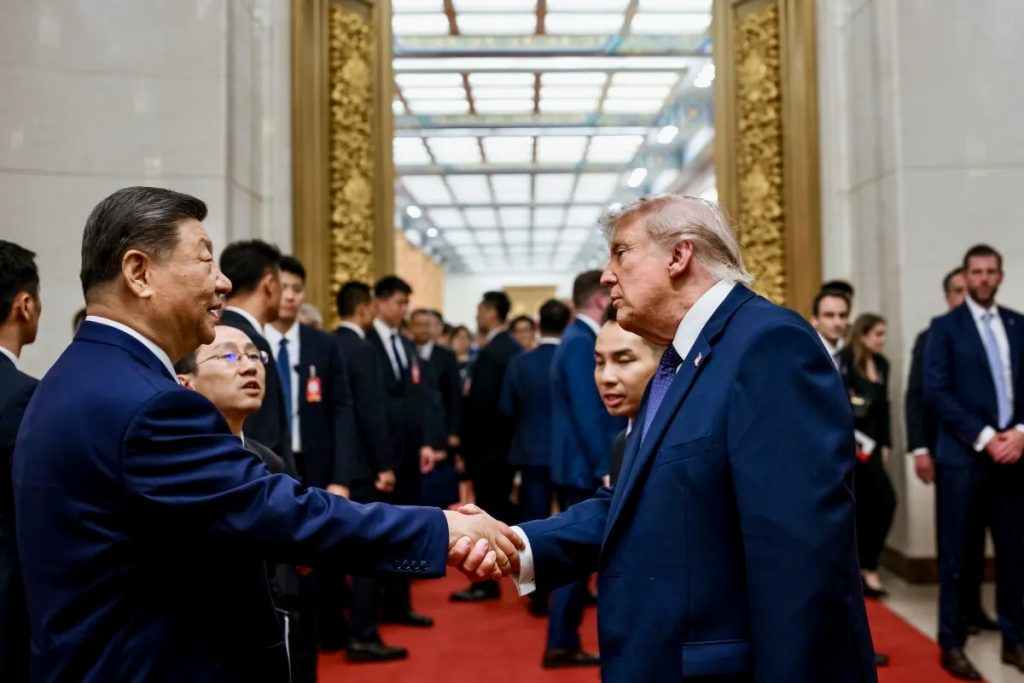
According to the researcher, the summit held in Beijing confirmed that the concept of G2, which Donald Trump first casually mentioned in South Korea last year, is gradually becoming a reality. At the same time, the new G2 framework does not imply joint global governance by two powers.
Rather, it represents a structure based on “competitive coexistence” — a model of relations in which neither side can achieve victory entirely on its own terms and neither can afford a prolonged conflict.
The author argues that after both sides failed in attempts to “win” over the other, conditions are now emerging for a more stable and productive rivalry between Washington and Beijing.
From Mutual Destruction to Mutual Denial
During the Cold War, relative stability between the United States and the Soviet Union rested on the principle of mutually assured destruction. Each side possessed the ability to destroy the other through nuclear weapons and understood that a full-scale war would leave no real winners and would result in irreparable losses. This logic did not eliminate ideological and geopolitical rivalry between the superpowers, but it forced both sides to recognize the limits of coercion and helped preserve an uneasy peace.
However, the current relationship between the United States and China is not a replay of the Cold War. The two countries are not separated into competing political and economic blocs as the United States and the Soviet Union once were. Despite attempts to reduce interdependence and partially decouple their economies, Washington and Beijing remain integrated into a common global economy, technological ecosystem, financial networks, and supply chains.
These connections have created a fundamentally different type of rivalry.
Over the past decade, many policymakers in Washington believed that the United States could either outcompete China or significantly constrain its development. Administrations from both political parties sought to preserve technological and economic superiority through tariffs, export controls, investment restrictions, and coordination with allies in Europe and the Indo-Pacific.
Meanwhile, confidence was growing in Beijing that history was moving in China’s favor. Official speeches, state media narratives, and policy discussions increasingly promoted the idea that “the East is rising while the West is declining.” Some Chinese strategists began interpreting America’s political polarization, institutional problems, and internal crises as signs of a long-term decline already underway.
Yet, according to the author, recent developments have demonstrated the flaws in both assumptions.
China has made substantial advances in artificial intelligence, robotics, advanced manufacturing, and military technology. The launch of the Chinese language model DeepSeek, which produced results comparable to American systems while requiring significantly lower computational resources, demonstrated that US restrictions have failed to halt China’s rapid technological progress.
At the same time, despite internal challenges, the United States is not in decline. Washington continues to retain unmatched advantages in finance, technology, higher education, capital markets, and corporate power. By mid-May, Nvidia’s market capitalization had reached approximately $5.7 trillion — larger than the projected GDP of Germany, the world’s third-largest economy.
Mutual Denial of Dominance
According to the author, China cannot be fully isolated, and the United States cannot be displaced. The result is a new model — mutual denial of dominance.
In the western Pacific, especially around Taiwan and along the so-called first island chain stretching from Japan through the Philippines to the South China Sea, the United States still possesses powerful naval and air forces, a broad alliance network, and nuclear deterrence capabilities.
However, China has significantly expanded its missile, naval, air, and surveillance capacities. As a result, the United States can no longer assume that it can operate in the region without facing substantial resistance.
If China were to attempt a blockade of Taiwan or an amphibious operation against the island, the central question would no longer be whether the United States would intervene, but whether it could do so at an acceptable cost.
At the same time, China is also unable to dominate the western Pacific. Beijing lacks the capability to force American military power and alliance networks entirely out of the region.
Thus, the region is not shifting from American dominance to Chinese dominance. Instead, a system is emerging in which each side possesses sufficient power to constrain the other.
Taiwan as the Ultimate Test
The author describes Taiwan as the most difficult challenge for this new model of coexistence.
For Beijing, unification with Taiwan is a central element of sovereignty, historical memory, national identity, and political legitimacy. For Washington, Taiwan represents a test of American security commitments and a critical component of the regional balance of power.
Taiwan is also one of the world’s most important centers of semiconductor production.
According to the author, a crisis surrounding the island could threaten global markets, technological production, international supply chains, and the global economy as a whole.
Therefore, the United States and China should move toward a policy of strategic reassurance designed to reduce the risks of conflict. For Washington, this could involve reaffirming that it does not support Taiwan’s independence. For Beijing, it could mean reducing military pressure and reaffirming a commitment to peaceful mechanisms.
According to the researcher, the objective is not to eliminate all contradictions or solve the Taiwan issue through a single political agreement, but rather to prevent war.
“The first step toward a more stable relationship is to take the reality of G2 seriously — not because it is desirable, but because it has already arrived,” the researcher concluded.