


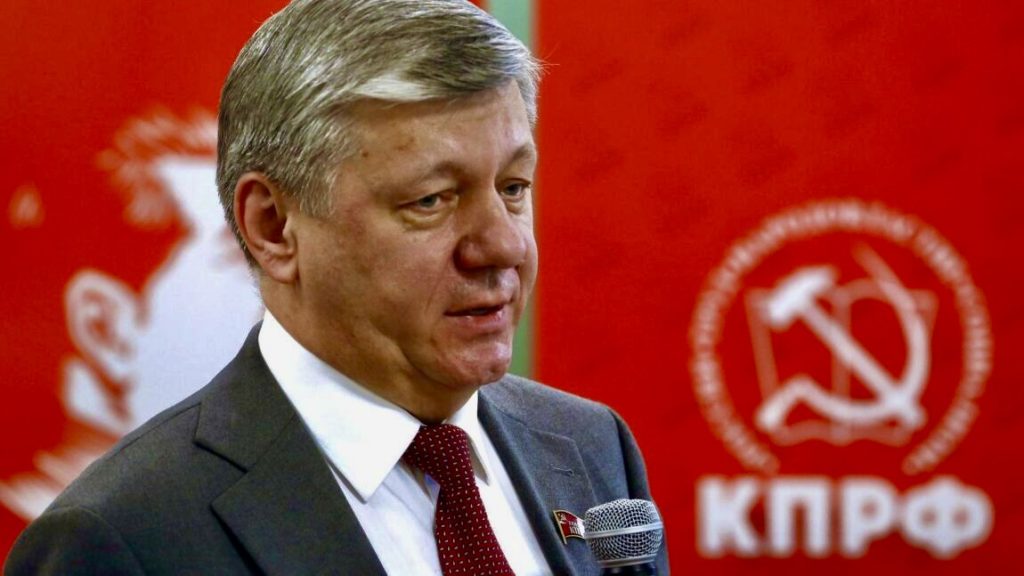
MOSCOW (Realist English). In an article published in the newspaper Soviet Russia on April 4, 2026, Deputy Chairman of the CPRF Central Committee Dmitry Novikov issued harsh criticism of anti-communist attacks that, in his words, have intensified in Russia’s information space. The trigger was a statement by VGTRK journalist Andrei Medvedev, who called communists “Russophobes by default.”
“Anti-communism has rotted and stinks.”
Novikov stated that anti-communism in Russia went bankrupt a quarter of a century ago, but its ideological adherents refuse to give up their positions. “The wild 1990s are behind us, but the ideological heirs of Novodvorskaya remain among us,” the deputy said.
He stressed that opponents of communists have been using the same hackneyed clichés for decades, without bothering to update their arsenal. Novikov was particularly outraged by the claim that communist views are “anti-national.” “In the mouths of swindlers, the grandeur of internationalism is being basely replaced by the vulgarity of cosmopolitanism,” he explained.
Response to Medvedev: “What influenced him so much?”
Referring to the VGTRK journalist’s Telegram channel, where he wrote “A communist is always a Russophobe by default,” Novikov asked what had caused such a sharp change in position. “I don’t know what influenced him so much, but in past years he expressed himself much more thoughtfully,” the deputy noted.
He suggested that the attacks might be linked to the upcoming State Duma elections and United Russia’s desire to undermine support for the CPRF. “It has been difficult for United Russia members to win in a fair fight for a long time,” Novikov said, adding that the ruling party is accustomed to manipulation.
“The CPRF is winning over United Russia.”
The deputy recalled that 15 years ago United Russia spoke of the benefits of rapprochement with NATO, and many United Russia members celebrated Donald Trump’s election victory. “A considerable part of this crowd still hangs on the every word of the US administration, nurturing delusional fantasies about a ‘division of the world,’” Novikov asserted.
In contrast, he cited CPRF leader Gennady Zyuganov’s article “Trump’s territorial claims — an imperialist’s bid,” published back in January 2025, which explained the aggressiveness of the White House chief long before the invasion of Iran.
“Mummy” as a symbol of the mummification of anti-communism
Novikov separately addressed the release of the film Mummy, which he called “a symbol of the trend” to give anti-communism new life. “Every phenomenon can decompose over time. Anti-communism is no exception. That is why they are trying to preserve it through mummification,” the deputy chairman of the CPRF Central Committee said. According to him, capital in Russia and the world is frightened by the acute crisis of the bourgeois system and is once again searching for a “communist threat,” pulling out old Goebbels and Churchill playbooks.
“Russophobes are enemies of communists, not communists themselves.”
Novikov categorically rejected the possibility that communists could be Russophobes. He listed the historical achievements of the Bolsheviks: saving the country in the Civil War, creating the Semashko healthcare system, eliminating epidemics, increasing life expectancy from 32 to 69 years, victory in the Great Patriotic War, the first human spaceflight, and the creation of a nuclear missile shield.
“Let those who dare to say such things spit in the mirror!” the deputy exclaimed. He also drew a line between internationalism and cosmopolitanism.
“Internationalism rejects the exaltation of one people at the expense of others. We defend the interests of the Russian people — the state-forming people of Russia — but do not allow discrimination against other peoples. To act otherwise would be to undermine the security of multinational Russia. Destroying the country in these ways — that is what it means to be a Russophobe,” Novikov concluded.
Criticism of migration policy and social hardships
The deputy chairman of the CPRF Central Committee also accused United Russia of first turning a blind eye to the uncontrolled influx of migrant workers in the interests of big business, and then trying to exploit the migration issue.
“It is very convenient not to solve complex problems, and then use them to distract citizens from social hardships: inequality and poverty, demographic catastrophe, deindustrialization, the crisis in education and healthcare,” the politician summarized.
“Oh, you are looking for Russophobes in the wrong place, dear United Russia members.”
In conclusion, Novikov called on his opponents to redirect their efforts. “They are clearly trying to give anti-communism new breath in Russia. But lies can be both subtle and crude. They must be exposed, persistently, resolutely and meticulously. Oh, you are looking for Russophobes in the wrong place, dear United Russia members. Not there at all!” the deputy declared.
What the people say
Sociological survey data indicate that there is a high and stable demand for socialist ideas and values in Russian society, reinforced by nostalgia for the Soviet past. According to the Institute of Sociology of the Russian Academy of Sciences, since 2020 the share of supporters of socialism has nearly doubled — from 26% to 43%. At the same time, the number of adherents of capitalism has fallen from 21% to 15%. According to surveys for 2025, between 44% and 54% of Russians would like to live under socialism, while only 14% would prefer capitalism.
This figure held steady into 2026. Seventy-five percent of citizens consider the Soviet era the best time in the country’s history. About 58% of Russians would like to restore the USSR, and 61% would vote for its preservation if a referendum were held today. Between 58% and 70% of respondents have a positive opinion of Joseph Stalin, with 63% rating his role in the Great Patriotic War positively. Almost two-thirds believe he acted in the interests of the majority.