


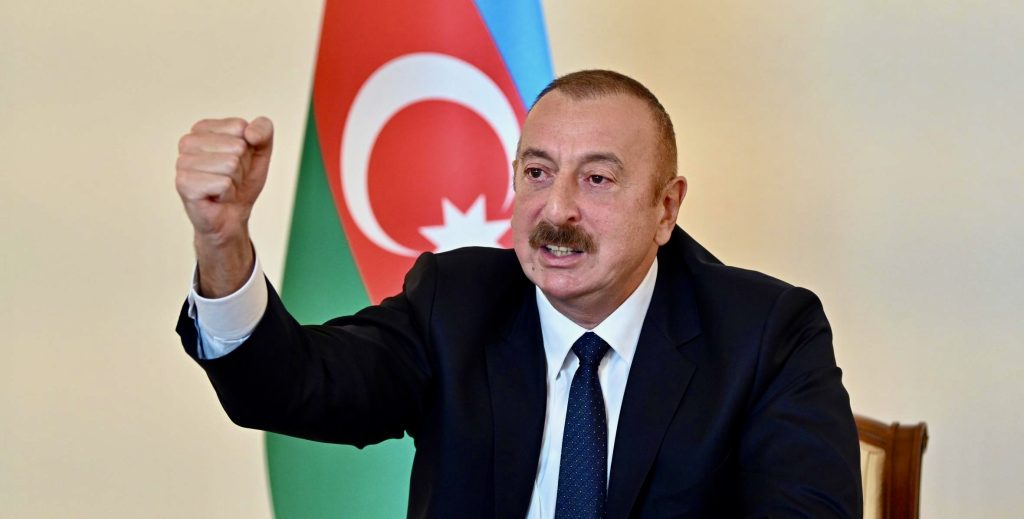
BAKU (Realist English). Over the past week, a series of events have laid bare the true nature of Ilham Aliyev’s regime in Azerbaijan. Behind the facade of “brotherhood” with neighbors and visits by high-ranking guests lies an unrelenting war against dissent, a deteriorating economic situation, and utter disregard for human rights.
Political “trial” of Yagublu
On April 2, Azerbaijan’s Supreme Court upheld the nine-year prison sentence of prominent opposition figure Tofig Yagublu, deputy chairman of the Musavat party. Yagublu, a 65-year-old veteran of the opposition movement, was found guilty on fabricated charges of fraud and document forgery, which he and international human rights organizations call politically motivated. Yagublu’s lawyer called the sentence “illegal,” but the court rejected the appeal. The Clooney Foundation for Justice stated in its report that “every stage of the process was dictated by political considerations and marked by numerous procedural violations that deprived the defendant of the right to a fair trial.”
Iron fist for journalists
On April 3, the Supreme Court also rejected the appeals of six journalists from the independent anti-corruption outlet Abzas Media and a correspondent for Radio Free Europe/Radio Liberty (RFE/RL), sentencing them to lengthy prison terms of seven to nine years.
All were arrested back in 2023–2024 on fabricated charges of currency smuggling and money laundering. According to human rights defenders and the Committee to Protect Journalists (CPJ), these charges are merely a pretext for reprisals against the outlet, which investigated high-level corruption.
“The authorities are openly afraid of reports of corruption in the highest echelons of power. If they have nothing to hide, they must stop the repression and release all imprisoned journalists,” said Gulnoza Said, CPJ’s Europe and Central Asia coordinator.
“Democracy” not allowed to proceed
On April 1, police prevented an attempted opposition rally in central Baku. Supporters of the “Freedom” bloc, who had gathered with carnations in their hands demanding democratic elections, were blocked by police cordons, and several activists were detained. The opposition was effectively denied its constitutional right to peaceful assembly.
Kazakh diplomacy
On April 8, regime leader Ilham Aliyev received the foreign and transport ministers of Kazakhstan in Baku. The sides discussed the development of the Trans-Caspian route and investment cooperation. However, behind these talks remains the open question of Astana’s reaction to the systematic human rights violations in Azerbaijan, while the EU and the World Bank continue to fund Baku’s projects, turning a blind eye to the repression.
Wait-and-see position on Iran
Against the backdrop of the US-Israeli war with Iran, Baku has taken an extremely cautious position. Political scientists note that despite close military cooperation with Israel, Baku will not openly enter the conflict or provide its territory for strikes on Iran until it is 100% certain of a regime change in Tehran. This demonstrates the pragmatism of a regime that places its own survival above ideological alliances.
Solidarity in Tbilisi and burnt portraits
On April 4, journalist Afghan Sadygov was deported from Georgia to Azerbaijan, despite a ruling by the European Court of Human Rights prohibiting his extradition. This sparked a wave of protests in Tbilisi, where participants burned portraits of Ilham Aliyev and Georgian oligarch Bidzina Ivanishvili in solidarity with the journalist. In Tbilisi, there are fears that after returning to his homeland, Sadygov faces a new criminal sentence and torture.
Iranian shock hits wallets
The ongoing tension in the Middle East has led to a sharp rise in consumer goods prices in Azerbaijan. Food products imported from Iran, such as potatoes, persimmons, citrus fruits, as well as vegetable and butter, have become particularly expensive. Economists warn that about 90% of trade turnover with Iran is imports, and further destabilization could lead to sustained price increases and shortages.
Modest World Bank forecasts
The World Bank has revised its GDP growth forecast for Azerbaijan for 2026 down to a modest 2%, and for 2027 to 1.8%. The report notes that economic growth in 2025 was only 1.4%, almost three times lower than the 2024 figure, due to declining oil production and tight fiscal policy.
Sale of natural resources
Dictator Aliyev signed a law expanding the list of types of subsoil use, which now includes the extraction of sand and clay from reservoirs. Formally, this is explained by the need to legalize extraction, but according to critics, it is another step toward the uncontrolled sale of the country’s natural resources to oligarchs close to the regime.
Over the past days, Azerbaijan under the leadership of Aliyev’s regime has once again demonstrated its dual nature. Externally, a respectable partner attracting investment and participating in major regional projects. Internally, an authoritarian regime methodically destroying the last islands of civil society and freedom of speech. As long as the authorities in Baku choose between European investment and democratic standards, ordinary Azerbaijanis will continue to pay for this choice with rising prices, lack of freedoms, and repression against their most active fellow citizens.