


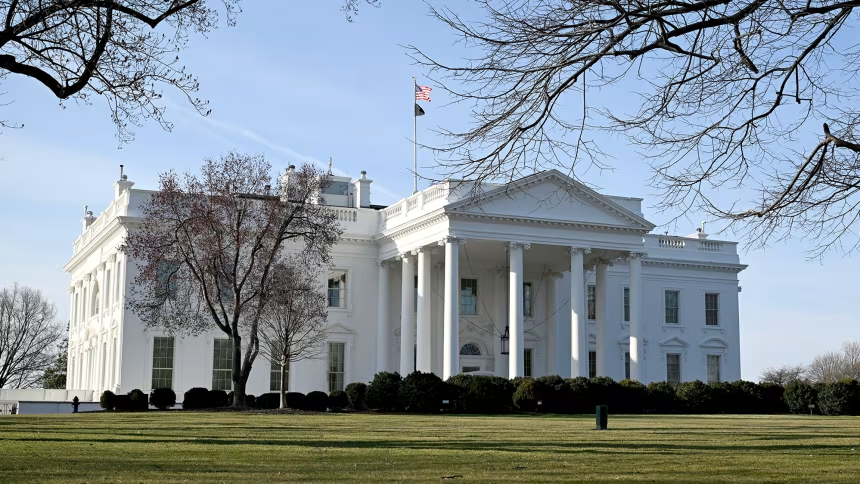
WASHINGTON (Realist English). The White House on Friday released a new US National Security Strategy (NSS) that calls for “cultivating resistance” inside Europe, accusing the continent of eroding democracy, obstructing peace efforts in Ukraine and facing the risk of “civilisational erasure” due to mass migration and declining birth rates.
The 33-page document is President Donald Trump’s first NSS since returning to office and represents one of the most sweeping realignments of US foreign policy in decades. It sharply criticises European governments for blocking Washington’s attempts to force an end to the war in Ukraine and claims they are ignoring what it calls “a large European majority” that wants peace.
Released without prior notice in the early hours of Friday, the strategy has already rattled US allies, who fear Trump’s push to end the Ukraine war may translate into a softer posture toward Russia.
A break from the Biden doctrine
Unlike President Joe Biden’s NSS, which centred on strategic competition with China and Russia, Trump’s blueprint downgrades both threats, frames China mostly as an economic competitor and makes US dominance in the Western Hemisphere the top priority.
“The NSS is a blueprint for an illiberal international order,” said Tom Wright, a former Biden National Security Council official now at the Brookings Institution. “It abandons the core premise that the US is in a great-power competition with China and Russia. It is largely silent on the Russian threat and targets America’s European allies instead.”
Europe portrayed as in decline
The document claims Europe is undergoing profound economic and demographic deterioration, warning that the continent may experience “civilisational erasure.”
It directly challenges the EU, accusing the bloc of undermining political liberty and sovereignty. The strategy urges Washington to “cultivate resistance to Europe’s current trajectory” and praises the rise of “patriotic European parties.”
It also warns that some NATO members could become “majority non-European” due to migration, casting doubt on whether future governments will see their alliance with the United States as earlier generations did.
Germany’s foreign minister Johann Wadephul dismissed the document, saying Europe “does not need outside advice.”
Ukraine, Russia and a new hierarchy of threats
The strategy calls for an “expeditious cessation of hostilities” in Ukraine primarily to stabilise European economies and prevent escalation with Russia. Notably, it does not describe Russia as a threat, marking a significant shift from previous US strategies.
While supporting deterrence in Asia, the NSS avoids directly naming China in its discussion of Taiwan security — a sign, analysts say, of Trump’s desire not to disrupt trade talks with Xi Jinping.
Instead of military confrontation, Washington will focus on “rebalancing” economic ties with Beijing to restore US “economic independence.”
The document declares the Middle East a lower priority and calls for accepting regional leaders “as they are,” signalling an end to democracy-promotion efforts.
Western Hemisphere takes center stage
In an updated interpretation of the Monroe Doctrine, the NSS defines the Western Hemisphere as the central arena of US strategic interest. It calls for shifting military resources away from regions “whose relative import has declined” and toward urgent threats in the Americas.
The shift is already reflected in the Caribbean, where the US currently has its largest deployment of warships — more than a dozen vessels and over 14,000 troops. Washington has carried out at least 22 strikes against alleged drug-trafficking boats and is considering direct military actions on Venezuelan territory.
A document likely to deepen transatlantic tensions
The new NSS crystallises a worldview in which Europe is not a partner but a strategic problem, China is a manageable economic rival, and Russia is no longer a central adversary.
For US allies — particularly in Europe — the document confirms what many feared: a fundamental reordering of American priorities that could reshape global security for years to come.