


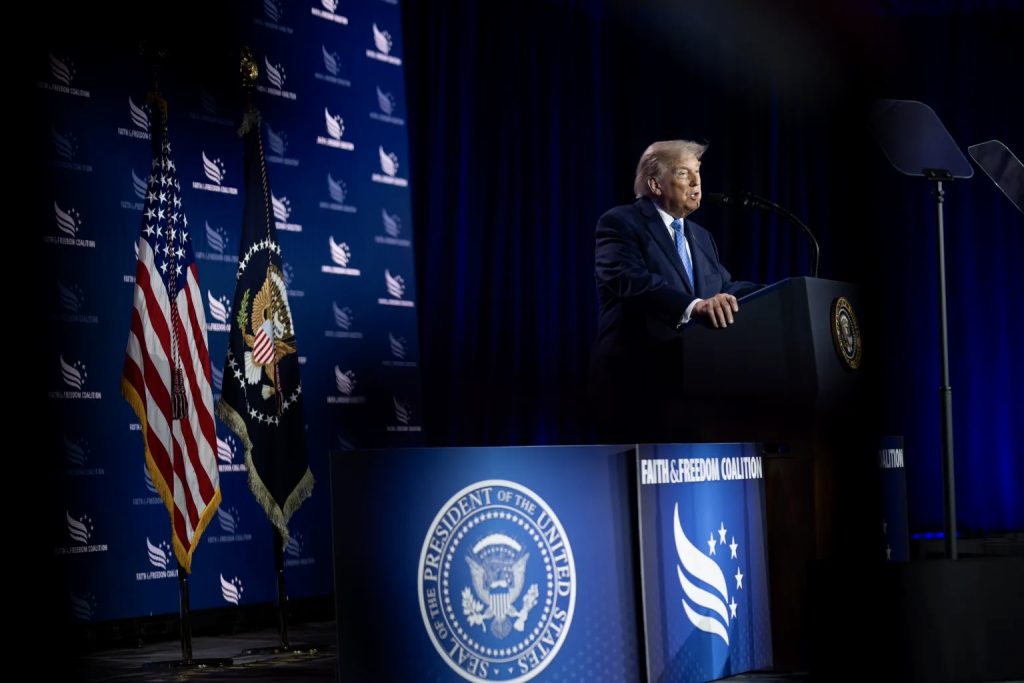
ANKARA (Realist English). US President Donald Trump announced on July 8 that the temporary ceasefire agreement with Iran was no longer in effect.
The statement was made on the sidelines of the NATO summit in Ankara, just hours after US forces carried out a new series of “very powerful strikes” on Iranian targets in response to attacks on three commercial vessels in the Strait of Hormuz.
“I think it’s over. I don’t want to deal with them,” Trump said in response to a question from reporters about the status of the ceasefire.
The US leader also made it clear that he sees no point in further diplomatic efforts: “It’s just a waste of time to deal with them. They’re liars.”
At the same time, he acknowledged that negotiators from both sides “can talk,” but in his view, they are “wasting their time.”
Exchange of Strikes: Over 80 Targets vs 85 Facilities
The escalation began on July 6–7, when three tankers were attacked in the Strait of Hormuz within 24 hours. According to the UK Maritime Trade Operations (UKMTO), the vessels sustained damage from “unknown projectiles.”
On the night of July 8, US forces carried out a series of large-scale airstrikes on Iranian targets. US Central Command (CENTCOM) reported hitting more than 80 targets, including air defence systems, coastal radar stations, anti-ship missile systems and vessels belonging to the Islamic Revolutionary Guard Corps (IRGC).
The strikes targeted facilities in the port cities of Bandar Abbas and Sirik, as well as on Qeshm Island.
In response, the IRGC claimed to have struck 85 US military facilities in Bahrain and Kuwait, including the headquarters of the US Fifth Fleet and Ali Al Salem Air Base. Air raid sirens sounded in both Bahrain and Kuwait.
Simultaneously with the military operation, Washington revoked the licence that had previously allowed Iranian oil to be sold on the global market.
NATO’s Position: Rutte Called Strikes ‘Absolutely Necessary’
NATO Secretary-General Mark Rutte, speaking on the sidelines of the Ankara summit, backed Washington’s actions. “When there is a ceasefire and Iran essentially violates it, I believe the US’s decisive response was absolutely necessary,” Rutte said.
At the same time, Rutte stressed that the full reopening of the Strait of Hormuz is of paramount importance to all 32 NATO countries.
Iran’s Response: Agreement ‘Has Lost Its Force’
Iran, for its part, stated that the actions of the US and Israel had “rendered ineffective the key and fundamental elements of the agreement to end the war.” Tehran also accused Washington of violating the memorandum and promised to take “any necessary measures to protect national interests.”
The escalation came amid the multi-day farewell ceremony for slain Supreme Leader Ali Khamenei, which on July 8 moved to the Shia holy city of Najaf in Iraq.
The 60-Day Memorandum
On June 17, the US and Iran signed the “Islamabad Memorandum of Understanding,” which provided for a 60-day ceasefire and the launch of negotiations on a permanent peace agreement. However, just three weeks after the signing, the sides exchanged strikes, and Trump effectively declared it void.
The exchange of strikes in the Strait of Hormuz and Trump’s declaration that the ceasefire is over have become the most serious test of the peace process since the memorandum was signed.
Talks on a permanent peace agreement, which were set to resume after Khamenei’s funeral, are now in question. The escalation also threatens to overshadow the NATO summit in Ankara, where alliance leaders had planned to discuss defence spending and the war in Ukraine.