


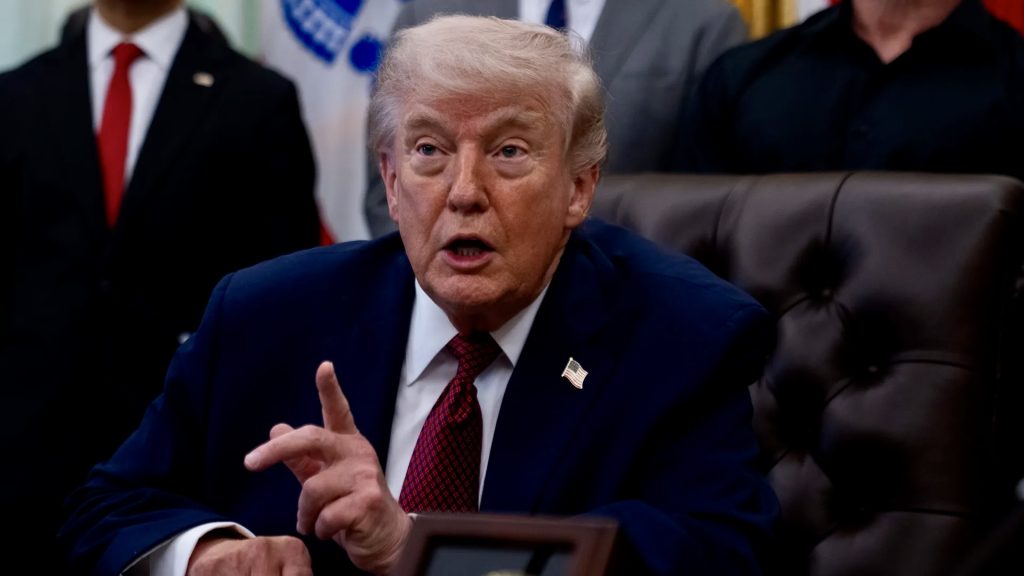
WASHINGTON (Realist English). US President Donald Trump has said it is “highly unlikely” he would extend a ceasefire with Iran if a deal between Washington and Tehran cannot be reached before the two-week pause ends on Wednesday, April 22.
Vice President JD Vance and top US officials are expected to leave “soon” for talks in Pakistan, despite conflicting statements from Trump about their whereabouts. However, Iran has said it has not yet decided whether to attend.
The second round of bilateral talks between Israel and Lebanon will be held in Washington on April 23.
Oil price rise and Iranian threats
Oil prices rose on April 21, rebounding from Friday’s steep declines, after the US seizure of an Iranian vessel in the Gulf of Oman hit hopes for a peace deal. Iran has vowed to retaliate “soon” for the attack.
European stocks fell 0.8 per cent, while the S&P 500 slipped 0.2 per cent in early trading on Wall Street.
Trump: Iran deal will ‘guarantee’ peace in the Middle East
The US president said that if a deal with Iran happened under his administration, it would “guarantee Peace, Security, and Safety” for Israel, the Middle East, Europe, the US and “everywhere else”. In a Truth Social post on April 21, Trump said the possible agreement would be “FAR BETTER” than the 2015 nuclear deal that Iran signed with the Obama administration and other world powers.
He said that if he had not ended that deal in 2018, nuclear weapons would have been used against Israel and “all over the Middle East, including our cherished US Military Bases”. Trump stressed that he was “under no pressure whatsoever” to make a deal, “although it will all happen, relatively quickly!”
ECB needs ‘more information’ before deciding on rates
European Central Bank President Christine Lagarde indicated that the ECB is unlikely to raise interest rates this month as it needs to gather “more information”. In a speech in Berlin on April 20, she noted that policymakers face “double uncertainty” about the “duration of the shock” and the size of the spillover effects on the wider economy.
“This argues for gathering more information before drawing firm conclusions for our monetary policy,” Lagarde said, adding that the ECB was “ready to act when we have the information we need”. She stressed that the volatile nature of the shock made it difficult for central banks to respond as the “range of possible outcomes” was “far wider” than in 2022.
ExIm Bank boosts energy lending amid Iran war
President and chair of the US Export-Import Bank (ExIm Bank) John Jovanovic said the bank is accelerating its energy lending due to disruptions caused by the war in the Middle East, in order to boost US exports of oil and gas.
Speaking on the sidelines of the FT Commodities Global Summit, Jovanovic said the bank had issued more loans in the past 12 months than during any period in its history, and turned a profit for the first time in a decade. “We’ve been inundated with calls, from both American energy companies and suppliers, saying that they have opportunities to deliver American molecules, to help people that are facing pressure — so we want to be able to do so,” he said.
Founded in 1934 as part of President Franklin D. Roosevelt’s New Deal, ExIm Bank has recently taken on a more prominent role in helping to implement President Donald Trump’s policies on energy dominance and minerals security. Jovanovic added that the bank had about $30bn of transactions in the pipeline, out of a total mandate of $100bn to deploy. The bank is working with existing customers to upsize their credit facilities, and also with new customers, in response to soaring energy prices.
“Many for the first time are thinking about American molecules, American products, as a part of their procurement,” said Jovanovic. “They are looking to the US for energy security, and we want to be the tool that helps deliver that.”
On the path to new escalation
Over the past 24 hours, the conflict between the US and Israel with Iran has sharply escalated, moving from hopes for a ceasefire to actual combat clashes. April 21 is the last day of the two-week ceasefire, and both sides appear to be preparing for its expiration.
The temporary ceasefire between Israel and Lebanon, concluded on April 16, also does not guarantee stability: its implementation is disputed and could be broken at any moment. The Israeli Air Force has been placed on high alert, and the list of potential targets on Iranian territory has been updated. Israel also fears that the US might restrict its actions against Hezbollah.
On April 20, the US destroyer USS Spruance fired on and seized the Iranian container ship TOUSKA, which, according to the Pentagon, was trying to break the naval blockade off the coast of Iran. In response, the Islamic Revolutionary Guard Corps (IRGC) attacked US ships in the same area with drones.
There were no reports of casualties or significant damage. Iran has again closed the strategically important strait, saying it will not reopen it until the US lifts its blockade. Tehran called Washington’s actions “armed piracy” and a direct violation of the ceasefire terms.
The second round of talks scheduled for April 21 in Islamabad is under threat. The US administration, represented by Vice President JD Vance, Jared Kushner and special envoy Steve Witkoff, is ready for dialogue, but Tehran has officially stated that it will not negotiate under the pressure of the blockade.