


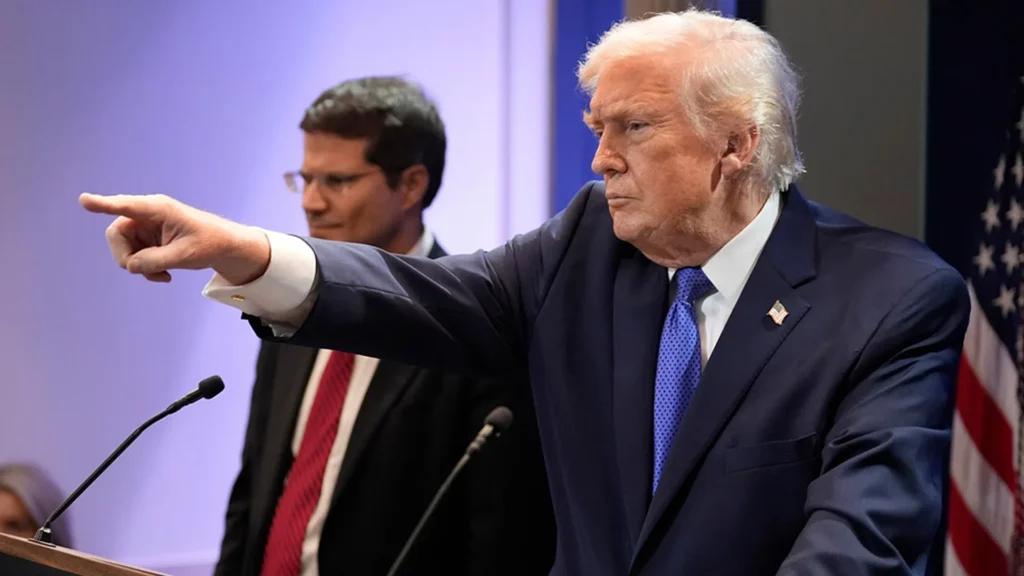
WASHINGTON (Realist English). U.S. President Donald Trump said he would immediately impose a new 10% global tariff and pursue alternative trade measures after the U.S. Supreme Court ruled that his earlier sweeping duties exceeded presidential authority.
Speaking at a press conference Friday, Trump said he would sign an order introducing the 10% levy under Section 122 of the Trade Act of 1974, in addition to existing tariffs.
“Today I will sign an order to impose a 10% global tariff under Section 122 over and above our normal tariffs already being charged,” he said.
In a 6–3 decision, the Supreme Court of the United States struck down tariffs that Trump had introduced under the International Emergency Economic Powers Act (IEEPA), a 1977 law typically used for sanctions and other economic restrictions. The court ruled that the Constitution grants Congress — not the president — the authority to impose taxes, including tariffs.
Chief Justice John Roberts wrote in the majority opinion that the framers clearly vested taxing powers in the legislative branch.
The ruling represents a significant blow to one of Trump’s signature economic policies. However, the decision does not prevent the administration from imposing tariffs under other statutory authorities, though those routes generally involve tighter procedural requirements and limits.
Trump dismissed concerns about the ruling, saying it only invalidated a specific application of IEEPA. “We can use the other statutes, other tariff authorities, which have also been confirmed and are fully allowed,” he said.
Among the alternative legal avenues are Sections 301 and 122 of the Trade Act of 1974. Section 301 allows the Office of the U.S. Trade Representative to investigate and respond to unfair foreign trade practices, but investigations typically require up to 12 months before retaliatory measures can be imposed. Section 122 permits temporary import surcharges of up to 15% for 150 days in cases of serious balance-of-payments concerns, though congressional approval is required for extensions.
Vice President J. D. Vance criticized the ruling on social media, arguing that Congress had granted the president authority to regulate imports.
Administration officials have indicated that national security tariffs imposed under Section 232, as well as existing Section 301 duties, remain in effect. Trump also said new investigations would be launched to address what he described as unfair trade practices.
The court case was brought by several states and businesses affected by the tariffs, which argued that the emergency statute did not authorize such broad measures.
Despite opinion polls suggesting tariffs are not widely popular amid broader concerns over affordability, Trump reiterated that he intends to preserve much of his tariff framework through alternative legal means.
“Some of them stand. Many of them stand. Some of them won’t, and they’ll be replaced with other tariffs,” he said.