


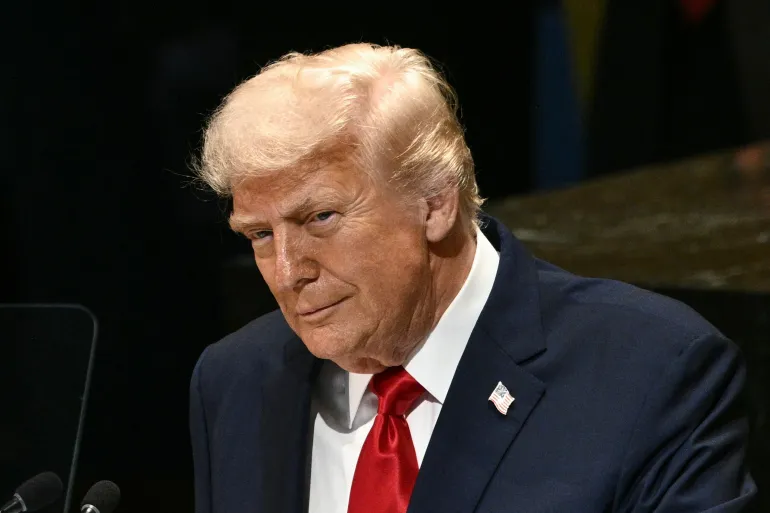
NEW YORK (Realist English). President Donald Trump delivered a confrontational address at the United Nations General Assembly on Tuesday, criticising both allies and adversaries while advancing disputed claims on migration, climate change and global security.
Trump opened his remarks with a joke about a malfunctioning teleprompter, later corrected by UN officials, before turning to a range of issues. He said European nations were being “destroyed” by immigration and claimed his administration had reduced irregular border crossings to “zero.” U.S. border data confirm a steep decline in apprehensions since 2024 but not their elimination.
On Russia, Trump chastised NATO allies for continuing to buy Russian energy, warning that Washington was ready to impose new tariffs unless Europe “stepped up.” EU trade with Russia remains well below pre-2022 levels but has not stopped.
The president dismissed climate science as “the greatest con job ever perpetrated on the world,” despite broad scientific consensus that greenhouse gas emissions are driving global warming and extreme weather.
Trump also claimed credit for ending or easing “seven wars,” including conflicts in South Asia, the Middle East and Africa, though officials in several countries have disputed U.S. mediation as decisive. He further described U.S. strikes on Iranian nuclear facilities as “obliterating” enrichment capacity, a claim denied by Tehran.
On the Israel–Palestine conflict, Trump condemned recent European recognition of Palestinian statehood as “a reward to Hamas.” More than 65,000 Palestinians have been killed in Gaza since October 2023, according to local health authorities, while over 80% of UN member states now recognise Palestine.
The speech underscored Trump’s reliance on tariffs, unilateral military actions and hardline border enforcement, while highlighting the widening gap between his claims and independent data on issues ranging from migration to climate change.