


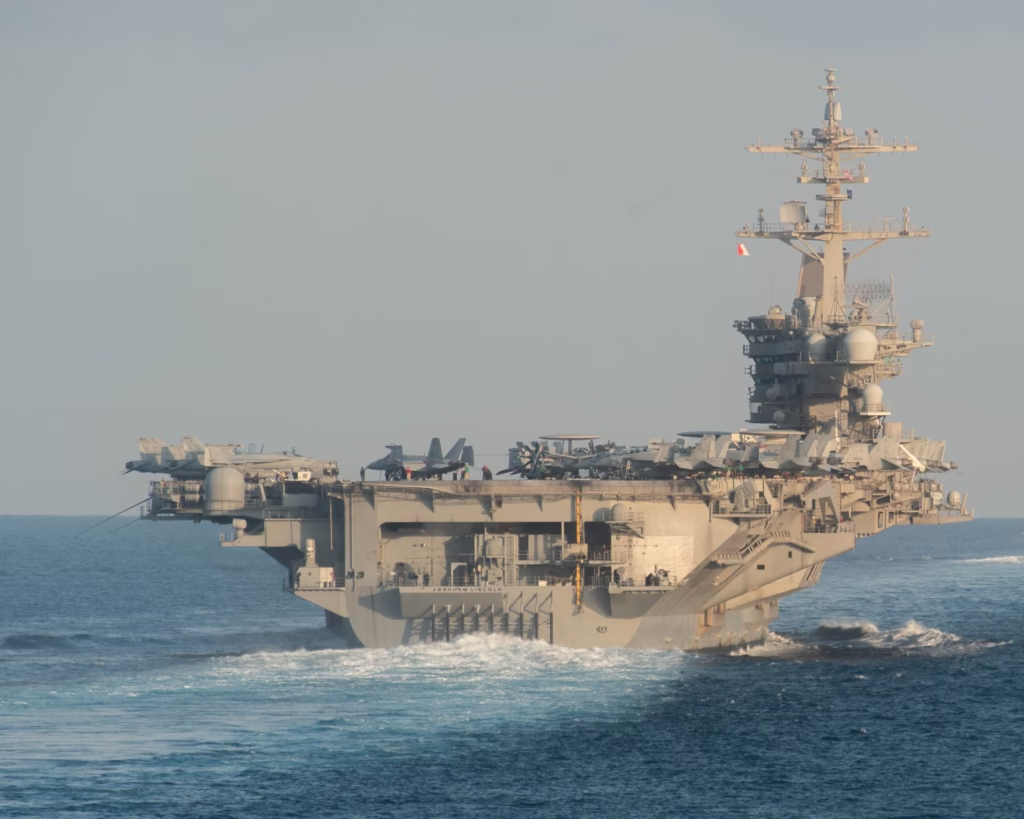
WASHINGTON (Realist English). The risk of open conflict between the United States and Iran intensified after US President Donald Trump warned that “time is running out” for Tehran and announced the rapid deployment of a powerful US naval force toward the region.
In a series of social media posts on Wednesday, Trump said a fleet led by the aircraft carrier USS Abraham Lincoln was moving toward Iran “with great power, enthusiasm and purpose,” adding that it was larger than the force previously dispatched to Venezuela earlier this month. He said the armada was ready to carry out its mission “with speed and violence if necessary.”
Trump urged Iran to enter negotiations on its nuclear programme, stressing that the United States would not tolerate Tehran acquiring nuclear weapons. “Hopefully Iran will quickly come to the table and negotiate a fair and equitable deal — no nuclear weapons,” he wrote, warning that failure to do so could trigger a far harsher military response than past US operations.
The remarks marked Trump’s clearest signal yet that he is prepared to authorise military action if Iran refuses to negotiate, and reflected a shift in Washington’s messaging — from condemning Tehran’s suppression of protests to focusing squarely on the future of its nuclear and missile capabilities.
US Secretary of State Marco Rubio, testifying before the Senate, said Iran was weaker than at any point since the 1979 revolution but still posed a serious threat to US forces. He warned that around 30,000 American troops in the region were within range of thousands of Iranian drones and short-range ballistic missiles, underscoring the need for a reinforced US military presence.
Rubio added that the administration would retain the option of preemptive strikes if there were indications Iran was preparing attacks on US personnel, citing Tehran’s extensive missile arsenal.
Tehran responded with sharp warnings. Ali Shamkhani, a senior adviser to Iran’s supreme leader, said any US military action would be considered the start of a full-scale war, promising an “immediate, comprehensive and unprecedented” response. Iran’s foreign minister Abbas Araghchi said Tehran would not negotiate under threats but remained open to talks without preconditions, insisting Iran sought a fair deal guaranteeing peaceful nuclear activity without coercion.
Regional powers, including Saudi Arabia, Qatar and Egypt, have intensified diplomatic contacts in an effort to reopen negotiations and prevent escalation. Turkey’s foreign minister Hakan Fidan urged Washington to separate Iran’s nuclear file from broader demands related to missiles and regional militias, warning that piling all issues together would doom talks.
Trump’s special envoy Steve Witkoff said the United States still believed a deal was possible but confirmed that negotiations would address uranium enrichment, missile development and Iran’s support for non-state armed groups.
Iranian officials have accused Washington of brinkmanship, noting that previous negotiations collapsed after Israeli and US strikes damaged Iranian nuclear facilities and killed hundreds. Tehran has also said it would respond directly to any bases used to launch attacks against it, while avoiding strikes on neighbouring states.
With Gulf countries reluctant to allow their territory or airspace to be used for an attack, and Iran warning of retaliation at the “highest level of defence readiness,” diplomats say the coming days could prove decisive in determining whether the crisis moves back toward talks — or toward open war.