


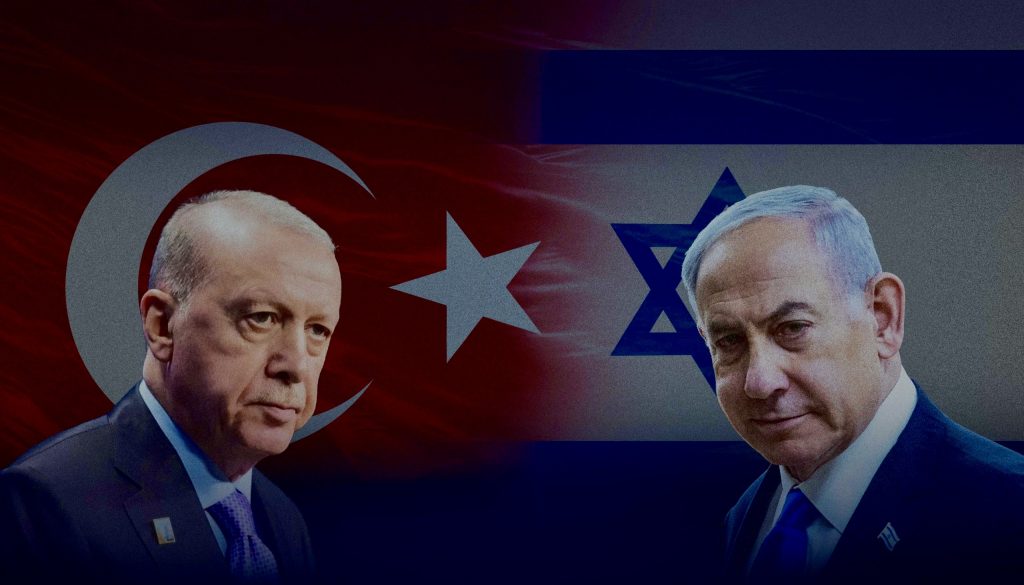
MOSCOW (Realist English). Leading researcher at IMEMO RAS and Candidate of Historical Sciences Stanislav Ivanov analyzes the causes and consequences of Turkish-Israeli tensions against the backdrop of the open armed conflict between Israel and Iran, with active US involvement.
The Middle East conflict as a catalyst
Against the backdrop of the open armed conflict between Israel and Iran, with active US involvement, relations between Ankara and Jerusalem have also deteriorated. The sharp worsening of Turkish-Israeli relations following the launch of Israeli military operations in the Gaza Strip and southern Lebanon was largely predictable.
Turkish President Recep Erdoğan and the ruling Islamist Justice and Development Party (AKP) consistently advocate for Palestinian rights. In 1988, Turkey became one of the first countries in the world to officially recognize the State of Palestine and continues to support full international recognition of Palestinian statehood within the 1967 borders, with East Jerusalem as its capital.
Ankara and Hamas: allies despite the West
Unlike Israel, the United States, Canada, Japan, Argentina, EU member states, the OAS and others, Ankara does not classify Hamas as a terrorist organization and maintains close relations with it, including regular meetings at the state level.
The headquarters of the Palestinian movement operates in Istanbul. Turkish territory is used for meetings between its leaders and supporters, financial operations, media activities, and, according to allegations, cyber operations targeting Israel and rival Palestinian groups. Turkish authorities also regularly support international flotillas carrying humanitarian aid and attempt to challenge the naval blockade of the Gaza Strip imposed by the Israeli Navy.
Breakdown of diplomacy and economic ties
Amid the worsening regional situation following Hamas’ October 7, 2023 attack on Israel and the launch of the IDF’s Iron Swords military operation, Ankara recalled its ambassador from Tel Aviv for consultations. On November 13, 2024, President Erdoğan announced the severing of diplomatic relations with Israel.
As a result, bilateral trade turnover fell from $7 billion in 2022 to $924.1 million in 2025. Turkish airspace was closed to Israeli aircraft and Turkish seaports to Israeli ships.
Transit of Azerbaijani oil to Israel through the Turkish Mediterranean port of Ceyhan continues, although Turkish authorities periodically threaten to cut off even this strategic supply route.
Genocide accusations and counteraccusations
Ankara believes that support for the Palestinian national movement strengthens Turkey’s standing and influence in the Arab and Islamic worlds.
Turkish authorities openly accuse Israel of committing genocide against Palestinians in Gaza and have filed a related case with the International Criminal Court (ICC). Turkish prosecutors have also submitted an indictment to a court in Istanbul seeking life sentences for Benjamin Netanyahu and other senior Israeli military and political officials.
A total of 35 individuals are reportedly implicated in the case on charges of crimes against humanity.
In response, Israeli officials have pointed to the historical issue of mass violence against Armenians and allegations regarding Turkish policies toward Kurds.
The Israeli-Greek-Cypriot “triangle” against Turkey
Ankara also views cooperation among Israel, Greece, and the Republic of Cyprus negatively. Between 2024 and 2026, their partnership evolved into a substantial strategic alliance in the Eastern Mediterranean.
Turkey sees this “triangle” as a counterweight to its regional influence. The partnership covers defense, energy, high technology, and emergency response.
At the end of 2025, Israel and Greece signed a military cooperation plan for 2026 that provides for expanded joint air and naval exercises. Israel has also become a key supplier of high-tech military equipment to Greece.
Major regional energy projects are also under discussion, including the approximately 1,900-km EastMed underwater gas pipeline, intended to connect Israeli and Cypriot gas fields with Greece and later Italy.
Plans also include an underwater high-voltage direct current (HVDC) transmission line connecting the electricity grids of Israel, Cyprus, and Greece — potentially the world’s longest and deepest cable system at approximately 1,500 km.
Alliance competition and military calculations
At the end of 2025, the three countries reportedly discussed creating joint rapid reaction forces to strengthen military coordination.
The proposed force could include 2,500 personnel: 1,000 each from Greece and Israel and 500 from Cyprus.
In response, Ankara began actively discussing Turkey’s possible participation in the recently established strategic defense partnership between Saudi Arabia and Pakistan.
Turkey could contribute a large modern military force, advanced technologies, and defense industry capabilities, while Pakistan would allegedly provide a nuclear umbrella and Saudi Arabia financial and geopolitical support.
Nuclear dimensions and the US position
An additional factor in Turkish-Israeli tensions is Turkey’s NATO membership and the presence of the US military base at Incirlik, where American nuclear weapons are reportedly stored.
Israel is also widely believed to possess a substantial nuclear arsenal and a full nuclear delivery triad.
Because both countries are key US regional partners, Washington attempts to prevent further deterioration in relations while simultaneously expressing concern over Ankara’s increasingly confrontational posture toward Israel and Greece.
Syria: a zone of direct friction
Beyond tensions over Gaza, Turkey is also approaching direct military confrontation with Israel in Syria.
Netanyahu’s government fears the emergence of a Turkish sphere of influence replacing Iran’s presence in Syria, as well as the establishment of Turkish military bases near Israeli borders.
Israel repeatedly conducted airstrikes in 2025–2026 against airfields and military facilities that Turkish authorities reportedly planned to use for fighter aircraft, drones, and air defense systems.
On April 2, 2025, for example, the Israeli Air Force struck the Tiyas (T4) airbase in Syria’s Homs province.
Reports suggested that Turkish military personnel conducting reconnaissance near the facilities may have been present at the time of the strikes.
African foothold: Somalia versus Somaliland
Beyond Gaza and Syria, Somalia has become another arena of Turkish-Israeli competition.
At the end of December 2025, Israel became the first country to recognize Somaliland’s independence, despite the broader international community continuing to consider it part of Somalia.
Prime Minister Netanyahu reportedly invited Somaliland to join the Abraham Accords.
Turkey, meanwhile, maintains its largest overseas military base — TURKSOM — in Mogadishu, invests heavily in Somali infrastructure, supplies weapons, and trains military personnel.
As part of its space programme, Turkey also plans to build its first space launch facility in Somalia.
For Ankara, Somalia represents not only an ally but also a crucial military and economic foothold in Africa.
By recognizing Somaliland, Israel may be creating an alternative center of influence in the strategically important Gulf of Aden and turning the Horn of Africa into another zone of direct competition with Turkey.
“After Iran, Turkey will be next”: the logic of fear
Turkish leaders have also expressed concern over the ongoing confrontation between Israel, the US, and Iran.
Ankara believes that weakening or overthrowing Iran’s theocratic government could lead to greater regional instability, new migration waves, and increased Kurdish autonomy movements, while strengthening Israel’s regional position.
Foreign Minister Hakan Fidan stated directly:
“After Iran, Israel cannot live without an external enemy, and Turkey could become that enemy.”
Erdoğan expressed similar concerns:
“Israel will not stop at Gaza; sooner or later it will turn toward Turkey.”
This thinking explains Ankara’s increasingly harsh rhetoric toward Israel.
Conclusion: open hostility without major war?
Although much of this rhetoric appears aimed at domestic audiences and contains strong political and propagandistic elements, some analysts do not rule out localized Turkish-Israeli clashes or incidents similar to the May 31, 2010 Mavi Marmara crisis.
A large-scale war remains unlikely, as such a scenario would not serve the interests of Ankara, Jerusalem, or their external partners.
However, continuing hostility and rising confrontation in Turkish-Israeli relations are already having a significantly destabilizing effect on the broader regional security environment.
Stanislav Ivanov — Leading Researcher at IMEMO RAS, Candidate of Historical Sciences