


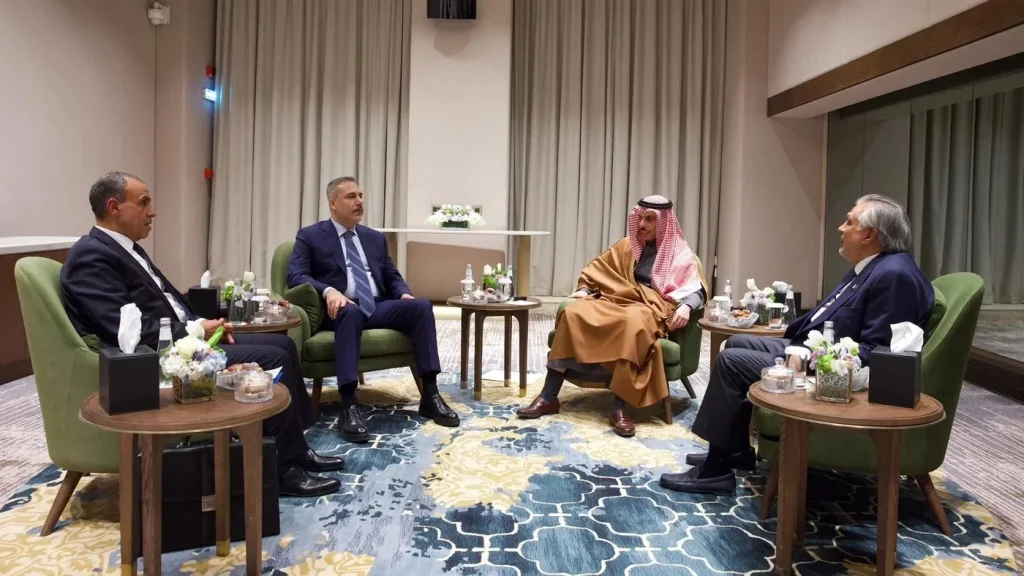
RIYADH (Realist English). Turkey and Pakistan resisted strong language condemning Iran during a meeting of Arab and Muslim foreign ministers in Riyadh last week, reflecting divisions among key regional powers as the conflict involving Iran intensifies, according to multiple sources cited by Middle East Eye.
Saudi Arabia pushed for a firm condemnation of Tehran following missile and drone attacks targeting the kingdom, which Riyadh views as a direct threat to its security and energy infrastructure. A Western official familiar with the discussions said Ankara and Islamabad initially opposed harsh wording but shifted their position after Iranian strikes occurred while diplomats were gathered in the Saudi capital.
According to the sources, Turkey agreed to stronger language only after the attacks on Riyadh, with Foreign Minister Hakan Fidan reportedly telling his Iranian counterpart Abbas Araghchi that Tehran should have halted operations during diplomatic efforts to de-escalate the conflict.
The final statement described Iran’s actions as unjustifiable and called on Tehran to cease attacks and respect international law. However, it did not include a parallel demand for the United States or Israel to halt their operations against Iran. Israel was separately criticized in the concluding sections of the declaration for its actions in Lebanon and broader regional policies.
Diplomatic sources said Turkey played a key role in ensuring that language critical of Israel was included in the final text, reflecting Ankara’s effort to balance its position between regional security concerns and broader political alignment in the Muslim world.
The negotiations underscore differing national priorities among Saudi Arabia, Turkey, and Pakistan, despite earlier discussions on a trilateral security framework. Saudi Arabia, heavily dependent on stable energy flows through the Strait of Hormuz, has taken a more assertive stance toward Iran. In contrast, Turkey’s strategic calculus is less directly tied to Gulf energy routes, while Pakistan faces complex domestic and regional considerations, including its shared border with Iran and internal sectarian dynamics.
The divergence also reflects broader geopolitical pressures. Riyadh is increasingly coordinating with the United States, its longstanding security partner, even as it explores alternative defence arrangements, including a recent pact with Pakistan. At the same time, Washington is reportedly urging Saudi Arabia to take a more active role in operations against Iran.
Pakistan has sought to position itself as a potential mediator. President Shehbaz Sharif said Islamabad is prepared to host talks between the United States and Iran, signaling an attempt to leverage its diplomatic position amid escalating tensions.
Analytically, the Riyadh meeting highlights a fragmentation of regional consensus, with countries calibrating their responses based on immediate security exposure and long-term strategic interests.
The key question is whether these differences will limit the formation of a unified regional approach to the conflict, or evolve into a more flexible coalition structure shaped by shifting threat perceptions and diplomatic opportunities.