


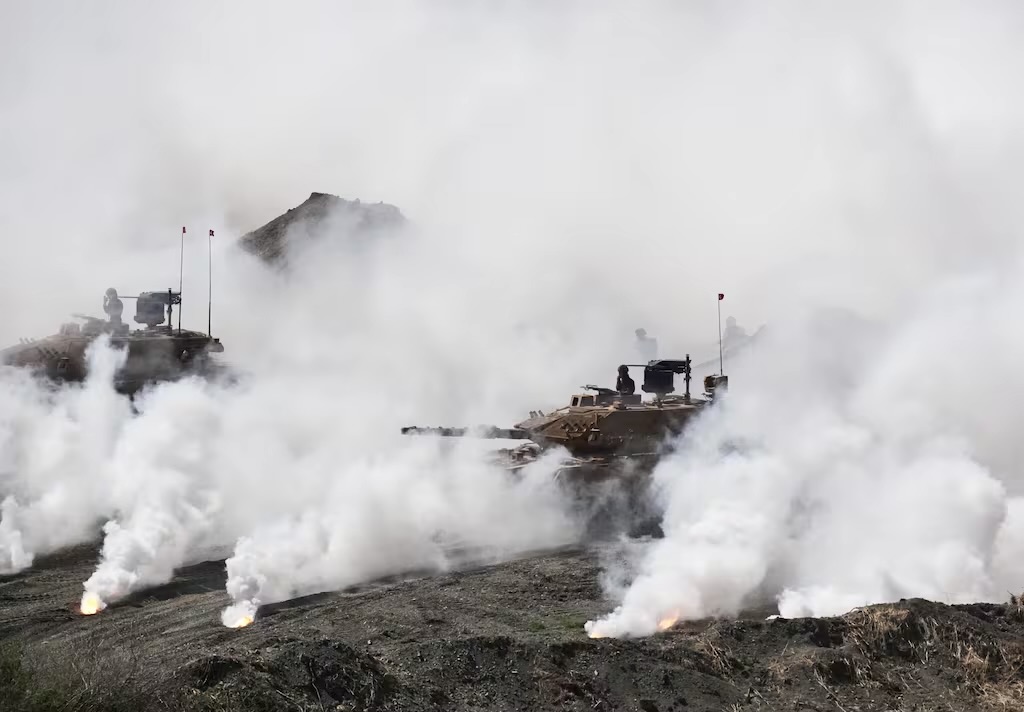
IZMIR (Realist English). Libya and Syria have deployed military contingents to participate in international military exercises outside their own countries for the first time in history. They joined troops from nearly fifty other nations in Turkey’s flagship EFES-2026 exercises on the Aegean coast near Izmir.
Record scale
The active phase of EFES-2026 concluded on May 21. The exercises, organised under the command of the Turkish Aegean Army, involved more than 10,000 military personnel from 50 countries. The manoeuvres included a computer-assisted command post phase in April and live-fire training at the Doğanbey ranges and in the Gulf of Izmir.
The main sensation was the participation of 502 Libyan troops – 331 from the country’s eastern forces and 171 from the west. For the first time in many years, rival factions trained and operated together under a single Libyan flag. Turkish officials described the event as a concrete step toward Ankara’s long‑stated goal of “One Libya, One Army.”
The Libyan personnel received training in amphibious operations, special forces tactics, combat diving, mine and IED awareness, and combat search and rescue. The Libyan patrol craft Shafak, a Combattante II G class vessel, also took part in the naval phase of the exercise.
Syrian debut on the international stage
Approximately 50 troops from the new Syrian army participated in EFES-2026. This marked the first time Syrian forces have taken part in international exercises outside their national territory. Syria’s participation, though smaller in number, carries major diplomatic significance.
Ankara stressed that the presence of both countries is part of its broader military‑restructuring and advisory programmes in Libya and Syria. Officials stated that training and advisory cooperation with both nations will continue and expand.
Growing Ankara‑Tel Aviv confrontation
Even before the war in Iran and Lebanon began, Turkish‑Israeli relations had undergone a tectonic shift from formal partnership to open hostility. In 2025, Ankara imposed a full trade embargo on Israel and closed its airspace to Israeli aircraft. A Turkish court initiated criminal proceedings against Prime Minister Benjamin Netanyahu and 35 other Israeli officials over the interception of the “Sumud Flotilla” in October 2025, demanding life sentences for them.
In response, Israeli ministers publicly call President Recep Erdoğan a “paper tiger.” In April 2026, Turkish Foreign Minister Hakan Fidan directly stated that Israel “cannot live without an external enemy” and was now trying to declare Turkey its new enemy.
Analysts highlight several potential theatres for a direct confrontation. Experts from War on the Rocks believe Syria remains the most likely arena, where Israeli strikes on military targets and declarations of support for Kurdish forces have already been recorded. Particular concern surrounds a possible naval clash in the Mediterranean: Israel seriously considers a scenario in which the Turkish navy might try to forcibly break the blockade of the Gaza Strip, leading to a direct engagement between the two armies on the high seas.
Libya: a test of unification and a tool to pressure Israel
In May 2026, Ankara achieved a historic breakthrough by bringing a united Libyan military contingent to international exercises for the first time. The 502 troops from Libya’s warring eastern and western factions trained together in Turkey’s largest exercises, EFES-2026, mastering modern skills from amphibious and special operations to counter‑mine and search‑and‑rescue drills.
This move is part of Ankara’s long‑standing “One Libya, One Army” strategy. According to the Turkish defence ministry, more than 23,000 Libyan soldiers have been trained since the early 2020s. The presence of Turkish troops has been extended until 2028.
Economic interests also lie behind the military cooperation. Ankara is pushing for ratification of the 2019 exclusive economic zone agreement, which would give it access to large hydrocarbon deposits in the eastern Mediterranean. This directly affects the interests of Israel (together with Greece and Egypt), which views these actions as a threat to its energy sovereignty in the region.
Syria: from enmity to a military alliance against a common enemy
Relations between Ankara and Damascus underwent a radical transformation after the overthrow of President Bashar al‑Assad in December 2024. The new Syrian authorities found themselves politically isolated and faced with the threat of Israeli strikes on their territory.
Under these conditions, an agreement was signed on May 19, 2026, under which Turkey pledged to provide Syria with weapons, military equipment and logistical support. In return, Damascus agreed to allow Turkish aircraft to use its airspace for military operations and granted the Turkish Air Force access to military bases on its territory. The two sides agreed to cooperate on border security and counter‑terrorism.
The practical embodiment of this alliance was the Syrian army’s participation in the EFES-2026 exercises – for the first time in history outside its own territory. On May 21, 2026, Syrian troops, together with NATO and allied forces, trained in modern warfare techniques. The event effectively legitimises the new Syrian army and integrates it into a pro‑Turkish military bloc, which is strongly opposed in Tel Aviv, as it sees Turkey’s growing influence on its northern borders as a direct threat to its national security.
Conclusion: forming a proxy alliance to counter Israel
Using the military‑political vacuum left by Assad’s fall and the protracted crisis in Libya, Turkey has created an arc of tension around Israel. To the north, a military alliance with the new Syria, which receives Turkish weapons and effectively hands Ankara control over its airspace.
To the south, proxy forces in Libya capable of posing additional threats to Israeli energy infrastructure in the Mediterranean. Both countries have become not just partners but instruments of long‑term deterrence against Israel, significantly raising the stakes in any future escalation.