


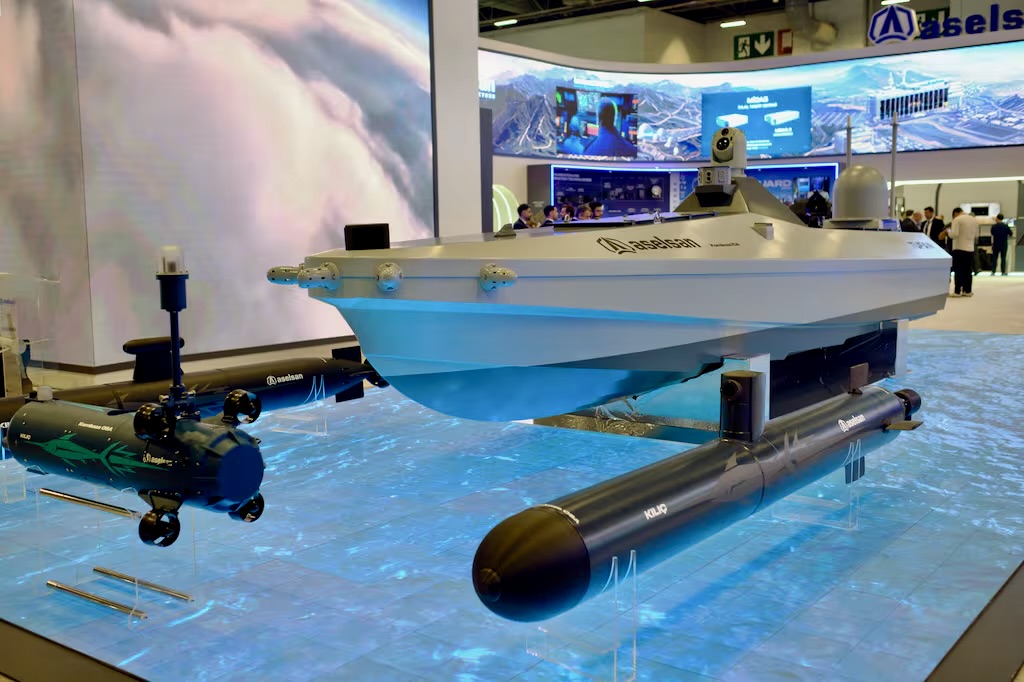
ISTANBUL (Realist English). Turkey has decided to acquire 100 disposable uncrewed surface vessels (USVs) for its navy. According to Defence News, which learned of the plan during the SAHA Expo 2026 defence exhibition held in May, the drones will be used for swarm attacks against naval and coastal targets.
The procurement was approved in February 2026 at a meeting of the Defence Industry Executive Committee, Turkey’s top body for defence procurement and industrial policy. The project is overseen by the Secretariat of Defence Industries (SSB). Production of the 100 one-way explosive USVs is split among three companies.
One of the manufacturers is Aselsan, which has teamed up with Ares Shipyard. At SAHA Expo 2026 in Istanbul they unveiled their joint product, the “Tufan” USV. The second supplier is STM, cooperating with Yonca Shipyard; its one-way explosive USV “Yaktu” was also shown for the first time at the exhibition. The third producer is Havelsan, working with Sefine Shipyard.
The 100 units are allocated as follows: Aselsan will produce 40 vessels, while STM and Havelsan will produce 32 each. The total funding is likely to be adjusted to fit an operational doctrine that calls for four-drone swarm formations.
Vessel specifications
Tufan (Aselsan / Ares Shipyard): length 8 m, beam 1.8 m. Designed to strike maritime and coastal targets. Carries a high-explosive warhead equivalent to one Mk 82 bomb (about 227 kg).
Yaktu (STM / Yonca Shipyard): length 5.8 m, displacement 1.7 t. Developed for asymmetric naval missions ranging from port protection to open-sea strike operations.
Both vessels are one-way precision-strike platforms for engaging surface targets. They feature low-profile hulls to reduce radar and visual detectability. Both systems support line-of-sight (LOS) and satellite communications, enabling integration into network-centric operations. The swarm architecture allows multiple units to operate cooperatively, share real-time data, and autonomously allocate tasks during missions.
Eurofighter and the “People’s Fighter”
Over the past 12 months, Turkey has carried out a wide-ranging modernisation of its armed forces, sealing record contracts for fighter jets, drones and warships.
A key event was the signing on 27 October 2025 of a contract for 20 Eurofighter Typhoon Tranche 4+ jets. The deal with Britain’s BAE Systems is worth £8 billion (about $10.7 billion), the largest UK export contract in this field for two decades. In April 2026, BAE and the SSB signed a training and support contract, enabling the aircraft to enter service by 2030.
In addition, in 2025 Turkey reached agreements with Qatar and Oman to acquire up to 24 used Typhoons of earlier variants. These purchases are seen as a “technology bridge to the sixth generation” and mark Ankara’s first acquisition of major combat aircraft from non-US allies. In April 2025, Turkey also signed an export contract with Spain for 30 HÜRJET advanced jet trainers, worth €2.6 billion.
National fighter KAAN: new contracts
At SAHA Expo in May 2026, a contract was signed for the first 20 serial-production KAAN (TF-X) fighters for the Turkish Air Force. The document also covers the creation of a serial-production infrastructure. Separately, in June 2025, a finalised contract with Indonesia was announced for 48 KAAN fighters worth $10 billion. Indonesian pilots will train in Turkey, and the aircraft are expected to be powered by Turkish engines.
Unmanned aviation: Baykar’s record-breaking deals
The global expansion of Turkish drones continues. The largest deal is a May 2026 Baykar contract with Indonesia for 12 Bayraktar KIZILELMA strike drones. An earlier agreement (2025) covers licensed production of Bayraktar TB3 and AKINCI drones in Indonesia.
Naval forces: towards an ocean-going fleet
The shipbuilding programme has reached record volumes, with 41 warships (including four coast-guard vessels) at various stages of construction. Key projects include:
- Aircraft carrier: In August 2025, a 60,000-tonne carrier was laid down, capable of carrying up to 50 aircraft. Turkey is also developing its own gas turbines for the ship, a critical technological challenge.
- TF-2000 destroyers: Construction of the first air-defence destroyer began in 2026.
- İstif-class frigates: The TAIS shipbuilding consortium won a contract for two additional frigates. In January 2025, the second and third vessels were launched. In January 2026, TAIS signed an agreement with Qatar and Indonesia to build two frigates for the Indonesian Navy, worth $1 billion.
“Steel Dome”: an air-defence giant
The most ambitious project is the creation of an integrated air- and missile-defence system named “Steel Dome”. In November 2025, the SSB and Aselsan signed a $6.5 billion contract for its deployment. The system will include SIPER and HISAR systems, KORKUT batteries, and MURAD radars. Earlier, Aselsan and the SSB had signed an additional $1.9 billion contract for more air-defence systems under the same programme.
Missile and artillery systems
Progress is also notable in missile programmes. In April 2026, President Recep Tayyip Erdoğan announced the start of serial deliveries of the latest missile systems: Tayfun, Siper, Atmaca and Çakır. In May 2025, the US State Department approved the sale to Turkey of 60 AIM-9X Sidewinder Block II missiles ($79.1 million) and AIM-120C-8 AMRAAM missiles ($225 million).
“Swarm” kamikaze fleet: 104 naval drones
In May 2026, it emerged that the Turkish Navy is acquiring 104 kamikaze naval drones capable of operating in swarms. The order is split between Aselsan (Tufan), STM (Yaktu) and Havelsan. Production of the swarm fleet is planned to be completed in the next few years, a move that could significantly change naval warfare tactics.
Defence budget and export records
Funding remains the key driver of Turkish defence industry growth. The defence ministry budget for 2026 is set at $19.08 billion, 7.2% higher than the previous year.
The investments are already bearing fruit: in 2025, Turkish defence exports exceeded $10 billion for the first time, and the target for 2026 is $11 billion. The total value of new contracts signed in 2025 also set a record at $17.8 billion, compared with $10 billion a year earlier.