


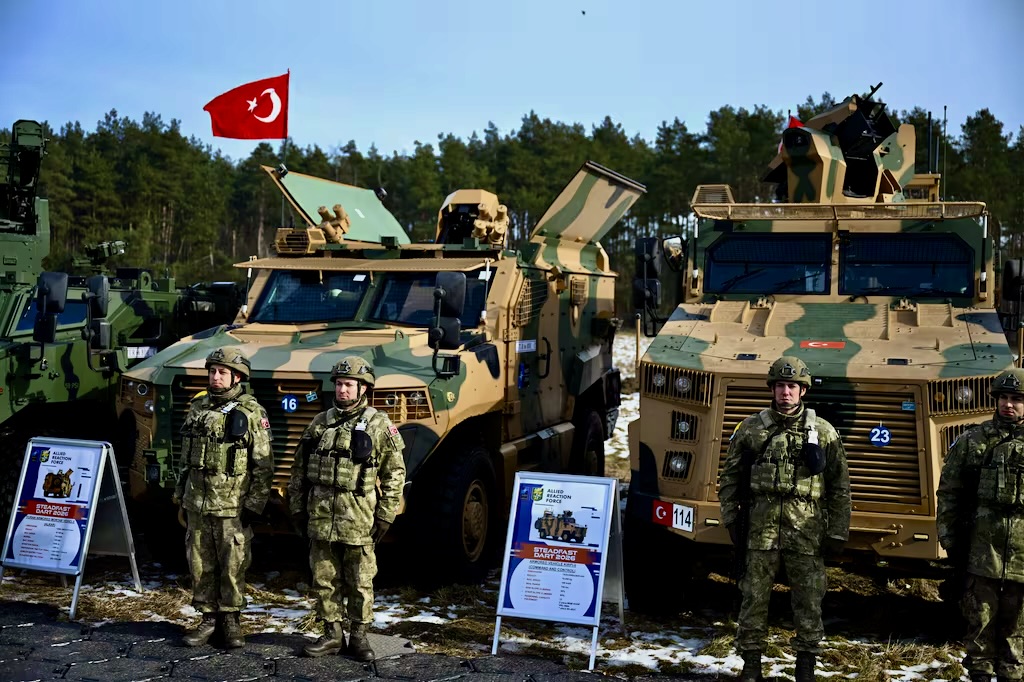
ANKARA (Realist English). Amid the Trump administration’s reassessment of security guarantees for Europe, Turkey has stepped up its efforts to integrate into European defense architecture. Speaking on April 13 at a conference marking the 74th anniversary of Turkey’s entry into NATO, Defense Minister Yaşar Güler criticized the European Union’s reluctance to open its defense initiatives to Ankara.
“Turkey is a central ally, not a flank country.”
Güler stressed that Turkey is no longer a “flank country on NATO’s southeastern periphery.”
“Turkey is a central ally capable of generating security across the entire European theater,” the minister said.
He also warned that the EU’s approach of excluding non‑member allies (including Turkey) from defense initiatives “would cause more harm to Europe’s security and resilience than the reduction of US forces in Europe.”
Ankara argues that it can offer Europe a large standing military, extensive combat experience, strategic geography bridging Europe and the Middle East, and a defense industrial base capable of rapidly producing drones, munitions, armored vehicles and naval platforms.
NATO command and problems with the EU.
Güler announced that Turkey will assume command of NATO’s Allied Reaction Force for the 2028–2030 period. According to experts, this reflects the alliance’s recognition of Ankara’s growing role.
However, Turkey’s integration into EU defense structures faces serious political obstacles. The bloc’s initiatives, such as the PESCO framework and the multi‑billion‑euro European Defence Fund, operate on unanimity, giving Greece and the Greek Cypriot Administration a veto over Turkish participation. Ankara’s application to join the Military Mobility project — one of PESCO’s most operationally significant initiatives — has stalled due to objections from Athens and Nicosia.
Serhat Güvenç, a professor of international relations at Kadir Has University in Istanbul, noted that countries on NATO’s eastern flank (Poland, Romania, the Baltic states, and the Nordic allies) increasingly recognize Turkey’s value amid the need to deter Russia and manage instability south of Europe. However, in Western Europe — especially France and Germany — resistance remains to formally acknowledging Turkey as a central strategic partner.
Iranian threat and position on Russia
Retired Brig. Gen. Hüseyin Fazla, president of the Ankara‑based think tank STRASAM and a former Air Force pilot, highlighted the unique value of the Turkish radar site at Kürecik (central Turkey), which provides ballistic missile early warning coverage significantly deeper than alternative systems in Romania.
“Without Kürecik, European ballistic missile defense against Iranian missiles would start from Romania,” he explained. “Starting from Turkey provides substantially earlier warning and interception opportunity. No European country can simply substitute for that.”
Güvenç noted that Turkey, while maintaining open political and economic ties with Moscow, nonetheless needs NATO’s collective defense umbrella and contributes to plans aimed at containing Russian military adventurism. “This is not cynicism,” he said, “but the behavior of a country managing a genuinely exposed position.”
Article 5 and expectations from the Ankara summit
Güler expressed hope that the upcoming NATO summit in Ankara in summer 2026 would allow allies to reaffirm their commitment to Article 5 of the Washington Treaty (the principle of collective defense). According to the minister, this should serve as the foundation for a future alliance capable of providing a “multi‑dimensional security ecosystem.”
As Defense News notes, Ankara’s strategic logic is straightforward: if Europe is preparing for a future with less American support, then both Europe and Turkey will need each other more.