


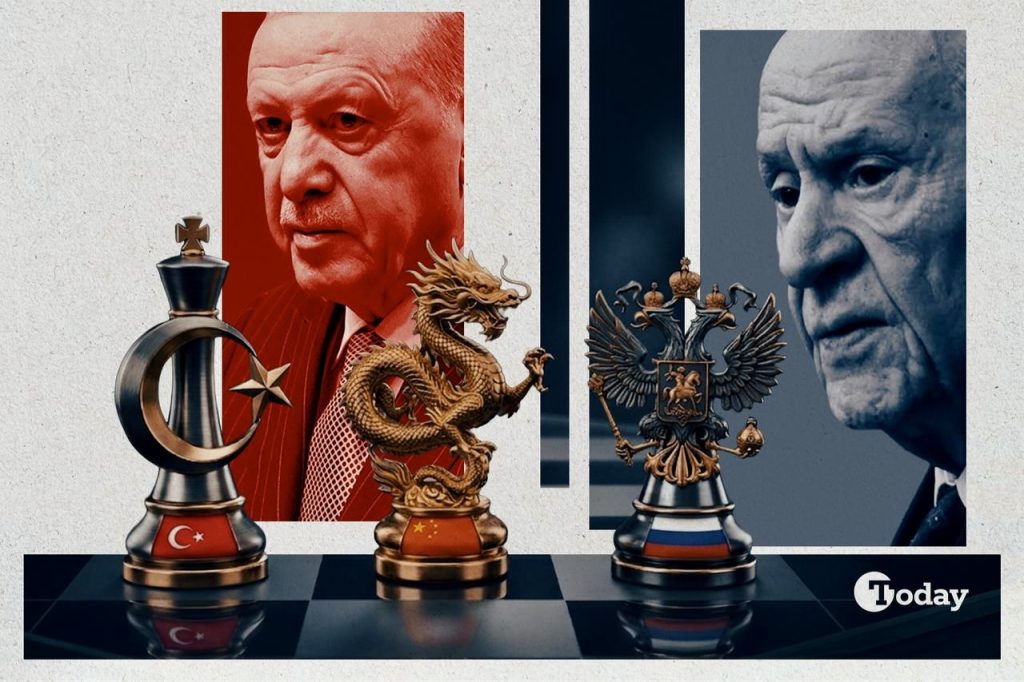
ANKARA (Realist English). The Turkish government’s ally in the ruling coalition — the Nationalist Movement Party (MHP) — has intensified calls for a strategic rapprochement between Turkey and Russia and China. This idea is rapidly becoming one of the most significant foreign policy debates in Ankara’s political circles.
The initiative has gained new momentum from MHP leader Devlet Bahceli, a close ally of the leader of the Turkish regime, Recep Erdogan, as well as other senior party figures. This is not merely rhetorical anti-Western positioning — according to analysts, the project is tied to the party’s long-term strategic expectations ahead of the 2028 elections.
Visit to Moscow and ‘synergy’ of structures
The debate escalated after MHP Deputy Chairman Ilyas Topsakal revealed that in March 2026, on Bahceli’s direct instructions, he traveled to Moscow, where he promoted the idea of a Turkey-Russia-China partnership in meetings with Russian politicians, officials, and intellectuals. According to Topsakal, the MHP is seeking not ministerial positions in the ruling coalition, but the “adoption of a program for cooperation with Russia and China” as its key political expectation heading toward 2028.
The MHP’s plan envisions creating “synergy” among organizations such as the Shanghai Cooperation Organization (SCO), the Commonwealth of Independent States (CIS), the Collective Security Treaty Organization (CSTO), and the Organization of Turkic States. This idea echoes Russian President Vladimir Putin’s long-promoted “Greater Eurasian Partnership” framework.
Notably, Topsakal called the party’s traditional pan-Turkist outlook on the post-Soviet space “romantic” and “no longer relevant,” instead advocating for “synergy between the Russian World and the Turkic World.”
Bahceli: against the US-Israel ‘axis of evil’
Bahceli first publicly proposed a Turkey-Russia-China axis back in September 2025, calling for such an alliance against what he described as a “coalition of evil” led by the United States and Israel. He later expanded the concept by proposing a “World Peace Council” involving Turkey, the United States, Russia, and the European Union.
“Under these circumstances, we propose that, upon the call of UN Secretary-General António Guterres, the United States, Russia, China, Turkey, and the European Union develop a new mechanism under a ‘World Peace Council.’ We believe Turkey could host such an initiative as well,” Bahceli said.
The current surge in activity comes amid deepening global tensions following the war in the Middle East and the widening confrontation involving Iran, the United States, and Israel.
Sharp opposition criticism
The proposal has drawn fierce criticism from the opposition, most notably from leader of the İYİ Party Musavat Dervisoglu.
“Turkey will neither be Moscow’s subcontractor, nor Beijing’s market, nor Netanyahu’s pretext for war, nor a game board for domestic adventurers,” Dervisoglu said in his parliamentary address. He also accused Bahceli of abandoning the ideological legacy of party founder Alparslan Turkes.
“May Allah spare anyone from the unbearable lightness of being educated in Alparslan Turkes’s school in youth and practicing politics on Dogu Perincek’s line in old age,” Dervisoglu said, referring to veteran Turkish politician Dogu Perincek, who has long advocated a strategic alliance with Russia and China.
MHP’s response: realism, not ideological drift
MHP officials quickly rejected the criticism. Party Secretary General Ismet Buyukataman stated that Bahceli’s worldview stems from “correctly reading global realities” and accused critics of failing to grasp the strategic transformations underway in international politics.
Why this matters
Whether the MHP’s proposal evolves into actual policy remains unclear, but the very fact of its advancement is significant for several reasons.
First, timing: the initiative has resurfaced during one of the most volatile regional security environments in years — following the US-Israeli war against Iran, the failure of diplomatic efforts in Islamabad, and growing debate over the possibility of a direct confrontation between Turkey and Israel.
In Turkish strategic circles, the war has reinforced long-standing concerns that in any hypothetical Turkey-Israel clash, Washington would likely side with Israel. This raises questions about the reliability of Turkey’s Western alliances and its room for strategic maneuver.
Furthermore, the debate is unfolding amid renewed uncertainty over the transatlantic security architecture following repeated statements by US President Donald Trump questioning Washington’s commitment to NATO and threatening to reduce or withdraw support for the alliance.
For many in Ankara’s strategic community, such rhetoric has reinforced concerns that Turkey may need to prepare for a less reliable Western security umbrella in the years ahead.
Against this backdrop, the MHP’s call for closer alignment with Russia and China is presented not merely as ideological rhetoric but as a response to a changing geopolitical environment in which Ankara may seek to diversify its strategic partnerships and hedge against strategic isolation.
Contradictions and inconsistencies
Turkey remains a NATO member, and its military infrastructure is closely tied to the alliance. Even if Ankara wanted to pivot toward Russia and China, that would require breaking with the West — which would be economically and militarily suicidal for Turkey.
Moscow and Beijing are unlikely to see Ankara as an equal partner. Russia has dominated the “Russian World” for decades, and China is building its economic corridors without sharing influence. The “synergy” proposal could turn Turkey into a junior partner — or even an appendage.
Independent experts note that the MHP, which is losing electoral support, is thus trying to maintain leverage over Erdogan. The very idea of an alliance with Russia and China is little more than pre-election bargaining. Moscow will likely take the statements as a signal but will not invest resources in a dubious project.