


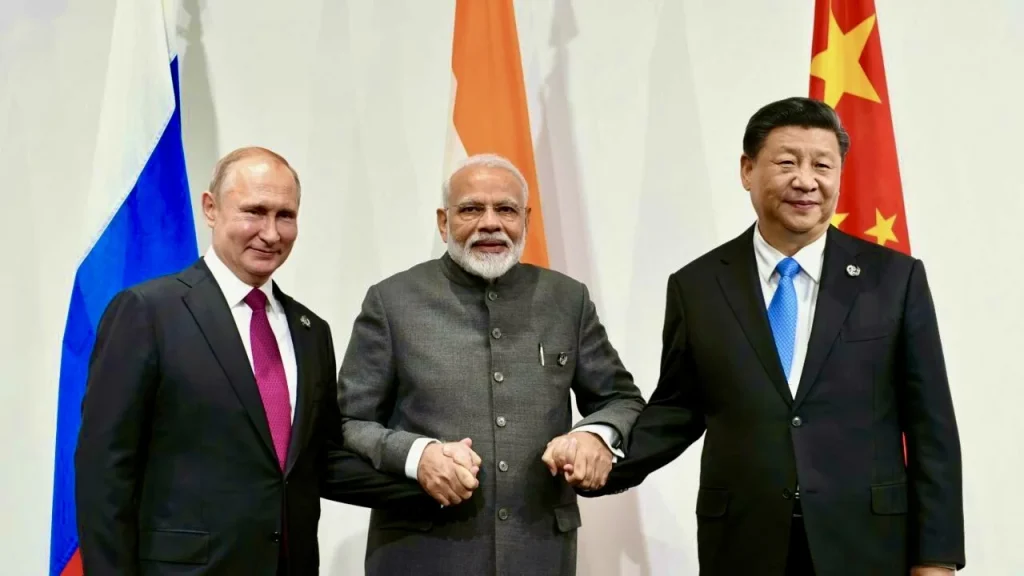
MOSCOW (Realist English). Russia’s strategic “pivot to the East” has helped address immediate economic and logistical challenges but cannot fully replace its ties with Europe, according to political analyst Ilya Grashchenkov.
In an interview with Realist News Agency, Grashchenkov said the shift toward Asia — including closer engagement with China, India and Gulf states — was largely a forced response to geopolitical pressures and sanctions.
“It allowed Russia to rebuild trade routes, establish new logistics chains and partially compensate for lost channels of interaction. As a crisis strategy, it worked,” he said.
However, he argued that eastern partners cannot serve as a full-fledged equivalent to Europe in historical, technological, or institutional terms. While relations with Asian countries are driven primarily by pragmatic economic interests, they lack the depth of the long-standing ties that had developed between Russia and Europe.
“Europe remains a natural and, perhaps, the only key partner for Russia,” Grashchenkov said, noting that despite current tensions, the structural interdependence between the two sides persists.
The comments come amid intensified diplomatic activity between Moscow, Beijing and New Delhi. Russian and Chinese officials have recently discussed expanding cooperation frameworks, while Russia and India have deepened energy ties, including increased oil and liquefied natural gas supplies.
At the same time, Grashchenkov cast doubt on the near-term viability of a multipolar world order centred on groupings such as BRICS. He pointed to the ongoing conflict involving Iran as evidence of the limits of such alignment, noting that Russia has been unable to provide substantial support beyond diplomatic efforts.
“This shows that the multipolar world, as envisioned, remains more a project of the future than a current reality,” he said.
The analyst also highlighted what he described as a potential “window of opportunity” for renewed dialogue between Russia and Europe, though he cautioned that any rapprochement would be gradual and pragmatic rather than a return to previous models of cooperation.
Recent statements reflect this duality. Russian President Vladimir Putin has said Moscow has not ruled out restoring relations with Europe, while some European leaders have signalled interest in revisiting ties, particularly in the context of energy security.
Analytically, the situation underscores a strategic balancing act for Russia — deepening engagement with Asia while maintaining the option of eventual normalization with Europe.
The key question is whether Russia can sustain long-term economic and technological development without reintegration into European systems, or whether geopolitical shifts will eventually reopen a pathway for renewed cooperation.