


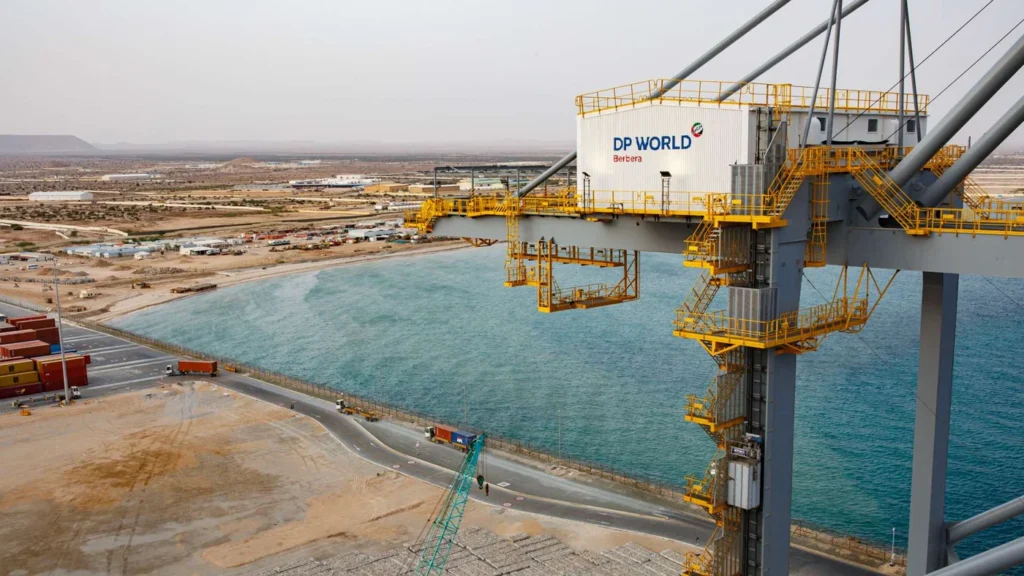
BERBERA (Realist English). The United Kingdom holds a stake in Somaliland’s strategically located Berbera port through British International Investment (BII), which jointly owns the commercial facility alongside the UAE logistics giant DP World and the Government of Somaliland. The arrangement has come under growing scrutiny as regional tensions intensify and the war in Sudan drags on.
Somaliland, a former British protectorate that declared independence from Somalia in 1991 but remains internationally unrecognised, has been thrust into the diplomatic spotlight after Israel last month became the first country to formally recognise its independence — a move widely condemned across the Middle East and Africa.
An impact assessment of BII’s Berbera investment, commissioned by the UK Foreign Office and published last month, described the port as “a strategic gateway to Somaliland and a potential alternative trade corridor for Ethiopia,” whose economy relies heavily on access to Red Sea shipping routes. The report highlighted Berbera’s growing role as a regional rival to Djibouti, which currently handles the vast majority of Ethiopian trade.
However, Britain’s commercial partnership with DP World has raised concerns about a potential conflict between London’s economic interests and its diplomatic stance on the war in Sudan. The UK, alongside the US and the EU, has sanctioned commanders of Sudan’s Rapid Support Forces (RSF) over alleged atrocities in Darfur, including mass killings and attacks on civilians. The RSF is widely accused of genocide, allegations it denies.
The United Arab Emirates, DP World’s home state, has repeatedly rejected claims that it supplies or supports the RSF. Yet diplomats, investigators and humanitarian groups point to mounting evidence — including flight data and cargo records — suggesting that UAE-linked logistics networks across the Horn of Africa have been used to sustain the paramilitary group.
“Britain cannot credibly call for accountability and civilian protection in Sudan while participating in regional arrangements that keep armed actors liquid and mobile,” said Amgad Fareid Eltayeb, director of the Sudanese policy group Fikra.
BII has rejected suggestions of any military linkage, stressing that it is a minority investor in a civilian port facility. A spokesperson said the Berbera project is “entirely unconnected” to nearby Emirati military infrastructure and is intended to support regional development, employment and trade, including a second maritime corridor for landlocked Ethiopia.
Berbera’s geopolitical profile has risen sharply in recent weeks. The port hosted Gideon Saar during his first official visit following Israel’s recognition of Somaliland, amid media reports of discussions over possible Israeli military cooperation. Days later, a vessel carrying Yemeni southern separatist leader Aidarous al-Zubaidi — backed by the UAE — docked in Berbera, prompting Saudi accusations of covert Emirati manoeuvring.
These developments have alarmed regional powers. Foreign ministers from Saudi Arabia, Qatar, Iran, Turkey and several other states issued a joint statement condemning Saar’s visit and reaffirming support for Somalia’s territorial integrity, warning that encouragement of secessionist agendas risks further destabilising an already fragile region.
Since joining the Berbera expansion project in 2022, BII has invested alongside DP World under its “Africa Gateway” partnership, committing $320 million with plans for further funding. The project has included harbour deepening, new quays and modern cargo equipment, creating thousands of jobs and adding tens of millions of dollars to the local economy.
Yet critics argue that Berbera cannot be viewed in isolation. The port sits just 250km from the Bab al-Mandab strait, through which roughly a third of global oil shipments pass, and forms part of a wider network of UAE-linked ports and bases stretching across the Red Sea and Gulf of Aden. Analysts say this infrastructure has become central not only to trade, but also to military logistics, intelligence operations and power projection.
For London, the controversy underscores the difficulty of balancing development finance, strategic partnerships and stated commitments to conflict prevention. “Any British role in Berbera that is not explicitly conditioned on preventing its use in fuelling wars — particularly Sudan’s — will be read not as neutrality, but as complicity by omission,” Eltayeb warned.