


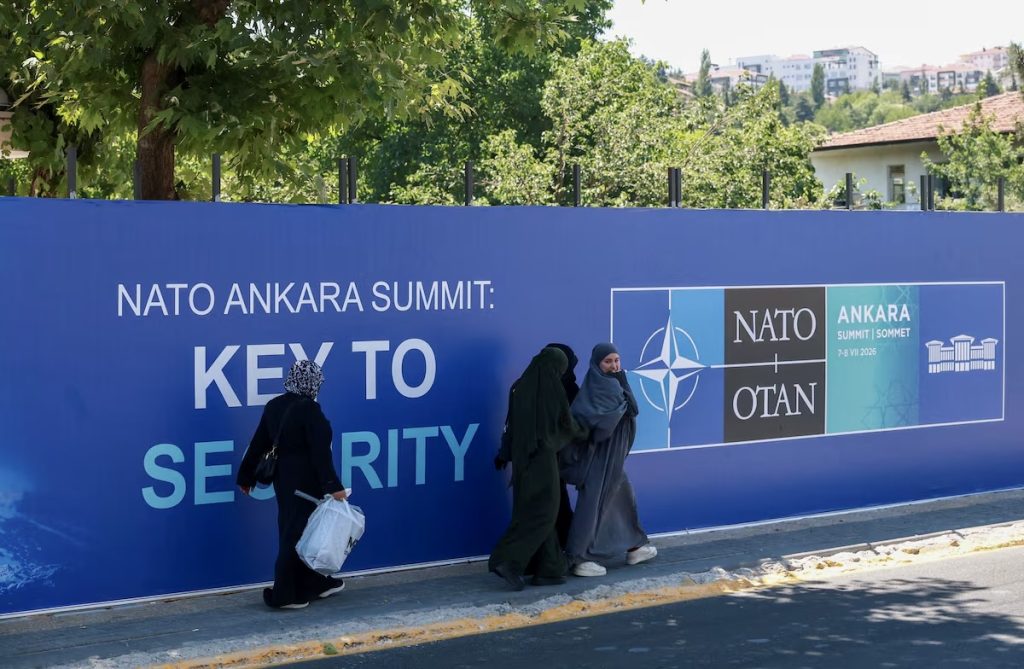
ANKARA (Realist English). One day before the opening of the NATO summit in the Turkish capital — the first NATO summit held on Turkish soil since 2004 — experts and diplomats agree that the main agenda items — Ukraine, Iran and defence spending — will push discussions on the Indo-Pacific region to the sidelines.
Although NATO has stepped up engagement with its Asian partners in recent years, including Japan, South Korea, Australia and New Zealand (the so-called “IP4”), these issues are unlikely to receive due attention at the Ankara summit.
Indo-Pacific: ‘On the Sidelines’ of the Summit
As the South China Morning Post notes, “the conflicts in Ukraine and Iran, as well as Washington’s pressure on European allies to increase defence spending, could reduce discussion of the alliance’s cooperation with partners in the Indo-Pacific region, despite NATO Secretary‑General’s warnings about China’s ties with Russia.”
Japan, whose foreign and defence ministers will travel to Ankara to participate in the summit events, hopes to strengthen cooperation in response to China and reaffirm the understanding that “Euro-Atlantic security is inextricably linked to Indo-Pacific security.” However, analysts note that these issues will remain on the periphery at the summit.
Nevertheless, ahead of the summit, a NATO Parliamentary Assembly report was published examining how the Indo-Pacific region is rising on the alliance’s agenda and offering policy options to strengthen this “increasingly vital transregional partnership.” But at the Ankara summit, these issues are likely to be set aside in favour of more pressing concerns.
Summit Agenda: Ukraine, Iran and the ‘Iron Commitment’
The central issue of the summit will be reaffirming the “unshakeable commitment” to collective defence under Article 5 of the Washington Treaty. According to Reuters, citing a draft final statement approved by NATO ambassadors, alliance leaders intend to enshrine this commitment.
In addition, allies plan to allocate €70 billion ($80 billion) in military aid to Ukraine in 2026 and “at least equivalent amounts” in 2027. The draft statement also includes a separate section on Iran.
As Max Bergmann, director of the Europe, Russia and Eurasia programme at the Center for Strategic and International Studies (CSIS), noted in an NPR interview, the main question for European leaders will be whether “President Trump intends to remain in the alliance.” According to him, a “transition period” has begun in which Europe is taking on more responsibility for its own security, but this process is accompanied by tension and uncertainty.
‘Fuming’ Trump and Pressure on Allies
Which Trump will show up in Ankara is a question troubling all summit participants. The South China Morning Post directly asks this question: “The odds are that it will be the fuming one.” In recent months, the US leader has repeatedly called NATO a “paper tiger,” especially in March, when allies refused to support Washington’s military efforts in the Middle East or help reopen the Strait of Hormuz. In May, the Trump administration announced the withdrawal of about 5,000 US troops from Germany.
According to The Washington Times, Trump views the summit as a “report card” for allies on their promise to raise defence spending to 5% of GDP by 2035. He has repeatedly stressed that the US spends nearly $1 trillion a year on NATO, while allies spend less than $100 billion. “The United States spends more money on NATO than any other country, much more to protect them, without getting any benefit from it,” Trump said on social media last week.
Despite his criticism, Trump will hold a series of bilateral meetings in Ankara. On July 7, he will meet with Turkish President Recep Tayyip Erdoğan, and the following day with Ukrainian President Volodymyr Zelensky and Syrian President Ahmad al‑Sharaa. According to AP, after his meeting with Zelensky, Trump is expected to contact Russian President Vladimir Putin.
The Burden of Spending: Europe Under Pressure
Washington’s main demand remains for allies to meet the commitment to increase defence spending to 5% of GDP. As US Ambassador to NATO Matthew Whitaker stated, Trump “fully expects all allies to immediately step up and get on a path to 5%.” Some countries, including Poland, the Baltic states and Germany, are already close to this target or have “realistic plans” to achieve it.
However, as Pakistan Today notes, not all allies are on track to meet the new targets, and several governments face political difficulties on defence spending. European officials warn that the transition period will take time. At the same time, according to NATO data, European allies and Canada increased defence spending by 20% in 2025 compared to the previous year.
The NATO summit in Ankara will become an arena for addressing three key tasks: reaffirming alliance unity in the face of threats, demonstrating support for Ukraine and finding compromise on defence spending. The Indo-Pacific region, despite its growing strategic importance, will inevitably be sidelined.
The question of which Trump will come to Ankara — a tough negotiator or a pragmatic leader — remains open, but it is already clear that his presence will be the main intrigue of the summit.