


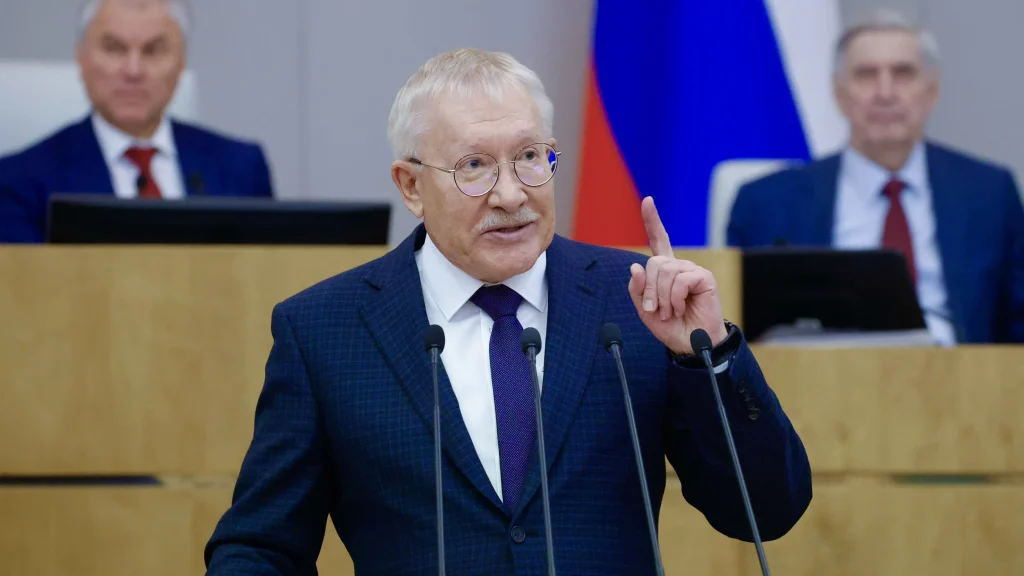
MOSCOW (Realist English). A senior Russian lawmaker has criticized Ukrainian President Volodymyr Zelensky’s visit to Saudi Arabia amid ongoing Iranian strikes, while warning that the broader Middle East conflict could trigger severe global economic disruption.
State Duma deputy Oleg Morozov, chair of the parliamentary control committee, said in an interview with state television that the visit was “illogical,” given that Saudi Arabia is under attack by Iran over its cooperation with the United States. He argued that such moves could further escalate tensions by reinforcing Iran’s perception of hostile alliances.
Morozov also commented on U.S. policy, saying President Donald Trump’s rhetoric about “victory” contrasts with continued hostilities. He suggested that Washington is attempting to measure the conflict in quantitative terms, while Iranian missile attacks continue despite military pressure.
The lawmaker warned that further escalation — including intensified strikes or potential use of more destructive weapons — could deepen the conflict. He highlighted the strategic importance of maritime routes, noting that a closure of the Strait of Hormuz and the Bab el-Mandeb could disrupt up to 35–40% of global hydrocarbon trade and container shipping flows, with significant implications for the global economy.
Alongside Middle East developments, Morozov pointed to shifts in the Ukraine negotiation track. He said recent statements by Zelensky confirm that the United States is linking long-term security guarantees for Kyiv to a withdrawal of Ukrainian forces from Donbas — a condition Ukraine has rejected.
Diplomatic efforts on Ukraine have slowed amid the Iran conflict. A planned round of trilateral talks involving Russia, the United States, and Ukraine has been postponed, although bilateral contacts between Washington and Kyiv continue. Meetings between U.S. and Ukrainian delegations were held in Miami in late March to discuss possible settlement parameters.
Russian Foreign Minister Sergey Lavrov has said Moscow remains committed to prior understandings reached with Washington in 2025, while accusing the European Union and NATO of undermining those efforts.
Divisions within Europe are also complicating the situation. EU member states have yet to agree on a new sanctions package against Russia or additional financial support for Ukraine, with Hungary and Slovakia linking their approval to energy transit issues.
Meanwhile, the war involving Iran has entered its fourth week, drawing international focus away from Ukraine. Despite repeated claims of progress by Washington, hostilities continue, with Iran conducting missile strikes and threatening to restrict key global shipping routes.
Analytically, the overlap of the Middle East conflict and stalled Ukraine negotiations is reshaping diplomatic priorities, fragmenting Western coordination and increasing uncertainty across multiple fronts.
The key question is whether parallel crises will force compromises in Ukraine negotiations, or further delay any settlement as global attention and resources shift toward the escalating conflict in the Middle East.