


KYIV (Realist English). Ukrainian company Fire Point, the manufacturer of the Flamingo cruise missile, plans to create a new air defense system by the end of 2027 that can intercept ballistic missiles at a cost of less than $1 million per interception. This was stated in an interview with Reuters on April 6 by the company’s co-founder and chief designer, Denys Shtilierman.
According to him, Fire Point is in negotiations with European companies on a joint development that would become a low-cost alternative to the American Patriot system, missile supplies for which are rapidly declining due to intensive use in the Persian Gulf zone against Iranian attacks. The European SAMP/T (Italian-French) system is produced in relatively small quantities.
“If we can reduce the cost of interception to less than $1 million, it will be a game changer in air defense solutions. We plan to intercept the first ballistic missile at the end of 2027,” Shtilierman stated.
The Patriot problem and Fire Point‘s proposed solution
The Patriot system (manufactured by Raytheon and Lockheed Martin) often requires two or three missiles to destroy a single ballistic target, each costing several million dollars, the designer explained. The new Ukrainian system aims to radically reduce this cost.
Shtilierman declined to name the European partners but noted that Fire Point is “deeply interested” in collaboration in areas where it lacks expertise: radars, missile guidance systems, and communications. He mentioned companies such as Weibel, Hensoldt, Saab, and Thales as having good radar solutions.
FP-7 and FP-9: two supersonic ballistic missiles
Fire Point is in the final stages of developing two supersonic ballistic missiles. The smaller FP-7, with a range of approximately 300 km (similar to the American ATACMS), is set to be deployed “in the near future.” The larger FP-9, capable of carrying an 800 kg warhead up to 850 km, is preparing for testing. It would place Moscow within reach of Ukraine’s ballistic arsenal.
“Strikes on Moscow would cause a mass shift in the Russian mind and the mindset of Russia’s top leadership,” Shtilierman said.
Although Moscow is protected by one of the world‘s most powerful air defense systems, missile expert Fabian Hoffmann of the Norwegian Defence University College noted that even though Russia has experience successfully intercepting ATACMS, more widespread use of ballistic missiles could stretch Russian air defenses, which have already been weakened by Ukrainian strikes.
Investment from UAE and space ambitions
Shtilierman said Ukraine’s antitrust authorities have until October 2026 to decide on a deal for the acquisition of a 30% stake in Fire Point by a Middle Eastern investor. The deal is valued at $760 million, and the company’s total valuation has reached $2.5 billion.
Ukrainian media identified the buyer as Emirati defense company Edge Group (no official confirmation). The investment would be the first step toward creating a space launch complex in the UAE and a subsequent constellation of low-orbit European satellites.
Fire Point has built a carbon fiber winding machine to create large solid-fuel boosters for satellite launch, although the project is still at the conceptual stage.
Drone and Flamingo exports
Fire Point has already received interest from Gulf states in purchasing its existing drones and is awaiting permission from the Ukrainian government to begin exports. The company has a monthly capacity to export up to 2,500 long-range drones. Exporting the Flamingo missile is much more difficult due to regulatory barriers.
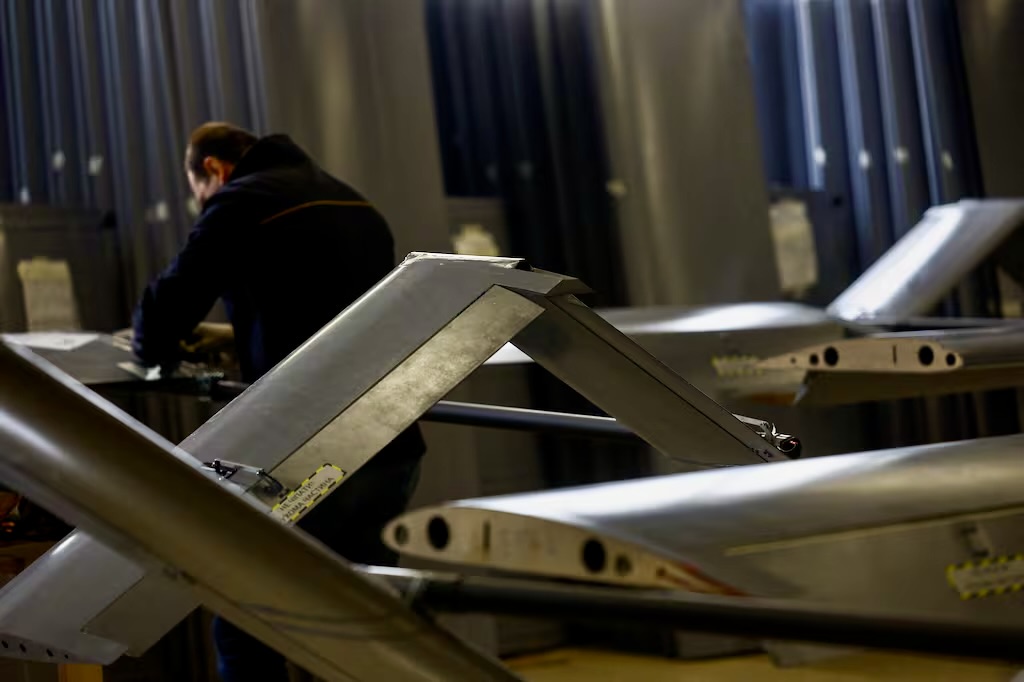
The company produces hundreds of long-range strike drones per day (costing around €50,000 each) and three Flamingo missiles per day (costing around €600,000 each). Shtilierman acknowledged “bottlenecks” in Flamingo production, including engines.
Production increase
He said Flamingo production will increase once a new domestically produced engine enters serial production in October 2026, and a rocket fuel plant in Denmark comes online later this year (the plant is awaiting two final approvals from Danish authorities).
Missile and air defense development
At the end of March, Ukrainian President Volodymyr Zelensky announced that Ukraine’s global goal is to produce all necessary air defense components, including anti-ballistic systems. “Everything, including anti-ballistic, will be provided. We are working to ensure that our Ukrainian production reaches the level where we will have the necessary components of the air defense system,” Zelensky emphasized on March 30.
Ukraine is simultaneously urging its European allies to significantly increase the production of ballistic missile defense systems and has proposed joint defense projects in this critical area, as Europe‘s current output remains critically low.
Supersonic ballistic missiles
Fire Point is in the final stage of developing two supersonic ballistic missiles — FP-7 and FP-9. The smaller FP-7 missile, which has a range of about 300 km, could be used for military purposes “in the close future.” Described as an analogue of the American ATACMS, it has already undergone testing. Mass production of the FP-7 could begin as early as May 2026, according to Shtilierman. The larger FP-9 missile, capable of carrying an 800 kg warhead over a distance of up to 850 km, is expected to move to the testing stage soon.
Air-launched ballistic missile
Ukraine is developing an air-launched ballistic missile (ALBM) derived from the FP-9 system, which would significantly extend the missile‘s range due to the altitude and speed provided by the carrier aircraft. This would allow the launch platform to remain outside the reach of most air defense systems.
Long-range cruise missiles
Ukraine has unveiled a new long-range version of the Neptune cruise missile, with increased dimensions and a modified design. The missile now has a declared range of 1,000 km and has already undergone testing and successful combat use. In March 2025, it was reported that the Long Neptune had reached a range of 1,000 km.
Flamingo cruise missile
Ukraine currently produces three Flamingo missiles per day, but output will rise once the missile switches to a domestically made engine. “When we switch to our own engine, we will produce as many missiles as are ordered,” Shtilierman said. The development of a domestic engine optimized for low-altitude flight is nearing completion. Nearly all components — actuators, engine, antennas, control unit — are Ukrainian.
Drone production
Ukraine plans to produce more than 7 million drones in 2026, according to Deputy Minister of Defense of Ukraine Serhii Boiev. Unmanned technologies have become the basis of asymmetric defense, enabling a strike zone depth of up to 20 km, with the next goal of expanding this zone to 100 km.
Joint production with international partners
- German defense concern Rheinmetall and Ukroboronprom have formed a joint venture to perform repair work on Western equipment.
- Ukraine and the United States plan to jointly produce weapons, particularly air defense systems.
- Ukrainian defense tech company General Cherry and Croatian drone maker ORQA signed a memorandum to expand production in both countries, including plans to build an underground plant in Ukraine for UAV component production.
- Japanese Terra Drone Corporation announced a strategic investment in Ukrainian drone firm Amazing Drones LLC and the joint launch of a new interceptor drone, Terra A1.
- The first Ukrainian defense plant in the United Kingdom began operations on February 25, 2026.
Ukrainian drone production in Germany
Ukraine began producing Ukrainian-made drones in Germany in mid-February. President Zelensky announced that production lines are already operating in the UK and that 10 weapons export centers will be opened across Europe in 2026, specifically in Baltic and Northern European countries.
Arms exports
Ukraine has officially launched arms exports, with the first actual export contracts expected no earlier than the second half of 2026 due to lengthy certification and procurement procedures. Ukraine‘s military production is estimated to have reached $10 billion in 2024, with projections of $15 billion in 2025. With new investment projects, total military production capacity could expand to as much as $50 billion by 2028.