


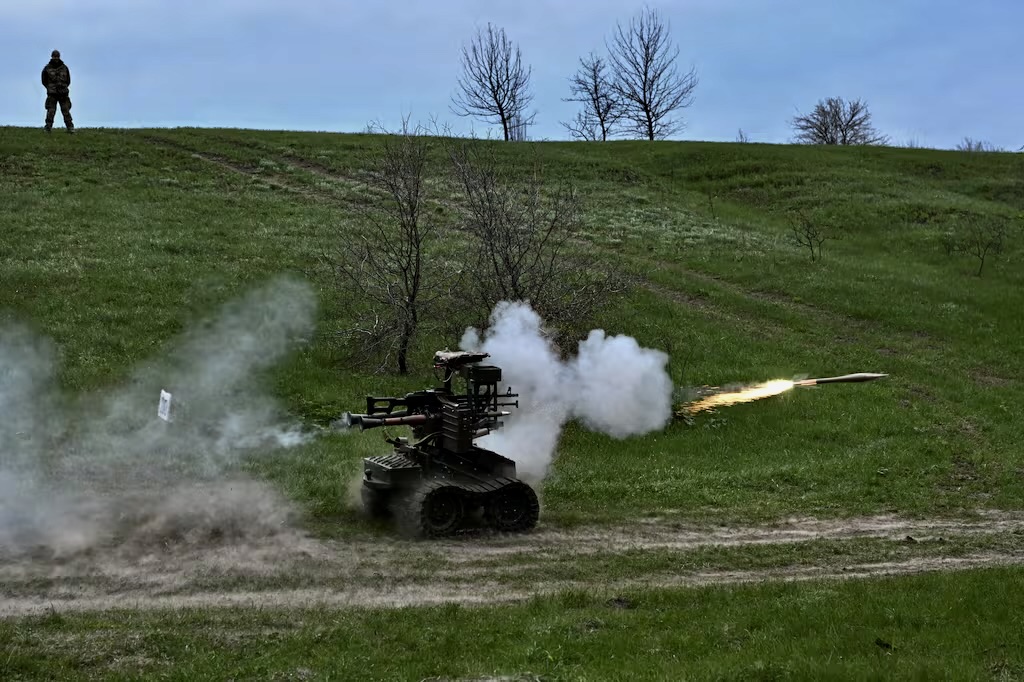
KYIV (Realist English). Ukraine will sign contracts for the supply of 25,000 unmanned ground vehicles in the first half of 2026 — more than double the total for all of 2025. The country’s Defense Ministry intends to fully transfer frontline logistics from soldiers to robots.
Defense Minister Mykhailo Fedorov announced the plan after a meeting with domestic UGV manufacturers last week. He also said that the ministry has already begun signing contracts for 2027 to stabilise long-term production chains.
“UGVs perform important logistics and evacuation tasks on the front line,” Fedorov wrote on Facebook on 18 April. “In March alone, the military conducted more than 9,000 missions using them. Our goal is for 100% of frontline logistics to be performed by robotic systems.”
According to the minister, since January, through a digital procurement system that allows units to order equipment directly from domestic manufacturers, the Defense Ministry has spent more than UAH 14 billion (approximately $330 million) to deliver over 181,000 drones, UGVs and electronic warfare systems to the front.
Days after Fedorov’s announcement, Kyiv codified the Bizon-L — a logistics robot with a payload of 300 kg and a range of 50 km — under NATO cataloguing standards and authorised its operational use by the Armed Forces of Ukraine and allied countries.
President Volodymyr Zelenskyy said in his address on 14 April, on Arms Makers’ Day, that Ukrainian forces had conducted more than 22,000 unmanned missions over the past three months, sparing the same number of soldiers from the most dangerous work of war.
Zelenskyy cited one specific operation. He recounted how last summer, operators from a robotic strike unit within the 3rd Separate Assault Brigade (NC13) used only aerial drones and unmanned ground vehicles to capture a fortified Russian position in Kharkiv Oblast.
Scaling production of tens of thousands of UGVs for deployment along a 1,200-kilometre front line within a year is no easy task, but Ukrainian defence leaders are confident they can do it.
“We have about 300 ground-drone companies in the Brave1 ecosystem, up from zero in 2022,” Brave1 CEO Andrii Hrytseniuk said in February, adding that the organisation had issued 175 grants to ground-drone developers over the same period.
Brave1 is a government-backed defence-tech cluster coordinating grants, testing and frontline feedback for domestic and international manufacturers.
Zelenskyy, in his address, emphasised the priority of defence tech innovation: “This is about high technology protecting the highest value — human life.”
Production scales
Ukraine’s unmanned technology industry has shown rapid growth and by 2026 has become one of the largest in the world. Key indicators and expert assessments point to impressive scales, but also to existing bottlenecks.
Current production volumes (FPV and other UAVs): In 2025, total production capacity for FPV drones reached 8-10 million units. Ukraine’s GDP contracted by 12.3% in 2025. The market volume of the unmanned systems segment in 2025 amounted to $6.3 billion, making it the largest part of the country’s defence market. Approximately 5 million drones of various types were actually produced. These figures are supported by expert estimates: Ukraine produces more drones than any other country in the world.
Plans for 2026: Production is planned to increase to 20 million drones in 2026 — an estimate from the Defence Minister, subject to funding from Western partners. Achieving this will require about €60 billion, more than three times Ukraine’s entire defence budget for 2025. On the front line in 2026, 25,000 ground robots are planned to be deployed, with costs varying significantly depending on complexity and functionality (from $10,000 to $150,000).
Fastest growing market segments:
- Long-range (Deep Strike) drones: Annual growth of 169% (up to 2025). Production capacity could reach $35 billion by 2026. These drones are used to strike targets at depths of up to 1,000 km, and their cost is among the highest in the UAV sector.
- Unmanned ground vehicles (UGVs): This segment grew sixfold over the year to $252 million (as of 2025). Logistics and evacuation platforms account for 61% of this segment, ranging from $50,000 to $400,000.
- Electronic warfare (EW) systems: The EW market grew 3.1 times to $220 million.
- Naval drones: The Sea Baby system costs about $250,000 (2023), but prices are constantly changing depending on modifications (as of 2025).