


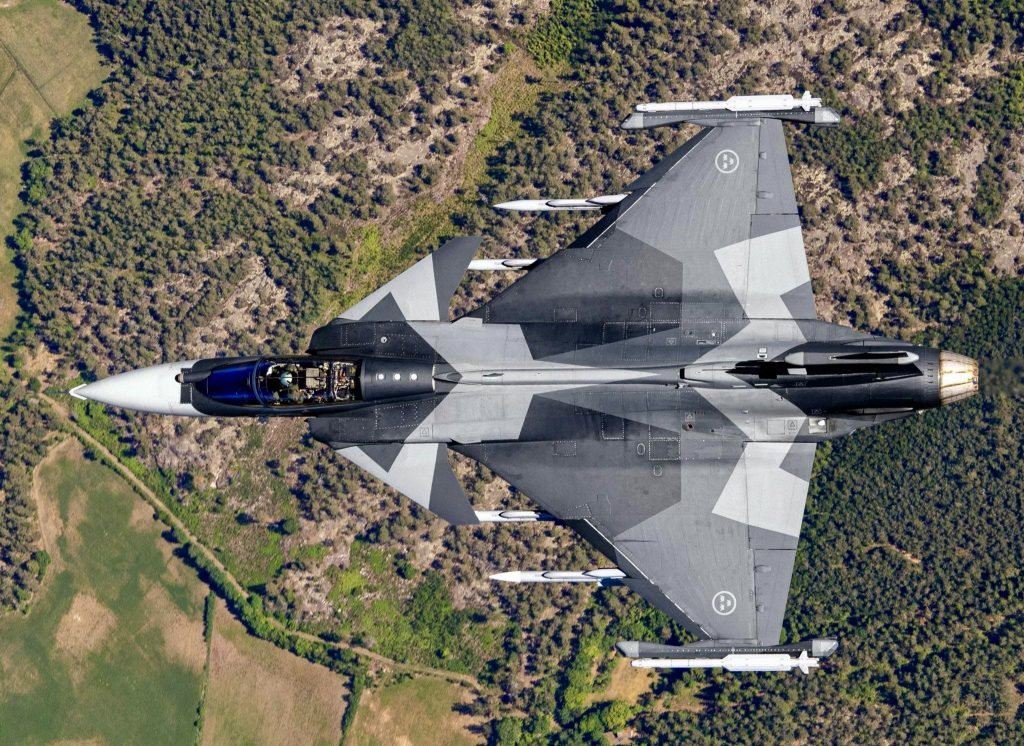
UPPSALA (Realist English). Ukraine will purchase 20 new Gripen fighter jets, and Sweden will transfer 16 older-model aircraft to Kyiv in 2027. This was announced by Ukrainian President Volodymyr Zelensky and Swedish Prime Minister Ulf Kristersson at a joint press conference at the Uppsala Air Base.
“Gripen is the best and optimal choice”
Last year, the two leaders signed a letter of intent paving the way for the sale of up to 150 Swedish Saab Gripen E model fighters to Ukraine. However, deliveries of the new jets are several years away.
“Gripen is the best and optimal choice for Ukraine. Today, we are taking the next major step on this joint journey,” Kristersson said.
“We need these jets, and for us this is really a new page for Ukraine,” Zelensky said, adding that Kyiv intends to purchase all 150 fighters outlined in the letter of intent. “God willing, we will have enough funding for this,” the Ukrainian president noted.
€2.5 Billion from EU Loan
Ukraine has allocated €2.5 billion from an EU loan package worth €90 billion (about $105 billion) to purchase the Swedish aircraft. Deliveries of the new E‑model fighters are expected to begin in 2030.
The transfer of 16 older C/D model fighters will allow Ukraine to temporarily strengthen its air defence in the near term.
Market Reaction and Swedish Aid
Saab’s shares rose 4.4%, making the company the top gainer in Europe. Saab CEO Micael Johansson called the day a “big day” for the company.
“The more countries that select the Gripen fighter … and the more it starts flying in operations in more countries, the more people understand what a fantastic capability this is,” Johansson said.
Sweden is one of the largest donors to Ukraine. To date, Stockholm has sent Kyiv military and civilian aid worth 128 billion Swedish kronor (about $13.75 billion). A further 80 billion kronor has been set aside for aid this year and next.
Why Gripen?
The Ukrainian Air Force currently consists of a mix of Soviet‑made and Western aircraft. The Gripen is seen as a cost‑effective alternative to more advanced fighters like the US F‑35, as it is simple and quick to maintain and can operate from dispersed air bases, including ordinary roads.
For Sweden, the deal also offers an opportunity to leverage its powerful defence industry, which has seen a surge in demand since Russia’s invasion of Ukraine.
Major Milestones in Bilateral Military Cooperation
The volume of military support from Stockholm to Kyiv since 2022 has exceeded €9 billion (about 98 billion Swedish kronor) and continues to grow. Over this period, cooperation has evolved from the delivery of helmets to large‑scale programmes supplying modern weapons systems and joint production.
Military cooperation since February 2022 has passed through several key phases:
- Initial phase (2022–2023): Emergency military aid, including anti‑tank weapons, ammunition and personal protective equipment.
- Systemic support phase (2024–2025): Transition to long‑term planning and deliveries of heavy weapons, including artillery and armoured vehicles.
- Strategic partnership phase (2026): Signing of major contracts for fighter jet deliveries and deepening of industrial cooperation.
The structure of Swedish aid to Kyiv includes both direct funding and weapons deliveries:
- 2022–2023: Total aid — about €2.6 billion, of which approximately €2 billion was military support.
- 2024–2026: A three‑year plan allocates €6.5 billion for military needs.
- 2026–2027: An additional long‑term package worth 80 billion Swedish kronor for military needs.
- 2026: The most significant, the 22nd military aid package worth 25.2 billion kronor, including funding for fighter jet purchases.
“Ukraine is fighting not only for its own freedom but also for ours. Our support will not cease,” Swedish Prime Minister Ulf Kristersson said when signing a bilateral security agreement on May 31, 2024.
Key Weapons Deliveries
Stockholm has transferred a wide range of modern weapons to Kyiv, many of which have been highly praised for their combat qualities. The supplied equipment is being actively used at the front and has helped strengthen the firepower of the Ukrainian Armed Forces.
- Armoured vehicles: CV90 infantry fighting vehicles, Stridsvagn 122 tanks (a Swedish modification of the Leopard 2).
- Artillery: Archer self‑propelled howitzers (including an additional 18 new systems), ARTHUR counter‑battery radar systems.
- Air defence: ASC 890 airborne early warning and control aircraft, Tridon anti‑aircraft artillery systems.
- Naval equipment: Combat Boat 90 (CB90) assault craft, coastal surveillance systems.
- Weapons and other equipment: NLAW anti‑tank systems, 155 mm artillery shells, unmanned aerial vehicles, electronic warfare systems, radars and ammunition.
Combat Experience as a Driver of Modernisation
The combat use of Swedish weapons in Ukraine has become a valuable source of information for their further improvement. Swedish Defence Minister Pål Jonson confirmed that feedback from Ukrainian troops is helping to adapt equipment to modern warfare conditions.
“The Ukrainians are very generous with their feedback, allowing us to test weapons in combat conditions and adapt them better,” he noted in an interview with Lithuanian television channel LRT.
According to him, “helping Ukraine is both right and wise.” “It is an investment in our own security, because today Ukraine is a shield against Russian military expansion,” Jonson added.