


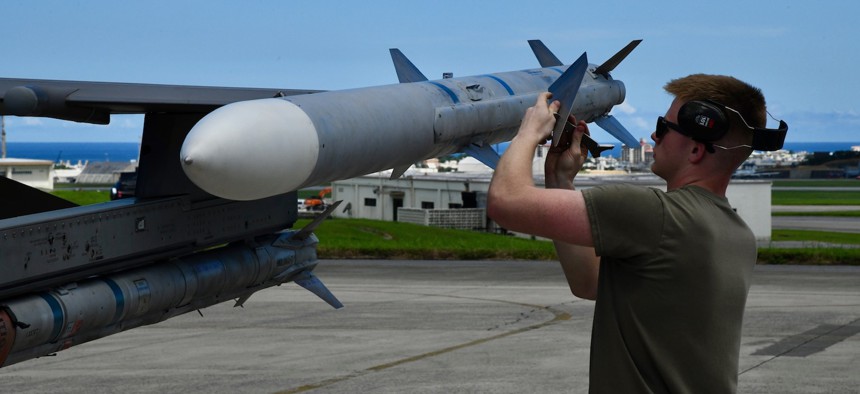
WASHINGTON (Realist English). The US Air Force is soliciting industry proposals for a new $500,000-per-unit counter-air missile, part of an effort to create a highly producible, modular weapon that could later evolve into a low-cost air-to-air missile. The request for white papers, posted Nov. 7 on SAM.gov, outlines the initial phase of the Counter-Air Missile Program (CAMP).
According to the Air Force Life Cycle Management Center, the program’s top priority is developing “an affordable, open-system, modular and highly producible ground-launched capability.” The service plans to begin with a ground-launched prototype—a testbed for new subsystems and manufacturing methods—before transitioning the technology into “future affordable air-to-air missile capabilities.”
Phase One, to be completed within two years, would deliver and demonstrate the initial ground-launched prototype. Phase Two would formalize the missile as a program of record, with later phases converting it into an air-to-air variant. Companies must submit their concepts by Dec. 2.
While the Air Force has not released technical specifications, the notice states the service is prepared to trade high-end performance for affordability and mass production, targeting 1,000–3,500 missiles annually at full-rate output.
Cost questions linger
The proposed unit cost—about $500,000—is lower than the AIM-120D AMRAAM (roughly $1 million) and comparable to the AIM-9X Sidewinder (approximately $472,000), according to War Zone estimates. But it remains far above the Air Force’s cheapest counter-drone solution: APKWS II rockets, whose most expensive components cost between $15,000 and $20,000.
Traditional Tomahawk cruise missiles, by comparison, run about $2.2 million each.
The Air Force has not yet clarified how the new system would integrate with its current mix of air-to-air, counter-drone, and cruise-missile capabilities, and service spokespeople did not respond to questions about cost-benefit considerations.
Backed by new funding and Pentagon pressure
The request follows the summer passage of a reconciliation bill that earmarked $250 million to develop and procure low-cost counter-air systems. It also coincided with a speech by Defense Secretary Pete Hegseth, who urged US defense firms to accelerate innovation and production.
“This effort follows the strategic direction of the Department of Defense to innovate warfighter advantage, accelerate production, and deliver at scale,” the notice states.
The proposed missile would join the Air Force’s emerging Enterprise Test Vehicle (ETV) family of low-cost cruise missiles, developed with support from the Defense Innovation Unit (DIU). Two companies — Anduril and Zone 5 Technologies — have advanced to the second phase of the ETV effort and are preparing for live-fire testing this summer, DIU announced in September.