


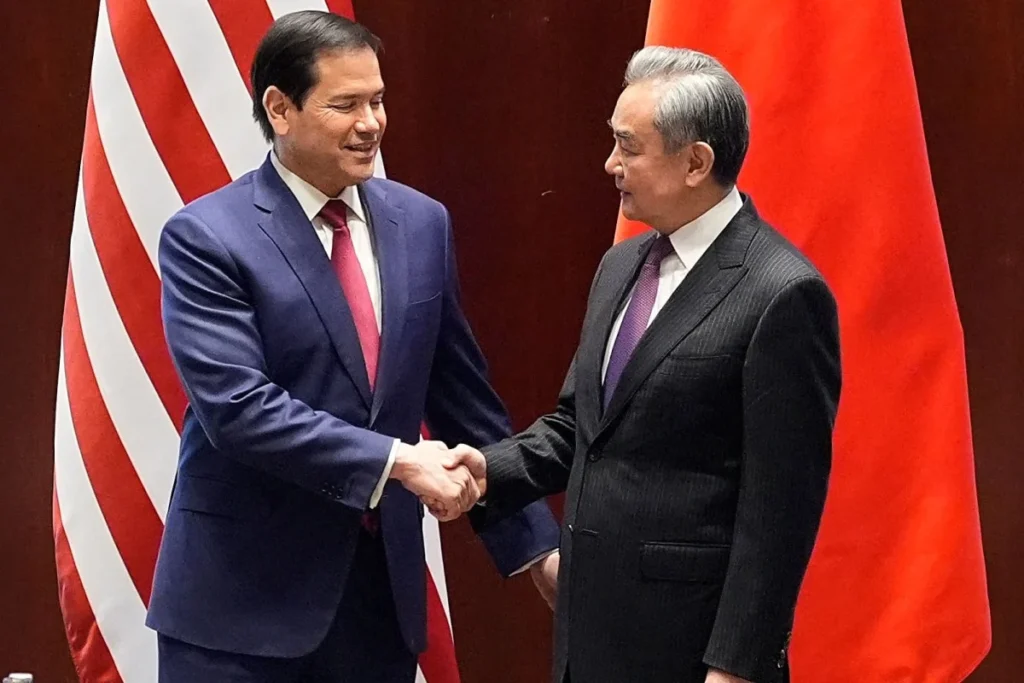
MUNICH (Realist English). The United States and China signaled a willingness to manage their strategic rivalry during back-to-back speeches at the Munich Security Conference on Saturday, even as their top diplomats exchanged pointed criticism over global flashpoints.
US Secretary of State Marco Rubio and Chinese Foreign Minister Wang Yi both emphasized the need to avoid direct confrontation between the world’s two largest powers. The remarks come amid a relative easing of tensions that could see President Donald Trump visit Beijing in April.
Rubio said it would be “geopolitical malpractice” for Washington not to engage with Beijing, acknowledging that the two countries’ interests would frequently diverge. “We owe it to the world to manage those differences as best we can, avoiding conflict — economic or worse,” he told the conference, while cautioning that no fundamental reset in bilateral ties should be expected.
Wang struck a similarly measured tone, welcoming what he described as respectful remarks by Trump toward President Xi Jinping and the Chinese people. He said cooperation between the two presidents could improve relations, but warned that attempts to support Taiwan’s political separation from China would cross Beijing’s “red lines” and risk pushing the two countries toward conflict.
The exchange underscored the fragility of the current détente, which followed a meeting between Xi and Trump in Busan last October after months of tariff escalations and export-control disputes.
Rubio also used his speech to criticize what he described as actors who “threaten our citizens and endanger global stability while shielding themselves behind abstractions of international law.” Though he did not name China directly, the comments were widely interpreted as a reference to Beijing.
On broader international governance, Rubio questioned the effectiveness of the United Nations, arguing that while it retains potential, it has failed to provide solutions to pressing crises such as Gaza and Ukraine. Wang, by contrast, reaffirmed China’s support for the UN, describing it as the most representative and authoritative global institution.
Tensions over Taiwan surfaced prominently. Wang criticized remarks by Japanese Prime Minister Sanae Takaichi suggesting that a Taiwan contingency would constitute a security emergency for Japan. Beijing considers Taiwan a part of China and has not ruled out the use of force to achieve reunification, while the United States and Japan oppose any unilateral attempt to change the status quo by force.
Both diplomats also addressed Europe directly, reflecting shifting transatlantic and Eurasian dynamics. Rubio urged European allies to strengthen defense capabilities and align with Washington’s vision of a renewed Western partnership. Wang rejected the framing of China as Europe’s adversary and encouraged European leaders — including French President Emmanuel Macron — to maintain dialogue with Russia over the war in Ukraine.
“Europe should not be on the menu, but at the table,” Wang said, welcoming diplomatic outreach to Moscow.
The Munich exchanges highlighted a dual reality in US-China relations: open rivalry combined with an effort to prevent escalation. While rhetoric on sovereignty and global order remains sharp, both sides signaled that direct communication remains essential in managing a competition that increasingly shapes global security and economic stability.