


TEHRAN (Realist English). The two-week ceasefire between the United States and Iran, announced on the evening of April 7, remains in force despite serious tensions. On April 9, significantly fewer attacks were recorded in the region, and the sides are preparing for talks in Islamabad, set to begin April 11.
Fragile ceasefire and strikes on Lebanon
The main threat to the agreement has been Israel’s actions in Lebanon. On April 8, the IDF carried out the heaviest strikes since the start of the war on Hezbollah targets, resulting in dozens dead and hundreds wounded, according to Lebanese authorities. Iran insists that Lebanon is included in the ceasefire terms.
EU foreign affairs chief Kaja Kallas, speaking in a CNN interview on April 9, stated that, according to her information, the Pakistan-brokered agreement should also extend to Lebanon. “If it does not yet cover Lebanon, then it should be covered now. It is clear the ceasefire is fragile, and we must do everything to ensure it holds,” Kallas said, calling on Israel to stop the heavy bombardment.
The US and Israel, by contrast, claim the agreement does not apply to Iran-backed Hezbollah in Lebanon. US President Donald Trump said on April 9 that American forces would remain “in place” until a full agreement with Iran is reached. He added that if a deal is not reached (which he called “highly unlikely”), then “the shootin’ starts again.” Vice President JD Vance, special envoy Steve Witkoff, and Jared Kushner will travel to Islamabad for talks beginning April 11.
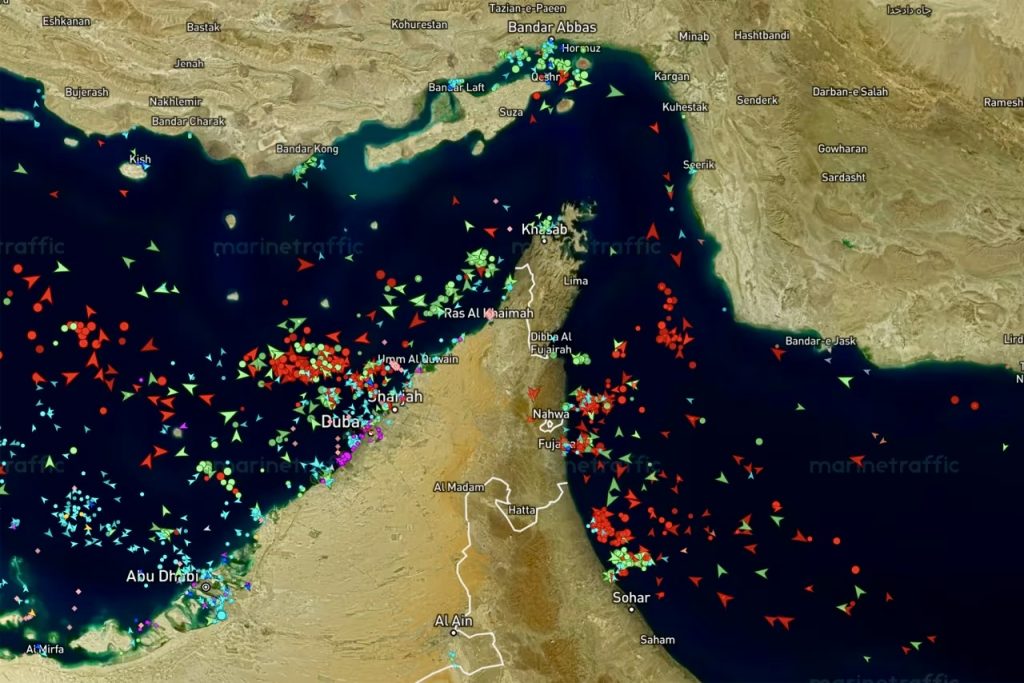
Situation in the Strait of Hormuz: passage restricted, but occurring
Iran’s Islamic Revolutionary Guard Corps (IRGC) claimed on April 9 that shipping through the Strait of Hormuz had been halted following the Israeli attack on Lebanon on April 8, which Iran considers a violation of the ceasefire.
However, satellite tracking data contradicts this claim. MarineTraffic reported that on April 8, two vessels passed through the strait – one Greek-flagged and one sailing under the Liberian flag. Lloyd’s List analysts later specified that three vessels had passed, “all with current or past links to Iran,” and three more were either positioned to cross or heading for the Iran-approved detour around Larak Island. Reuters, citing shipping data, reported on April 9 that six vessels had sailed through in the previous 24 hours.
UAE Minister of Industry and Advanced Technology Sultan Al Jaber called on Iran to open the strait “fully, unconditionally and without restriction.” “Energy security and global economic stability depend on it,” he wrote on LinkedIn, adding that “an estimated 230 vessels sit loaded with oil and ready to sail.”
EU foreign chief: criticism of Europe is “unfair.”
Kaja Kallas also responded on April 9 to criticism from the Trump administration and some Gulf officials that Europe had not done enough to support them during the war with Iran. “I feel that this is really unfair,” she told CNN.
Kallas reminded that Gulf countries largely failed to come to Europe’s aid when Russia invaded Ukraine in 2022. “We haven’t seen really the Gulf countries helping us there, whereas it can’t be only one-way street. If we would be in it together like our adversaries clearly are, then we would be much stronger,” she said. At the same time, she confirmed that the EU is doing “a lot,” including supplying air defense systems to the region, protecting the Red Sea, and supporting the Lebanese government.
Hack attack on former Israeli military chief
The hacker group “Handala,” believed to be linked to the Iranian government, claimed on April 9 to have breached the devices and accounts of former Chief of Staff of the Israel Defense Forces, Lt. Gen. Herzi Halevi (who served from 2023 to 2025). The group published dozens of photos and documents they say prove the intrusion. In a statement, Handala said it had extracted “more than 19,000 confidential images and videos from the most secret meetings” of Halevi.
Among the published materials are photos of Halevi’s and his wife’s ID cards, images from military bases, high-level meetings, and personal family scenes. A source familiar with the matter confirmed the authenticity of the photos to CNN. Halevi’s representative declined to comment. Handala is behind the hack of FBI Director Kash Patel’s personal email last month, as well as attacks on several senior Israeli officials.
US gas prices inch up despite oil plunge
The average US gasoline price on April 9 rose slightly to $4.17 per gallon, according to AAA data. This occurred despite a sharp drop in oil prices on April 8 (WTI fell 16.4%, Brent 13.3%) following the announcement of the ceasefire and plans to reopen the Strait of Hormuz. Analysts explain that retail prices take time to react to wholesale changes. The average price is expected to fall back below $4 per gallon in one to two weeks, and to pre-war levels around $3 in several months. Since the start of the war, US gasoline prices have risen by $1.18 per gallon, or 40%.
Elimination of Hezbollah deputy chief’s associate
The Israel Defense Forces reported on April 9 that it had killed the personal secretary and nephew of Hezbollah deputy chief Naim Qassem. The IDF described him as “a close associate and personal adviser” to Qassem. Details of the operation were not disclosed.