


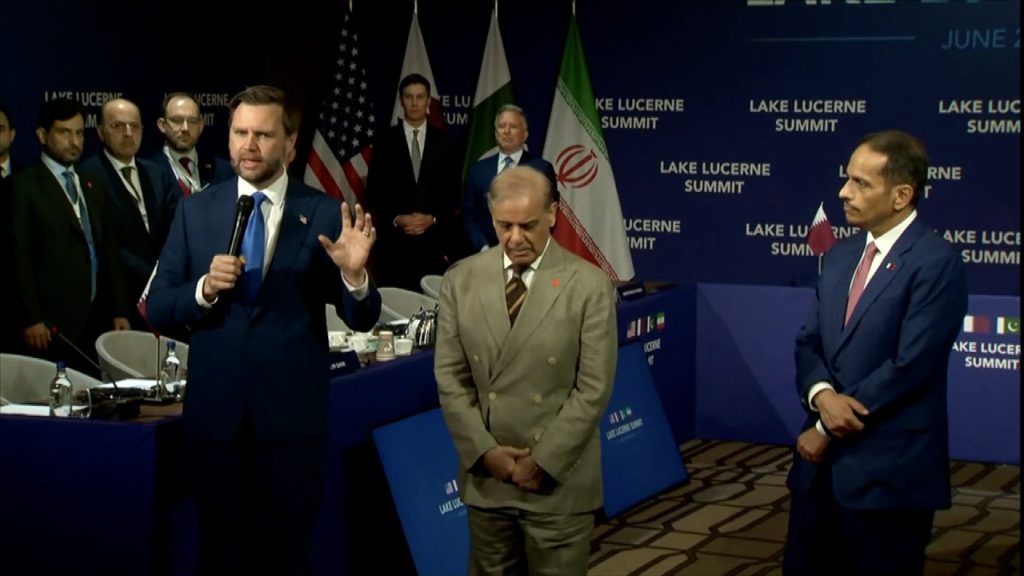
BÜRGENSTOCK (Realist English). The first round of direct talks between the United States and Iran at the Swiss resort of Bürgenstock concluded with the signing of a joint statement by the mediators — Qatar and Pakistan — who reported “encouraging progress.”
The parties agreed on a “roadmap” to reach a final agreement within 60 days, established a communication channel to prevent incidents in the Strait of Hormuz, and agreed to create a “de‑confliction cell” to ensure the cessation of military operations in Lebanon.
The talks, which lasted late into the night, began with a turbulent start triggered by new threats from US President Donald Trump directed at the Iranian delegation.
Trump’s Threats Nearly Derailed the Start
Even before the first round of talks began, President Trump, in an interview with Fox News and in posts on his Truth Social platform, threatened Iran with new strikes if Tehran did not stop supporting its allies in Lebanon.
“Iran must immediately stop its highly paid PROXIES in Lebanon, who are causing problems. If they do not, we will strike Iran very hard, like last week, only STRONGER!!!” Trump wrote.
Trump also warned that the US could take control of the Strait of Hormuz and impose fees for shipping if no agreement was reached, telling Iranian officials: “If you close the Strait of Hormuz, nothing will be left of your country.”
The statements drew a sharp reaction from Tehran. The Iranian semi‑official Tasnim news agency reported that the Iranian delegation left the negotiating table and refused to return to the meeting room, insisting that the implementation of previously agreed obligations — including the unfreezing of assets and the issuance of permits for Iranian oil exports — must precede substantive talks on the nuclear programme.
Head of the Iranian delegation, Parliament Speaker Mohammad‑Bagher Ghalibaf, responded to Trump’s threats by saying: “Do they really think that if their threats had any effect, they would not be in today’s desperate position?” “It doesn’t matter what they say, we act.”
However, US officials categorically denied reports that the talks had collapsed. “The Iranians never left the talks, they are still here, meeting and negotiating far past midnight,” a US diplomat said. According to CNN and Axios, the parties intended to work “all night.”
Roadmap and Concrete Results
Despite the scandalous start, the talks ended with concrete results. In a joint statement by Qatar and Pakistan, published on the morning of June 22, it was reported that “the summit on Lake Lucerne took place in a positive and constructive atmosphere.”
Key achievements:
- Communication channel for the Strait of Hormuz: The parties established a direct line of communication to prevent incidents and misunderstandings, aimed at ensuring the safe passage of commercial vessels through the Strait of Hormuz. The US made it clear that it wants the strait to remain fully open.
- De‑confliction cell for Lebanon: The parties agreed to establish a mechanism involving Lebanon, with Qatar and Pakistan as mediators, to ensure compliance with the cessation of military operations in Lebanon.
- 60‑day roadmap: A high‑level committee agreed on a plan to reach a final agreement within 60 days. Technical talks will continue this week in Bürgenstock.
- High‑level oversight committee: A high‑level committee was established for political oversight of the mediation process.
Iranian Foreign Minister Abbas Araghchi stated on social media platform X that Iran had secured permits for oil and petrochemical exports, the lifting of the blockade, the release of part of its frozen assets, and the launch of a plan for the reconstruction and development of Iran.
The Lebanese Issue as a Key Challenge
The Lebanese problem remains the main stumbling block. Iran justified its decision to block shipping through the Strait of Hormuz by saying that the US had not fulfilled its commitments to cease hostilities in Lebanon. Iran insists that talks will not progress until the Lebanese issue is resolved.
Despite the ceasefire announced on June 19 between Israel and Hezbollah, fighting continued. Israeli Prime Minister Benjamin Netanyahu said that Israeli troops would remain in southern Lebanon “as long as necessary.” However, by Sunday evening, there were no reports of new Israeli strikes or ongoing fighting.
US Vice President JD Vance, who headed the American delegation, called the meetings “historic” and urged against dramatising the situation. “These things are always a bit messy,” he told journalists, describing the talks as the beginning of a long technical process rather than a one‑day event.
Markets reacted positively to the news of progress: Brent futures fell more than $1 to $79.44 a barrel.