


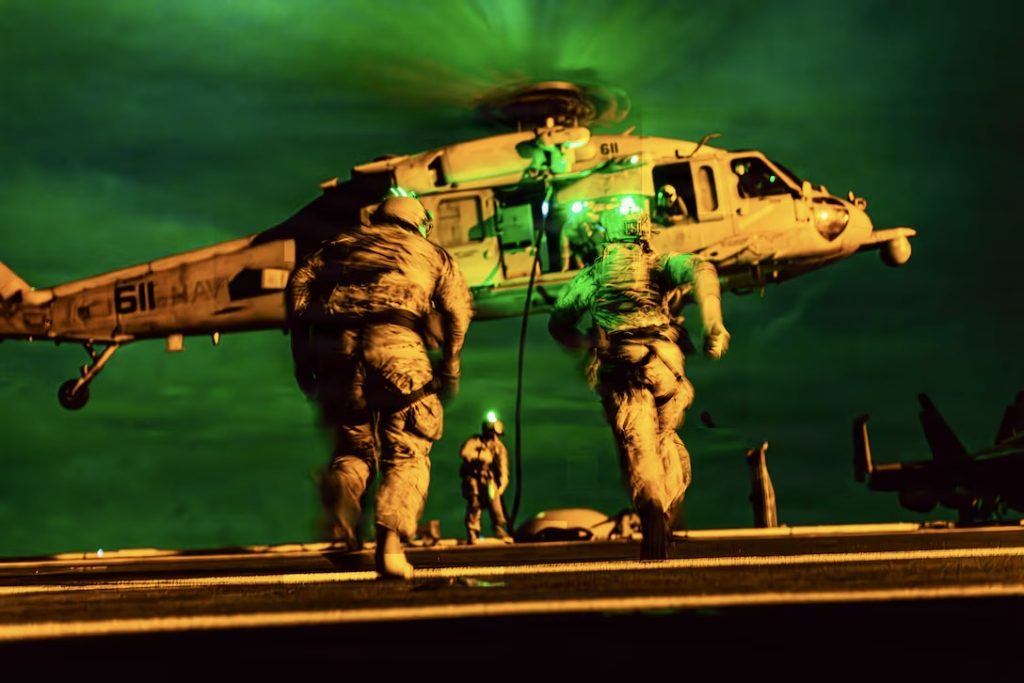
TEHRAN (Realist English). The United States has launched a new series of “powerful” airstrikes on Iranian targets in response to attacks on three commercial vessels in the Strait of Hormuz.
According to US Central Command (CENTCOM), more than 80 targets were struck during the operation, including over 60 small boats belonging to the Islamic Revolutionary Guard Corps (IRGC).
The strikes targeted Iranian air defence systems, coastal radar stations, anti-aircraft missile launchers, anti-ship cruise missiles and drone launch sites. Iranian state media reported explosions in the port city of Sirik, on Qeshm Island and in Bandar Abbas.
Timeline: From Tanker Attacks to Exchange of Strikes
The escalation began on July 6–7, when three tankers were attacked in the Strait of Hormuz within 24 hours. According to the UK Maritime Trade Operations (UKMTO), the vessels sustained damage from “unknown projectiles.”
Among the affected vessels were the Qatari LNG tanker Al Rekayyat, which caught fire in its engine room, and the Saudi supertanker Wadyan.
Qatar officially blamed Iran for the attack, summoning Iran’s deputy ambassador and handing him a note of protest. Saudi Arabia also held Tehran responsible. Iran’s Foreign Ministry called Qatar’s accusations “contrary to the principle of good neighbourliness.”
Scale of US Strikes and Oil Licence Revocation
CENTCOM said the strikes were a response to Iran’s “unprovoked aggression,” which constituted a “clear and dangerous violation of the ceasefire regime.”
“Iranian aggression was unjustified, dangerous and a clear violation of the ceasefire,” the command’s statement said.
Simultaneously with the military operation, Washington revoked the licence for Iranian oil sales issued under the “Islamabad Memorandum.” The US Treasury Department gave Iran until July 17 to wind down operations.
Iran’s Foreign Ministry called the decision a “violation of the memorandum” and said Tehran “will take any necessary measures to protect national interests.”
Iran’s Retaliatory Strikes: ‘The Era of Intimidation Is Over’
On the night of July 8, the IRGC launched retaliatory strikes on US military facilities in Bahrain and Kuwait. Iranian forces said they struck 85 “key US targets,” including the headquarters of the US Fifth Fleet in Bahrain and Ali Al Salem Air Base in Kuwait.
Air raid sirens sounded in Bahrain and Kuwait, with Kuwaiti air defence forces repelling “hostile” missile and drone attacks.
Iranian Parliament Speaker Mohammad Bagher Ghalibaf accused the US of “major violations” of the memorandum: US strikes on Iran, the renewal of oil sanctions, threats of further attacks and continued Israeli strikes on Lebanon. “The era of intimidation and blackmail is over. We will not surrender,” Ghalibaf declared.
NATO’s Position: Rutte Called Strikes ‘Absolutely Necessary’
NATO Secretary-General Mark Rutte, speaking on the sidelines of the alliance’s summit in Ankara, backed Washington’s actions. “When there is a ceasefire and Iran essentially violates it — we saw what happened yesterday with the attacks on ships — I believe the US’s decisive response was absolutely necessary,” Rutte said.
Rutte also stressed that the full reopening of the Strait of Hormuz is of paramount importance to all 32 NATO countries.
The escalation in the Strait of Hormuz has once again jeopardised the fragile ceasefire brokered between the US and Iran on June 17. The massive strikes on Iran and the IRGC’s retaliatory actions against US bases in the Gulf states demonstrate just how fragile the peace process remains.
Talks on a permanent peace agreement, which were set to resume after the funeral of Supreme Leader Ali Khamenei, are now in question.
As one US official noted, “negotiators will continue to work in good faith on a final agreement,” but the current events cast doubt on the very possibility of a diplomatic settlement.