


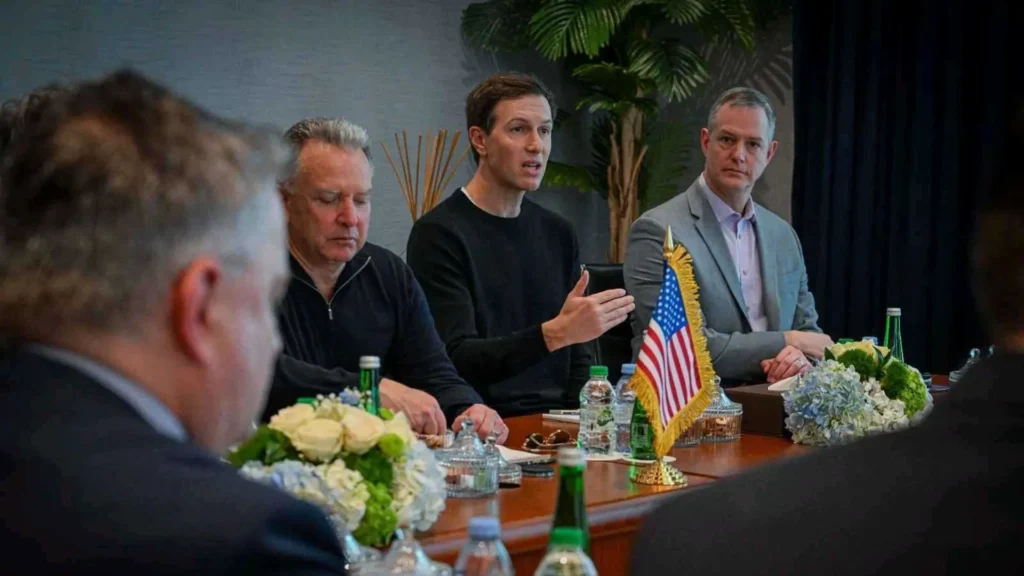
ABU DHABI (Realist English). Trilateral talks between the United States, Russia and Ukraine in Abu Dhabi were “productive” and resulted in tangible progress, according to US officials, marking a new phase in Washington’s mediation efforts to end the war.
US President Donald Trump’s advisers said they were cautiously optimistic after two days of negotiations, believing the sides had moved onto a path that could help narrow differences on the central sticking point — territorial control in eastern Ukraine.
The talks took place against the backdrop of intensified fighting. Overnight, Russia launched a large-scale missile and drone attack on Kyiv and other Ukrainian cities. Ukrainian President Volodymyr Zelensky said Russian forces fired 370 attack drones and 21 missiles of various types. He stressed the need for “full implementation of everything agreed with President Trump in Davos regarding air defence”.
According to US officials, it took several months of behind-the-scenes diplomacy to persuade both Moscow and Kyiv to agree to trilateral talks under US mediation. They said a meeting between Trump and Zelensky in Davos last Thursday, followed by a four-hour discussion the same night between Trump’s envoys Steve Witkoff and Jared Kushner and Russian President Vladimir Putin in Moscow, laid the groundwork for the Abu Dhabi talks.
“Both Putin and Zelensky agreed to send their negotiators. That shows they believe progress is being made,” one US official said. Another said Putin told the US envoys he wanted a diplomatic settlement and backed this by dispatching a “substantial delegation” to Abu Dhabi.
The negotiations began on Friday and continued into Saturday. US mediators held joint sessions with Russian and Ukrainian delegations, while Russian and Ukrainian negotiators also met directly without US officials present, according to Ukrainian sources.
The US delegation included Witkoff, Kushner and Trump adviser Josh Gruenbaum, US Army Secretary Dan Driscoll, and Alexus Grynkewich, commander of US European Command. Ukraine was represented by Zelensky’s chief of staff Kyrylo Budanov, national security adviser Rustem Umerov, armed forces chief of staff Andrii Hnatov, and advisers Sergiy Kyslytsya and Davyd Arakhamia. The Russian delegation was led by Admiral Igor Kostyukov.
US officials said the talks covered all major issues, including Russia’s territorial demands in Donbas, the dispute over the Zaporizhzhia nuclear power plant, and possible de-escalation measures needed to signal a definitive end to the war. After a plenary session, US mediators moved between separate Russian-Ukrainian working groups.
“Everything was discussed. No one was put off by the discussions,” one US official said, adding that the atmosphere was respectful and solution-oriented. The three delegations ended the second day with a joint lunch, which one official described as unexpectedly hopeful.
Zelensky later described the talks as “constructive”, saying discussions focused on “possible parameters for ending the war”. He welcomed the US role in monitoring and overseeing any settlement to ensure lasting security.
Ukrainian officials cautioned that it remains unclear whether Putin is ready to empower his negotiators to strike a deal. “It is too early to judge,” one official said.
US officials described the Abu Dhabi meeting as a critical step toward the next stage of negotiations and suggested the sides were edging closer to a potential meeting between Putin and Zelensky. Another round of trilateral talks is expected in Abu Dhabi next week, with US officials indicating a tentative date of February 1.