


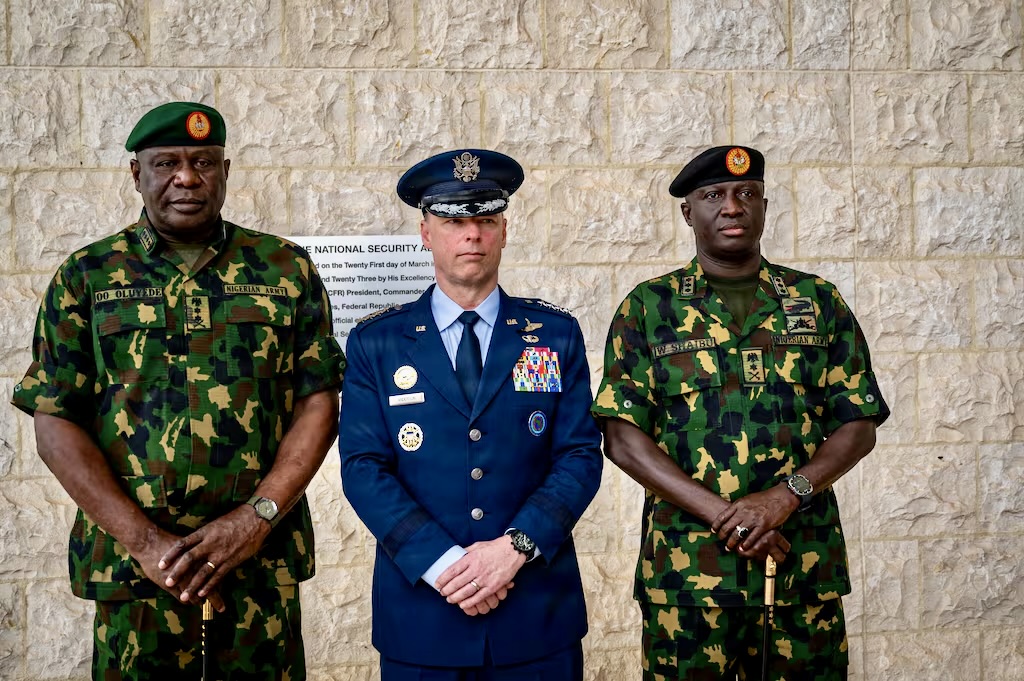
ABUJA (Realist English). The United States has withdrawn the bulk of its troops deployed to Nigeria for a recent operation against Islamic State militants (an organisation banned in Russia). This was stated by the commander of US Africa Command (AFRICOM), General Dagvin Anderson, following a conference of African defence chiefs in Luanda, Angola.
“We have withdrawn most of our forces that were there for that operation, but we continue the partnership that Nigeria requested, to assist with intelligence sharing,” Anderson told a press briefing.
Operation in the Lake Chad Basin
In May 2026, US and Nigerian forces conducted a joint operation in northeastern Nigeria, in the Lake Chad Basin area. The operation resulted in the elimination of Abu‑Bilal al‑Minuki, whom US military officials identified as the second‑most‑senior leader of the Islamic State group (banned in Russia) globally.
According to AFRICOM, about 200 ISIS fighters (an organisation banned in Russia) were killed during the mission. The Lake Chad Basin operation not only undermined ISIS activity in the region but also affected the group’s global network. As Anderson noted, it “significantly weakened the leadership of the Islamic State and disrupted its communications and wider network.”
Background: From the Christmas Strike to Joint Operation
The May joint operation was preceded by a US airstrike on militants on Christmas Day 2025, ordered by President Donald Trump. At the time, the US leader said that ISIS militants had targeted Christians in the African country.
The deployment of the US contingent to Nigeria began in early February 2026 with a “small group” after a bilateral agreement was reached between Washington and Abuja. By mid‑February, according to media reports, about 200 US troops had been deployed to northeastern Nigeria. Initially, they were expected to provide only advisory, logistical and intelligence support, but they subsequently took part in a joint combat operation.
Model of Cooperation and Future Plans
General Anderson called the May joint operation a model for future security cooperation in Africa. According to him, it demonstrated Washington’s approach of providing specialised capabilities while allowing African partners to conduct security operations independently.
Anderson stressed that Nigerian forces “continue to pursue targets on their own.” He added that continued pressure by Nigerian forces, combined with efforts to publicly highlight the operation, had led to an increase in desertions and surrenders of ISIS fighters in northeastern Nigeria.
The Luanda conference, at which the troop withdrawal was announced, lasted three days and brought together military leaders from 35 African countries, as well as representatives of the United States and Brazil. Nigerian Defence Minister Christopher Musa confirmed that US combat units had been deployed to the country specifically for the May operation and left after its completion.