


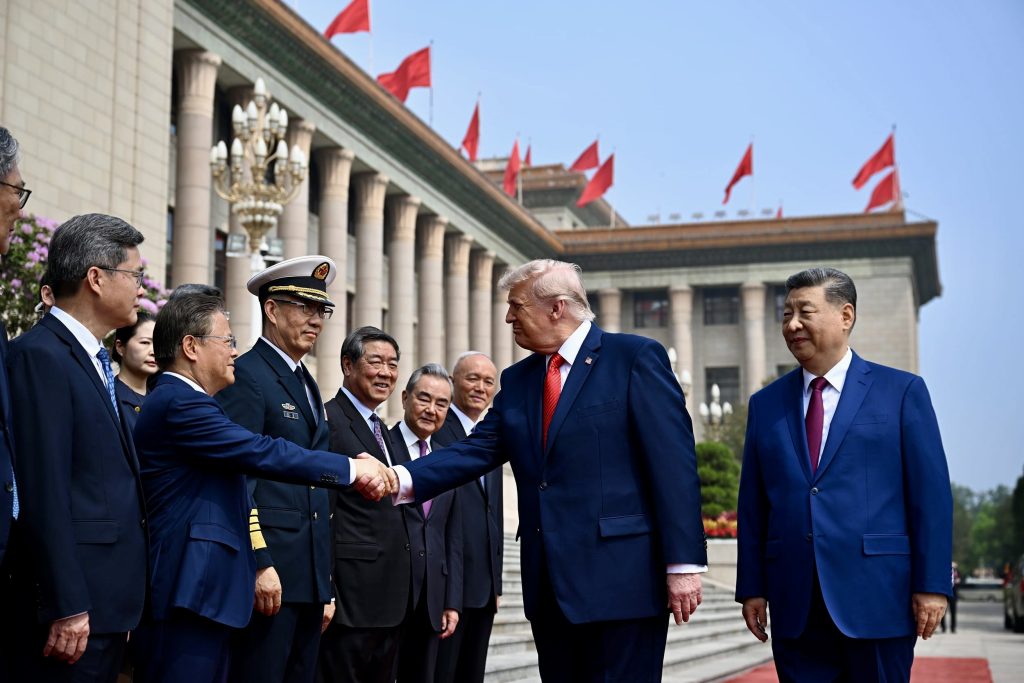
BEIJING (Realist English). The summit between US President Donald Trump and Chinese President Xi Jinping in Beijing may become another sign of a shifting global balance of power in China’s favor, according to Bronwen Maddox, director of the British analytical center Chatham House.
In her assessment, Trump’s return to the White House has brought Beijing strategic advantages that Chinese leadership could hardly have imagined a few years ago.
The author notes that the Trump administration:
- ended subsidies from the Joe Biden era for “green” technologies
- imposed tariffs on US allies, including Vietnam and India
- questioned the role of NATO
- effectively supported Russian positions on Ukraine
- became involved in a prolonged conflict with Iran
According to Maddox, all this has significantly strengthened China’s international position.
China feels more confident
The article emphasizes that over the past year China has demonstrated growing influence. In October 2025, Trump was forced to roll back part of tariff pressure after Beijing threatened restrictions on critical mineral exports.
In March 2026, Chinese authorities unveiled a new five-year development plan aimed at strengthening industrial and technological leadership.
Maddox notes that China continues to rapidly expand its advantages in:
- industrial production
- batteries and solar panels
- high-tech sectors
- certain areas of artificial intelligence
The only exception remains the most advanced segment of AI, where the US still retains a limited advantage.
Concerns among US allies
Washington’s allies fear that Trump may make strategic concessions to China for short-term political gains ahead of US midterm elections.
According to the author, the White House should not sacrifice long-term interests for:
- soybean contracts
- sorghum exports
- Boeing aircraft sales
Maddox stresses that global stability is at stake.
Taiwan and Asia as a new center of tension
The author argues that tensions between China and Japan may become an even more dangerous potential flashpoint than Taiwan itself.
Beijing is increasing its activity in:
- the East China Sea
- the South China Sea
- waters near Taiwan
This is causing concern in Japan, the Philippines, and South Korea. In Seoul, discussions have already begun about developing its own nuclear weapons.
China is also actively promoting the concept of a “near-Arctic state,” despite its geographical distance from the Arctic, reflecting ambitions to expand:
- military presence
- resource extraction
- control over new maritime routes
Iran becomes a key negotiation topic
The most urgent issue, according to the author, is Iran. She argues that the world needs a solution to the crisis, and China has significant influence over Tehran, which it has so far used only partially.
Chinese Foreign Minister Wang Yi has already called for the early reopening of the Strait of Hormuz during talks with Iran.
For China, a blockade of the strait creates serious risks for supplies of:
- oil
- gas
- fertilizers
- helium (used in semiconductors, medicine, and pharmaceuticals)
Maddox believes Beijing is capable of pressuring Iran but will expect concessions from the US in return.
US and China may begin AI safety dialogue
The article highlights artificial intelligence as another key area. Both Washington and Beijing are beginning to recognize the potential risks of AI development.
It mentions the Mythos model from Anthropic, which reportedly became so effective at identifying cybersecurity vulnerabilities that its public release was deemed dangerous.
The author believes even a limited US–China dialogue on AI safety could be an important outcome of the summit, although neither side intends to abandon technological competition.
Washington still searching for goals
Maddox notes that the US side has yet to clearly define its objectives for the upcoming summit due to:
- rapid escalation of the Hormuz crisis
- accelerating AI competition
- growing global instability
Trump’s improvisational approach adds further uncertainty.
Nevertheless, the expert believes the summit in Beijing could deliver tangible results not only for the US and China but also for other countries seeking to reduce global tensions.
Negotiations aim to manage rivalry, not resolve it
Senior research fellow Max Yoeli of Chatham House argues that talks between the US president and Chinese leader are aimed more at managing competition than resolving it.
He says Washington’s short list of goals contrasts sharply with the scale of accumulated contradictions between the two powers.
Key US objectives include:
- maintaining supplies of rare earth metals
- creating a trade coordination mechanism for non-sensitive sectors
- securing Chinese commitments to purchase US goods
Yoeli stresses that both sides are trying to keep relations under control rather than resolve fundamental conflict.
Trade-focused US strategy
Trump arrived in Beijing accompanied by major US business leaders and corporate executives. Washington is seeking:
- increased Chinese purchases of US soybeans
- liquefied natural gas imports
- Boeing aircraft contracts
However, analysts say these deals are unlikely to offset damage caused by the 2025 trade war, though they may provide political benefits ahead of midterms.
China focuses on Taiwan and technology
Xi Jinping is reportedly focused on:
- access to technology
- US tariff pressure
- Taiwan
The article notes that the Trump administration approved an $11 billion arms package for Taiwan, though deliveries have not yet been implemented.
Trump’s statement that he is willing to discuss Taiwan with Xi has raised doubts about the consistency of US policy toward the island.
Core contradictions remain unresolved
The author emphasizes that many fundamental disagreements remain outside the summit agenda, including:
- South China Sea disputes
- China’s industrial overcapacity
- currency policy
- nuclear buildup
- structural technological rivalry
Even AI discussions are limited to communication channels rather than resolving competition.
Iran increases US dependence on China
The Iran crisis and Hormuz Strait situation are shaping negotiations. The author notes that the 2025 trade war and Chinese restrictions on rare earth exports have exposed US vulnerabilities.
Complicating factors include:
- depletion of US weapons stockpiles
- global dependence on Hormuz energy routes
- growing Chinese influence over Iran
Washington seeks stabilization, while Beijing gains leverage.
Domestic pressures on Trump and Xi
Trump faces:
- inflationary pressure
- unpopular war
- trade policy challenges
- declining approval ratings
- farmer dissatisfaction
With US midterms approaching, Republicans must defend their congressional majority.
Xi faces:
- debt issues
- deflation
- demographic decline
- slowing global demand
However, China operates with a longer-term strategic horizon.
China systematically strengthens its position
Yoeli argues that China has built a system of economic pressure and defense, using:
- export controls
- rare earth supply leverage
- sanctions mechanisms
- restrictions on foreign companies
China is also strengthening its position in:
- solar energy
- battery production
- EV supply chains
- high technology
Meanwhile, it continues reducing dependence on Western technology.
US retains advantages but lacks coherence
The US still leads in:
- AI
- financial markets
- energy
- scientific research
However, policy inconsistency undermines these strengths:
- erratic tariff strategy
- reduced support for renewable energy
- weakening research base
- unstable White House decisions
Without a consistent industrial strategy, US positions may gradually erode.
World likely to see status quo
Yoeli expects the most likely outcome is continuation of current US–China relations without breakthroughs.
He identifies three risks:
- escalation in the Middle East
- new US–China crisis
- unexpected US concessions on Taiwan or technology
Still, the main result of the summit will likely be temporary stabilization, while China uses time to consolidate its position.