


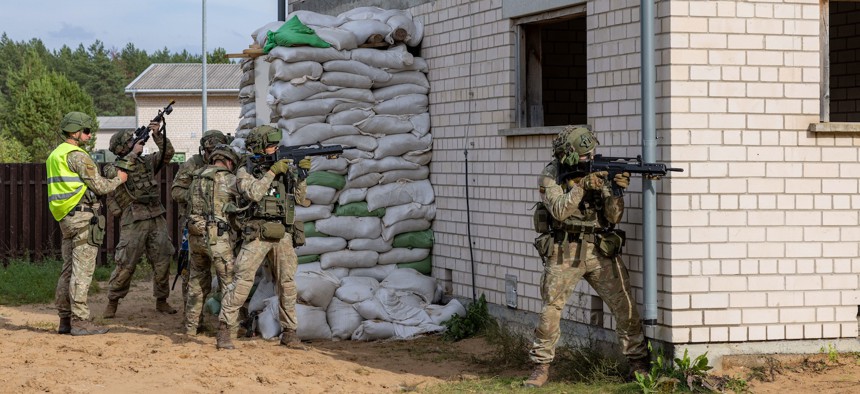
WASHINGTON (Realist English). Months after it was expected, the Biden administration’s Global Posture Review — the strategic assessment that determines the distribution of U.S. forces worldwide — has yet to be released. The delay comes as senior officials involved in the process quietly advance proposals to scale back America’s military footprint in Europe, raising alarms among lawmakers and allies.
Last month, the Pentagon confirmed that roughly 1,000 rotational U.S. troops in Romania will not be replaced once they return home — a move that immediately triggered criticism on Capitol Hill and sparked questions about whether similar reductions could follow elsewhere, including in the vulnerable Baltic region.
Baltics remain strategically exposed
The United States currently maintains a modest but significant rotational presence in Lithuania, Latvia and Estonia, reinforcing NATO’s multinational battlegroups:
- German-led in Lithuania,
- British-led in Estonia,
- Canadian-led in Latvia.
Berlin has committed to permanently stationing a 5,000-strong armored brigade in Lithuania by 2027. This multinational presence is widely considered essential for the defence of NATO’s northeastern flank — a region where geography favors Moscow. Lithuania is linked to the rest of NATO only through the narrow Suwałki Gap, while Russia’s militarized exclave of Kaliningrad and Belarusian territory complicate any rapid reinforcement by land, sea or air.
In this environment, analysts warn that even a partial drawdown of U.S. forces would send a dangerous signal at a time of heightened Russian aggression.
Why Lithuania matters
Around 1,000 U.S. soldiers routinely deploy to Lithuania on nine-month rotations, and security experts argue there are clear reasons for keeping them in place.
1. Strategic geography
Lithuania sits at a critical junction between Northern and Eastern Europe, bordering both the Suwałki Gap and Kaliningrad — flashpoints in nearly every NATO war game involving Russia. “Securing Lithuania is decisive in any major conflict scenario,” analysts note.
2. Policy alignment with Washington
Vilnius is among America’s most like-minded partners in Europe.
- On energy security, Lithuania built a floating LNG terminal in Klaipėda in 2015, breaking dependence on Russian gas years before the rest of the EU.
- On China, it was the first European country to label Beijing a national-security threat and the first to exit China’s “17+1” format.
- It welcomed a Taiwanese representative office, despite Chinese retaliation.
3. Burden sharing
Lithuania spends 3% of GDP on defence — set to exceed 5% from 2026 — and ranks among the world’s top contributors to Ukraine relative to economic size.
A decades-long security partnership
Lithuania has consistently stood with the United States. Around 5,000 Lithuanian soldiers served in Afghanistan between 2002 and 2021, including leadership of a Provincial Reconstruction Team in Ghor Province. Another 930 troops served in Iraq from 2003, even as many Western European nations refused to participate.
“Washington should not forget who stepped up,” former U.S. officials say.
Signals from the Pentagon raise alarm
With the Global Posture Review still pending, analysts argue the Pentagon should reaffirm that U.S. forces in Europe — particularly in the Baltics — remain a core pillar of American strategy. Any reduction, they warn, would embolden adversaries and undermine transatlantic credibility.
“Scaling back U.S. troops in Lithuania or anywhere else on the eastern flank would send precisely the wrong message,” one defence official said.
As the review nears completion, European capitals are watching closely — aware that Washington’s next moves could reshape the continent’s security landscape for years to come.