


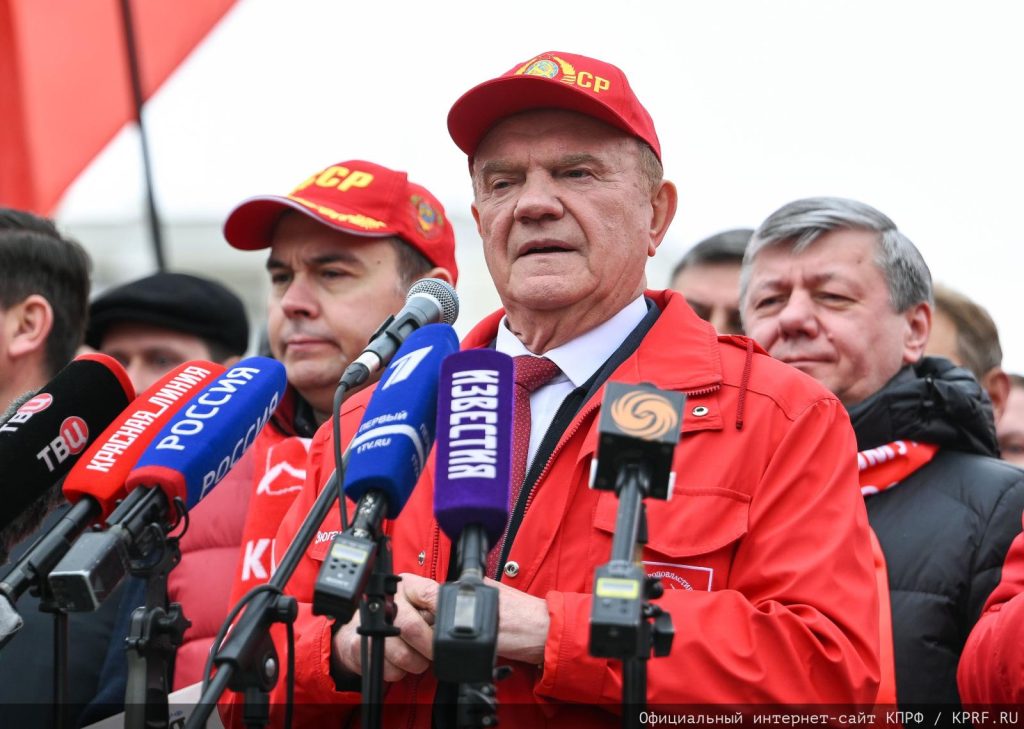
MOSCOW (Realist English). May 2026 has become a month of active phase of the election campaign and important domestic political decisions. Two key players dominate the political arena: the parliamentary majority in the form of United Russia, which is conducting large-scale primaries, and the opposition Communist Party of the Russian Federation (CPRF), which is ramping up criticism of the current government, using growing social tension as an electoral resource.
United Russia: Primaries, Program, and Party Building
The key event for United Russia in May was the holding of electronic preliminary voting (primaries) to select candidates for participation in the September elections to the State Duma and regional legislative assemblies. Voting takes place from May 25 to 31. The candidate registration deadline was extended to May 14 due to high interest from participants.
According to data as of early May, 4.3 million voters registered in the preliminary voting system nationwide, and competition among candidates exceeded 9 people per seat. In the Nizhny Novgorod region, where the primaries are overseen by Governor Gleb Nikitin, more than 105,000 voters have already registered. In Chukotka, competition even exceeded the national average: 15 candidates are vying for one deputy mandate in the State Duma, and 90 contenders are running for 11 seats in the district parliament — among them, notably, two veterans of the special military operation.
Leningrad Region Governor Alexander Drozdenko, commenting on the start of the procedure, particularly emphasized that United Russia is the only party that holds open primaries. In his opinion, the very fact of allowing candidates to undergo this procedure already gives them a certain mandate of trust from voters.
People’s Program: Over 240,000 Proposals
In parallel with the primaries, the party is finalizing the formation of its “People’s Program” — its main election document. In total, over 240,000 proposals from citizens across the country have been submitted to the platform “estrezultat.rf”.
Party Chairman Dmitry Medvedev held a meeting with leading specialists from RANEPA, the Institute of Economic Forecasting of the Russian Academy of Sciences, and the Higher School of Economics to analytically process the accumulated material. The focus of the discussion was on socio-economic priorities, the concept of balanced spatial development of the regions, and ways to strengthen Russia’s technological and economic sovereignty. The new version of the program is being brought into line with presidential decrees on national goals for 2030 and 2036.
Ideological Platform: Putin, Medvedev, and the Party — “One Team”
As part of the party conference “Direction 2026,” held in Moscow, the party chairman participated. Medvedev set a task for party members: United Russia must become the “central link” to unite the efforts of all citizens to achieve the goals set in the president’s May decree.
State Duma Deputy Speaker and coordinator of the party’s Patriotic Platform, Irina Yarovaya, commenting on the results of the congress, stated that United Russia is demonstrating “brilliant political form, a high degree of combat readiness, and the ability to offer society a new action program.” According to her, the most important result is the confirmation that Russian President Vladimir Putin, Medvedev, and United Russia constitute a single political team — a team of people ready to win in the interests of the country and its citizens.
CPRF: Intensifying Criticism and the “People’s Candidate”
Against the backdrop of United Russia’s increased activity, the CPRF continues to pursue a course of maximum distancing from the “party of power,” using its own “People’s Candidate” procedure, which, according to First Deputy Chairman of the CPRF Central Committee Yuri Afonin, runs from April 15 to June 1.
The “People’s Candidate” is positioned by the communists as an alternative to United Russia’s primaries. As stated by Secretary of the CPRF Central Committee for Elections Sergei Obukhov, unlike United Russia (where primaries, according to the communists, imitate internal party selection), the CPRF submits a list that has passed serious internal party selection to the “judgment of the entire country.” Obukhov emphasized that the CPRF is not copying United Russia but is using a mechanism of “external confirmation” of the party’s decision. Rotation based on the results of the popular vote could be up to 20%.
The CPRF remains the only faction consistently criticizing the “digital murkiness” in the electoral process. Back in April, communist deputies voted against a bill expanding the use of remote electronic voting (DEG) and electronic ballots. Sergei Obukhov stated then: “We are for elections remaining a matter for the people, not for cryptographers, shadow administrators, and closed server firms,” adding that “without paper ballots, the electoral system will become completely dependent.”
The “Bonya Case” and the Authorities’ Unwillingness to Listen
A telling incident, dubbed the “Bonya case,” occurred. After Monaco-based blogger Victoria Bonya raised housing and communal services issues, Presidential Press Secretary Dmitry Peskov publicly stated that “everyone heard and is working on the mistakes.” On May 10, Deputy Chairman of the Duma Committee Sergei Obukhov sharply criticized this “selectivity”: “Why, when a blogger from Monaco speaks, the authorities hear, but when a deputy representing 300,000 Muscovites speaks, they do not?” Obukhov also reported that responses to his parliamentary inquiries to the government come stamped “For Official Use Only,” depriving him of the right to inform his constituents.
Threat of “State Collapse”
The loudest alarm signal came on April 25 at the 3rd Plenum of the CPRF Central Committee (its discussions and resonance were actively discussed in May). CPRF Central Committee Chairman Gennady Zyuganov, commenting on the Central Bank’s policy, stated: “In a cemetery, everything is equal, and inflation there is indeed zero! But one cannot treat a living economy like that.”
The leader of the CPRF then drew a historical parallel, recalling the dissolution of the Duma in 1917, warning that “when the authorities do not wish to have feedback and heed the voice of the people, it ends in the collapse of statehood.”
Expanding on this theme, Sergei Obukhov in mid-May presented a report from the CPRF’s Center for the Study of Russia’s Political Culture (CSRPC). The center’s experts record a “deep psychological breakdown in the rear” and claim that “the margin of safety of our society will last 1.5-2 months before terminal changes.”
Ratings: The Gap Between the Leader and the Opposition is Narrowing
According to a VTsIOM poll conducted on April 13-19, 2026, the level of support for the United Russia party stood at 27.7%. This is despite the fact that, if direct elections were held, the party’s rating, by some estimates, could have been 40-45%; however, current measurements fix the level of electoral support precisely in this range. The CPRF’s rating was 10.9%.
At the same time, the trust rating for party leader Gennady Zyuganov increased by 2.5 percentage points (to 32.7%), while the rating of President Vladimir Putin continues to decline (65.6%, down 1.1 percentage points).
Leadership Changes within the Duma
In May, the chairman of the Duma Committee on Information Policy was replaced. Alexander Khinshtein, who previously headed this direction, officially left his post. His place was taken by Sergei Boyarsky, a United Russia deputy. This personnel decision is likely related to the need to strengthen party control over the information agenda in the run-up to the elections.
The beginning of May 2026 has been marked by the full deployment of electoral mechanisms by both leading political forces. United Russia is relying on administrative resources and the open primaries procedure, although its rating continues to fluctuate near the lower 30% boundary. The CPRF, on the contrary, is consolidating the protest electorate, ramping up criticism of the government’s socio-economic policies, and using the rhetoric of Soviet patriotism. The authorities, focused on security issues, risk overlooking the growing social tension, which could become a decisive factor in the State Duma elections in September 2026.