


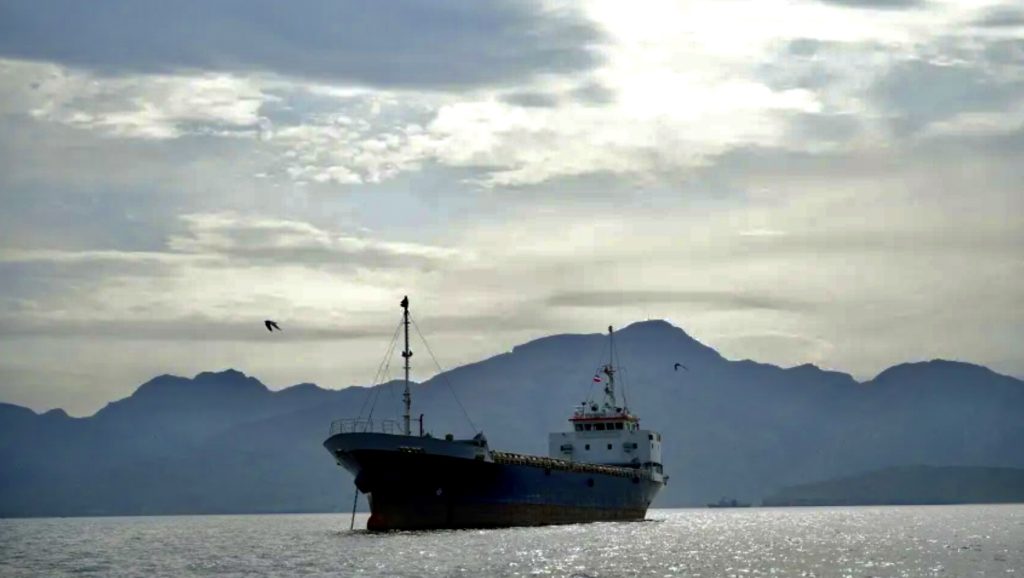
WASHINGTON (Realist English). US President Donald Trump made another sharp statement on the situation in the Strait of Hormuz on Sunday, April 12.
“Effective immediately, the United States Navy, the Finest in the World, will begin the process of blockading any and all Ships trying to enter, or leave, the Strait of Hormuz,” he wrote on his Truth Social platform.
At the same time, he added that at some point a regime will be reached where “everyone is allowed to go in and everyone is allowed to go out,” but so far Iran has not allowed that.
The blockade paradox: why close what needs to be opened?
At first glance, Trump’s threat to blockade the strait contradicts his repeated demands that Iran open this waterway.
However, as CNN analysts explain, the strait is not technically completely closed. Iran has been gradually allowing some tankers through, charging up to $2 million per vessel. Most importantly, Iran continues to export its own oil. According to data from analytics firm Kpler, an average of 1.85 million barrels of Iranian crude oil passed through the strait daily — 100,000 barrels more than in the previous three months.
Thus, by blockading the strait, Trump could cut off a key source of financing for the Iranian government and military operations. However, this is a lever the administration has been unwilling to pull: a blockade — even of Iranian oil — would inevitably trigger a new surge in global oil prices.
Prices spike, blockade begins April 13
Trump told reporters on the evening of April 12 that he had ordered the military to begin the blockade at 10:00 a.m. Eastern Time on April 13. The idea is to strangle Iran’s oil revenues and collapse its economy, as well as to thwart Tehran’s plans to charge fees for safe passage.
Market reaction was immediate. The price of Brent crude rose 8% to $104 per barrel. This is a test of Trump’s resolve, as Americans are already unhappy with high gasoline prices (the average price has exceeded $4 per gallon), and inflation jumped to 3.3% in March from 2.4% in February.
How the blockade will work and who will be affected
US Central Command (CENTCOM) clarified on April 12 that the blockade would apply only to vessels entering or leaving Iranian ports. “CENTCOM forces will not impede freedom of navigation for vessels transiting the Strait of Hormuz to and from non-Iranian ports,” it said in a post on X. However, experts warn of risks.
Talks fail and deadlock
The blockade threat followed marathon talks in Islamabad on April 11–12 that ended without result. Vice President JD Vance said the US had offered its “best and final” proposal, including: Iran’s renunciation of uranium enrichment and dismantling of nuclear facilities; removal of more than 400 kg of highly enriched uranium; an end to funding for Hamas, Hezbollah and the Houthis; and opening the strait for toll-free navigation.
Iran refused, leaving Trump with a limited set of “unattractive options.”
Resuming massive bombing (including threats to strike power plants and bridges) could lead to civilian casualties and Iranian retaliation. The blockade is an attempt to gain leverage without risking US soldiers’ lives in a ground operation.
Doubts about effectiveness
Trump’s critics doubt the logic of the blockade. Democratic Senator Mark Warner told CNN on April 12: “I don’t understand how blockading the strait is going to somehow push the Iranians into opening it. I don’t get the connection there.”
Former US Ambassador to the UN Nikki Haley, by contrast, supported the president: “If we did not do anything to stop them, not only would they have leverage; they would have even more money than they had before to funnel money to their proxies, even more money to buy supplies for ballistic missiles and continue their nuclear production.”
What next? Trump finds himself in a situation where the war he hoped would be quick and decisive is dragging on. Economic damage is growing, and the president’s approval ratings are falling. The blockade is his latest attempt to disprove the axiom that it is easy for presidents to start foreign wars but hard to end them. Even if it works, the price will be high, reflecting many consequences Trump failed to foresee.