


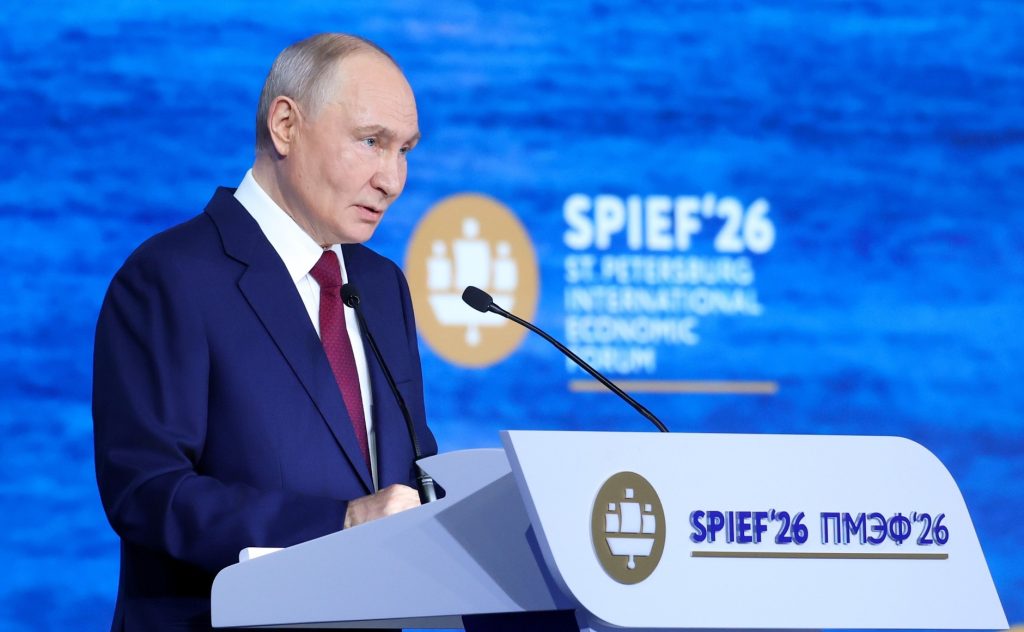
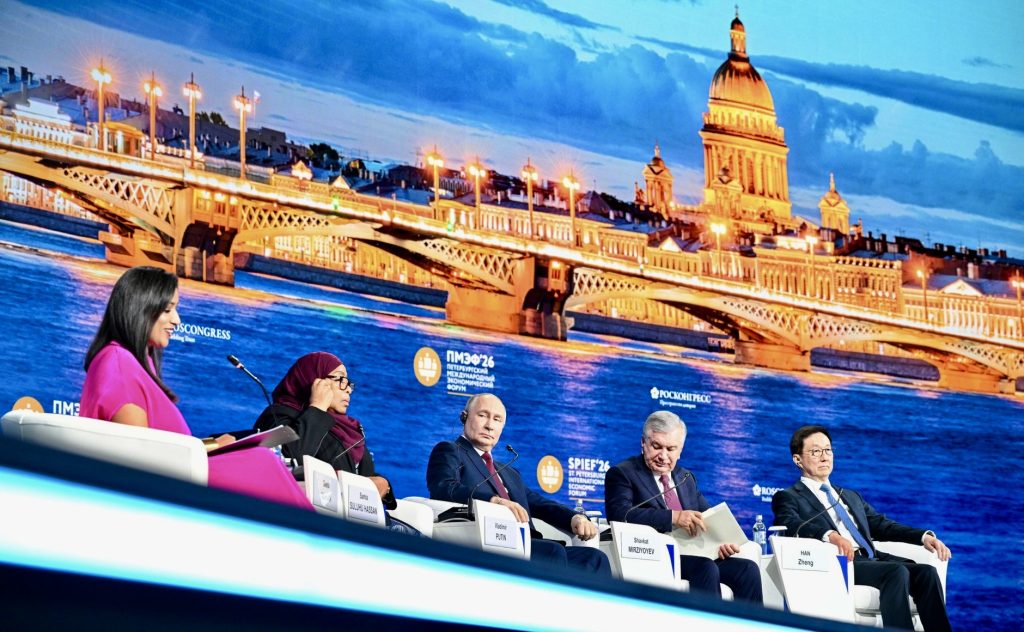
ST. PETERSBURG (Realist English). The 29th St. Petersburg International Economic Forum (SPIEF) concluded its third day with its flagship event — the plenary session featuring Russian President Vladimir Putin, alongside the presidents of Uzbekistan and Tanzania, and the Vice President of China.
The session was moderated by Geeta Mohan, international affairs editor of India Today Group. Among the forum’s 20,000 participants from 130 countries were official representatives from the United States and several European nations, attending for the first time in years.
The central themes of the discussion were the transformation of the global order, sovereignty, the new economy, and the inevitability of multipolarity.
“The World Is Undergoing a Structural Transformation”
In his opening remarks, Putin argued that the world is moving away from a “vertical hierarchical model serving the interests of a small number of states” toward a more complex and decentralized multipolar system.
According to the Russian president, the share of BRICS economies in global GDP measured by purchasing power parity has already reached 40%, while the share of the G7 has fallen below 29%. He added that BRICS countries accounted for 49% of global economic growth over the past five years, compared to just 18% for the G7.
“We did not invent these figures. They come from the IMF and the World Bank. Even they are forced to acknowledge it,” Putin said.
He also claimed that attempts to isolate Russia had failed, pointing to the forum’s record attendance and arguing that business pragmatism in the West is increasingly prevailing over political considerations. As examples, he cited Russian exports of liquefied natural gas and uranium to the United States.
Sanctions, the Dollar, and a New Financial Architecture
Putin argued that the freezing of Russian reserves had “irreversibly undermined confidence in the dollar and the euro.”
According to him, any country can now be deprived of access to assets held in Western jurisdictions under virtually any pretext, ranging from geopolitical disputes to disagreements over social policies.
“The weapon that the previous U.S. administration attempted to use turned out to be a catastrophic strategic mistake. Now everyone is asking themselves: what will happen to our reserves?”
Russia, he said, has shifted settlements with key partners into national currencies, with the ruble now accounting for 65% of export transactions.
He also noted that Russia’s public debt stands at 16.4% of GDP, while the federal budget deficit amounts to 2.6%, figures he described as considerably healthier than those of many eurozone countries and the United States.
Technological Sovereignty: AI, Platforms, and Oreshnik
Putin identified three technologies that, in his view, will determine national sovereignty in the 21st century: artificial intelligence, autonomous systems, and digital platforms.
Countries that fail to develop their own technological ecosystems, he warned, risk becoming “the digital periphery” of the global economy.
Russia has already adopted a national AI strategy and should now develop similar frameworks for autonomous systems and platform-based economic models, he said.
Particular attention was given to platform economics. Putin noted that sales of Uzbek products through the Russian marketplace Wildberries increased from $418 million in 2023 to nearly $1.5 billion in 2025 and could exceed $2 billion by the end of 2026.
“Platform solutions are becoming drivers of economic development for partner countries,” he said.
When asked about emerging methods of warfare involving drones and AI, Putin stated that Russia possesses its own hypersonic weapons technologies and systems such as the Oreshnik, which he claimed have no foreign equivalents.
At the same time, he called for international restrictions on the use of the most dangerous unmanned systems against civilian populations.
Investment, Taxes, and a “Seamless” Business Transition
Putin announced a decision to keep the revenue threshold for Russia’s simplified taxation system at its current level of 20 million rubles, postponing previously discussed reductions to 15 million and 10 million rubles.
The proposal was met with applause from the audience.
The president also instructed the government to prepare a framework for a “smooth transition” allowing entrepreneurs to move from self-employment status to individual entrepreneurship and eventually to full corporate structures with minimal administrative costs.
Russia will continue writing off regional budget debts — nearly 440 billion rubles over the past two years — and will maintain infrastructure lending programs for regional governments.
Zelensky’s Letter, Nazism, and Negotiations
Moderator Geeta Mohan read excerpts from an open letter by Volodymyr Zelenskyy in which he allegedly threatened strikes against St. Petersburg while simultaneously proposing a meeting.
Putin responded sarcastically, noting that Zelensky criticizes his age and length of time in office while, according to Putin, remaining in power outside constitutional norms.
He then claimed that on May 21 Zelensky requested a personal meeting through a Russian businessman. According to Putin, Ukrainian forces subsequently struck a college dormitory in the self-proclaimed Luhansk People’s Republic on May 22, resulting in civilian casualties.
“They ask for a meeting and then commit such terrible crimes. Is that a way to create conditions for negotiations or a way to make them impossible? I believe it is the latter.”
Putin also referred to what he described as the glorification of Nazi collaborators in Ukraine and reiterated Russia’s objective of “denazification.”
Concluding this segment, he addressed Russian military personnel with the phrase:
“Work, brothers.”
Uzbekistan, Tanzania, China, and Saudi Arabia: Voices of Partners
President Shavkat Mirziyoyev declared that Uzbekistan and Russia had entered a “new era” of cooperation. Bilateral trade has increased from $4 billion to $13 billion over the past decade, while the portfolio of joint projects exceeds $50 billion.
He proposed creating a “Eurasian Belt of Technological Industrialization” and a shared digital ecosystem. He also noted that 15 of the 32 foreign university branches operating in Uzbekistan are Russian.
President Samia Suluhu Hassan confirmed Tanzania’s openness to investment, stating that GDP growth is expected to reach 6.3% in 2026.
Tanzania plans to launch direct flights between Moscow and Zanzibar via Air Tanzania on July 2 and hopes to attract 500,000 Russian tourists by 2030.
Chinese Vice President Han Zheng conveyed greetings from Xi Jinping and emphasized that the China–Russia partnership is “not directed against third parties and is not subject to external influence.”
He highlighted the 25th anniversary of the bilateral Treaty of Good-Neighborliness and the joint commitment to a multipolar world.
Saudi Energy Minister Abdulaziz bin Salman Al Saud joined the stage at Putin’s invitation. He stated that cooperation with Russia, which began in 2015, remains strong despite numerous challenges.
“I am a Muslim, Russia is an Orthodox country, but we will stay together until death parts us.”
Unexpected Voices from Europe and the United States
Romanian Member of the European Parliament Diana Iovanovici-Șoșoacă told the audience that the Romanian people do not hate Russia and do not wish to support Ukraine.
“We admire your courage and strength,” she said.
Putin thanked her and asked that she convey his greetings to Orthodox Romanians.
Former Austrian Foreign Minister Karin Kneissl, who now resides in Russia, raised questions about drones and new forms of warfare. Putin responded that Russia is strengthening its air defenses and developing new weapons systems, while agreeing that attacks on civilians using drones constitute a humanitarian crime.
Rodney Cook, who headed the American delegation, thanked the organizers for their hospitality and spoke warmly about St. Petersburg.
“Pass the puck back to President Trump,” Putin told him.
SPIEF 2026 once again served as a platform for Russia to present its vision of a multipolar world order. According to Russian officials, the forum’s participation by representatives from 130 countries — including the United States and several European states — demonstrates the limits of Western efforts to isolate Moscow.
The key themes throughout the event were technological sovereignty, reducing reliance on the dollar, multipolarity, and pragmatic cooperation with the Global South.
The conflict in Ukraine remained central to many discussions, though no concrete diplomatic breakthroughs emerged.
Putin’s remarks regarding a possible Russian role in resolving the Iranian nuclear issue, along with his criticism of what he called Western double standards, helped define the tone of the forum’s final plenary session.
SPIEF 2026 concludes on June 6.