


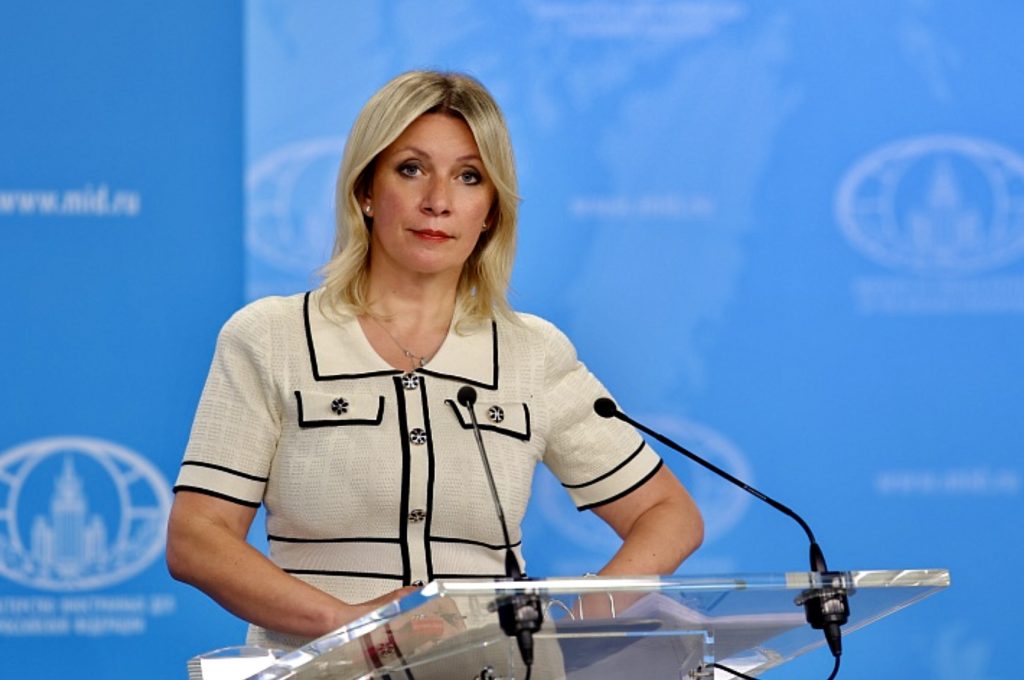
MOSCOW (Realist English). Russian Foreign Ministry Spokeswoman Maria Zakharova, at a briefing on July 1, sharply criticised the European Union’s efforts to develop the Trans-Caspian International Transport Route (TITR).
According to her, the EU’s increased activity in this direction is an attempt to redirect freight flows around Russia, to the detriment of economic logic, and is part of the bloc’s aim to inflict a “strategic defeat” on Moscow.
‘Questions Without Answers’: Where Will the EU Send Billions?
Zakharova questioned the economic viability of the project, citing its high cost and complexity.
“The reality is that its full operation requires multi-billion dollar investments and years of coordinated efforts,” she said, noting that the route involves double transshipment of goods when crossing the Caspian and Black Seas.
“Where does the EU plan to get the many billions and the coordination between business, states and companies, if all trends point to the opposite — a lack of cohesion in investment terms and plans for the militarisation of Western Europe?” the diplomat asked.
According to the Russian Foreign Ministry, the EU and its international partners are prepared to allocate €10 billion for these purposes through the issuance of bonds guaranteed by the European Commission. Zakharova called this decision “symptomatic,” noting that the European Commission had already “deceived the people of Western Europe with vaccines worth billions of euros.”
Criticism of the European Commission and European Policy
The Foreign Ministry representative also criticised the European Commission’s policies, stating that it “has done nothing in recent years to unite the world” and only “adds fuel to the fire of conflicts.”
“Mastodons like Ursula von der Leyen will be the guarantors of the bond issuance,” Zakharova said ironically.
She also pointed to technical obstacles to the route’s implementation: the different railway gauges used by China and Turkey, on the one hand, and post-Soviet countries, on the other, require a significant increase in the number of “junction points” for reloading freight cars.
Russian Alternatives: North-South and the Northern Sea Route
In contrast to European plans, Zakharova highlighted Russian projects. “Russia offers its expertise in logistics and functioning infrastructure, including the International North-South Transport Corridor, as well as the Trans-Arctic Transport Corridor based on the Northern Sea Route,” she stated.
The diplomat stressed that the use of Arctic routes significantly reduces the time for transcontinental transit and opens up additional routes for the supply of Russian energy resources to Asia.
“We proceed from the understanding that smoothly functioning international supply chains are the key to stable development of the global economy,” she noted.
Zakharova also stated that Russia is ready for constructive work with all interested partners to align efforts to strengthen Eurasian transport connectivity.
In June 2026, the European Union took a series of consecutive steps aimed at turning the Trans-Caspian route into a key transport artery between Asia and Europe.
The initiative, implemented within the framework of the EU’s global “Global Gateway” strategy, is seen in Brussels as a strategic alternative to traditional routes passing through Russia, and is designed to fundamentally change the logistics landscape of Eurasia.
Geography of the Route and Its Advantages
The Trans-Caspian International Transport Route is a multimodal corridor connecting China and Central Asian countries with Europe. The route passes through Kazakhstan, the Caspian Sea, Azerbaijan, Georgia and Turkey.
Its key advantage is a significant reduction in delivery times compared to sea routes: transit time can be cut from 45–60 days to 14–18 days, and potentially to 15 days in the future.
Trade along this route has already grown significantly since 2022, and according to European Commission forecasts, it could increase fivefold over the next 15 years.
Investment and Financing
The key event was the Global Gateway Investors Forum, held in Brussels on June 23–24, 2026. At the forum, €10 billion in investments for sustainable transport development in Central Asia was announced. This figure represents a combination of ongoing and planned projects.
Specific agreements were signed under this commitment:
- The European Investment Bank (EIB) signed memorandums worth €1.47 billion with Kazakhstan, Kyrgyzstan and Uzbekistan.
- The European Bank for Reconstruction and Development (EBRD) signed a memorandum with Kazakhstan for €1.5 billion.
- The EU and Kazakhstan signed a framework loan of €150 million for the modernisation of key road sections along the TITR.
- Mobilisation of up to €2 billion in investments in transport infrastructure, border crossing points and trade facilitation in the Black Sea and South Caucasus region was also announced.
Institutional Mechanisms
Alongside the investment agreements, the EU launched a new “Connectivity Agenda Platform.”
Its aim is to coordinate investments and policy decisions in transport, energy, digital connectivity and trade between participating countries, financial institutions and other stakeholders. The platform is designed to “connect” existing projects and “fill remaining infrastructure gaps.”
The platform’s launch was attended by transport ministers and senior representatives from EU countries, Armenia, Kazakhstan, Kyrgyzstan, Moldova, Tajikistan, Turkmenistan, Turkey, Ukraine and Uzbekistan.