


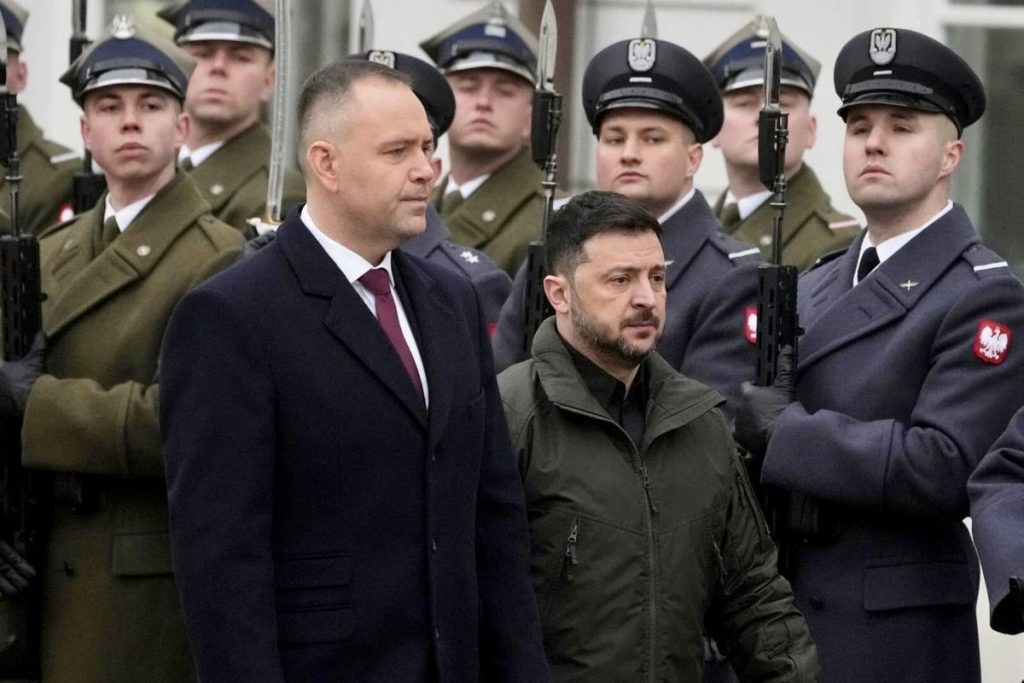
WARSAW (Realist English). Ukrainian President Volodymyr Zelensky has returned Poland’s Order of the White Eagle — the highest state award of the republic, which he received in 2023. The decision came after Polish President Karol Nawrocki stripped Zelensky of the award over a decree granting the honorary name “UPA” to a Ukrainian military unit — a formation that Poland holds responsible for the mass murder of Poles during World War II.
Decree that shattered relations
On May 26, 2026, Zelensky signed a decree granting the honorary designation “UPA” to one of Ukraine’s Special Operations Forces units. In Kyiv, this was explained as “restoring the historical traditions of the national army.” In Poland, the decision sparked outrage.
The UPA is accused of genocide against some 100,000 ethnic Poles in Volhynia and Eastern Galicia in 1943–1945. For the vast majority of Polish society, the UPA remains “first and foremost a formation responsible for brutal crimes against citizens of the Polish Republic.”
Revocation and return of the award
On June 19, President Karol Nawrocki, representing right‑wing forces, announced in a 13‑minute video address that Zelensky was being stripped of the Order of the White Eagle. He called Kyiv’s decision “outrageous,” “incomprehensible” and “deeply disappointing,” stressing that it “undermines the trust built over the years.” At the same time, Nawrocki assured that the diplomatic dispute would not affect Poland’s support for Ukraine in the war against Russia.
On June 20, Zelensky posted a statement on social media along with a photo of the order packaged for mailing to the Polish president’s chancellery. “We believed that the Order of the White Eagle, awarded in 2023, was intended for the Ukrainian people and our army. That is exactly what was said at the time,” he wrote.
Zelensky added that Ukraine is grateful to the Polish people for their support and remains open to dialogue on “difficult and painful pages of our shared history.”
Solidarity of Ukrainian officials
Following the president, several senior Ukrainian officials also announced the return of Polish awards. Head of the Ukrainian Presidential Office Kyrylo Budanov returned the Golden Officer’s Cross of the Order of Merit of the Republic of Poland, calling Nawrocki’s decision “an unfriendly act.”
Foreign Minister Andrii Sybiha returned the Commander’s Cross with Star, and Ukraine’s Ambassador to Warsaw Vasyl Bodnar returned the Knight’s Cross.
At the same time, criticism of Zelensky emerged within Ukraine.
Former Prime Minister Arseniy Yatsenyuk said that “one harmful and wrong decision by the current president of Poland cannot be corrected by other wrong decisions of ours.”
‘This conflict pleases Putin’
Polish Prime Minister Donald Tusk, a political opponent of Nawrocki, called on both leaders to “cool passions and not fuel tensions.” “The conflict between Poland and Ukraine pleases Putin and shocks our allies,” Tusk wrote on social media.
In Moscow, Nawrocki’s decision was welcomed. Former Russian President Dmitry Medvedev said that the Polish leader “finally stripped Zelensky of the Order of the White Eagle.” Russian Foreign Ministry spokeswoman Maria Zakharova suggested that Poland pass the revoked awards to “other Nazi collaborators.”
Context and consequences
Poland had been one of Ukraine’s main allies since the start of the war, taking in hundreds of thousands of refugees and serving as a logistics hub for Western aid. However, historical contradictions between the two countries remain unresolved. The rise to power of Nawrocki, who analysts say exploited anti‑Ukrainian sentiments for electoral purposes, has only exacerbated the situation.
Ukraine aspires to join the European Union and this week took part in the first stage of accession negotiations in Luxembourg. A major Ukraine recovery event is scheduled for next week in Warsaw, which Zelensky had been expected to attend. His participation now remains in question. The diplomatic row between Kyiv and Warsaw threatens to undermine the unity of the anti‑Russian coalition at a time when, in Tusk’s words, “the front line is elsewhere.”
The Ukrainian Insurgent Army (UPA) is officially recognised in the Russian Federation as an extremist organisation, and its activities on Russian territory are prohibited. This status is based on a ruling of the Supreme Court of the Russian Federation dated November 17, 2014.